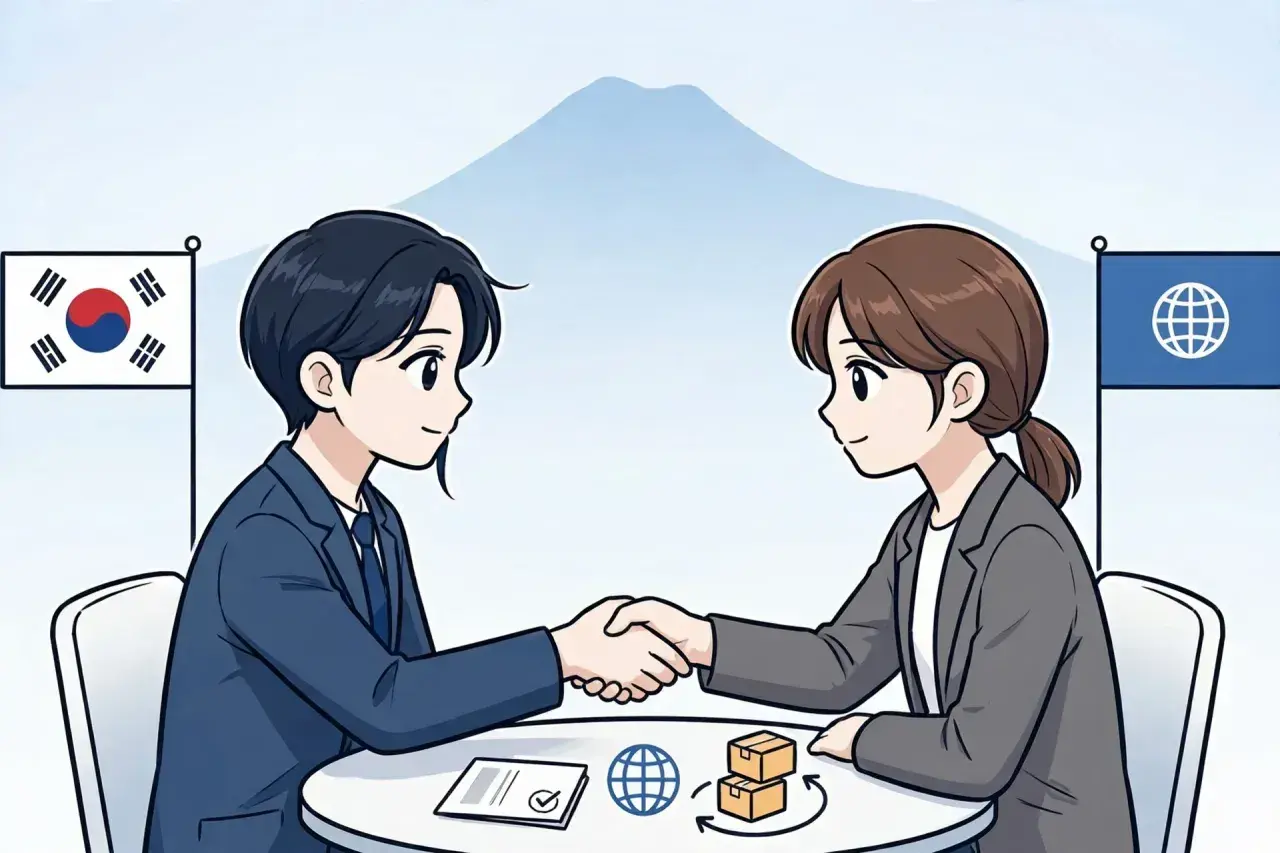
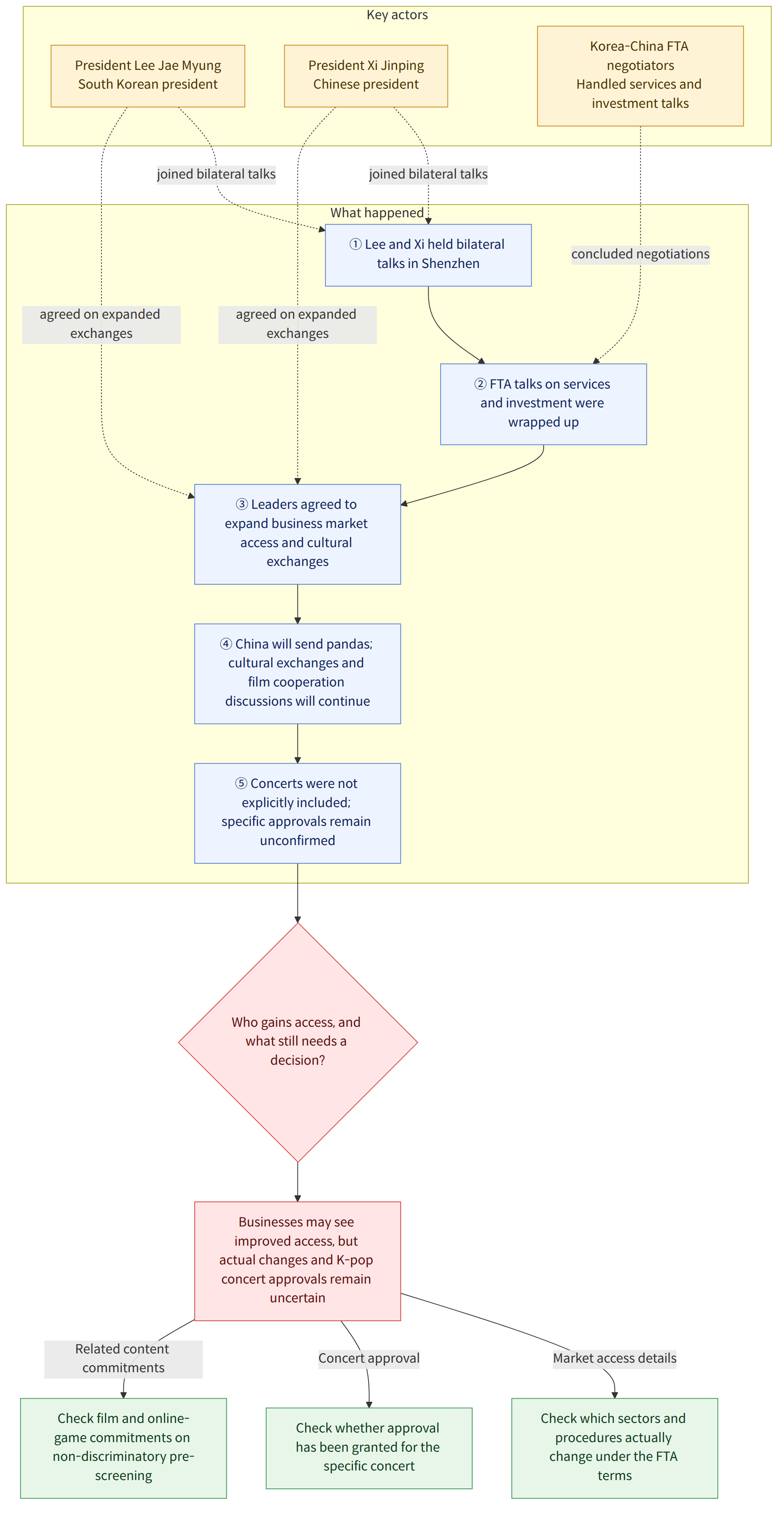
President Lee Jae Myung and Chinese President Xi Jinping held bilateral talks on November 18 in Shenzhen on the sidelines of the Asia-Pacific Economic Cooperation (APEC; 아시아태평양경제협력체) forum, and wrapped up negotiations on services and investment under the Korea-China Free Trade Agreement (한중 자유무역협정, FTA). The two leaders agreed to expand market access for businesses in both countries and increase people-to-people and cultural exchanges ahead of the 35th anniversary of diplomatic relations next year. However, concluding the negotiations does not mean that markets will immediately open in every sector or that cultural content will circulate freely.
Background and context
This was the two leaders’ third meeting. They previously met in Gyeongju, North Gyeongsang Province, last November and in Beijing this January. Lee said momentum toward a full restoration of bilateral relations had become firmly established, and said he hoped to develop a more mature and strategic cooperative partnership as the countries mark the 35th anniversary of diplomatic relations. Xi said relations had improved and developed comprehensively as the two countries successively hosted APEC meetings and supported each other, and called for building a more mature and resilient relationship.
The economic centerpiece of the meeting was the talks on services and investment under the FTA. One report said the two countries had wrapped up the negotiations, while another described the follow-up negotiations as having been “substantially concluded.” Both reports point to progress in the talks, but neither confirms all the details of the agreed market openings.
Expanding cultural exchanges was also part of the agreement. China will send a pair of pandas to South Korea to promote friendship, and the two countries will gradually increase cultural and content exchanges. They agreed to continue discussions on specific areas of cooperation, such as joint film production, but the publicly available information does not specify when the pandas will arrive or when joint production projects will take place.
What this news means
For businesses, what matters is how the talks on services and investment change the actual conditions for market access. Concluding the negotiations is a starting point that could improve conditions for businesses in both countries, but it is difficult to determine from the publicly available agreement alone which sectors and procedures will change. It is therefore important to distinguish the stated goal of “expanding market access” from actual business opportunities.
In the cultural industries, too, expectations should be distinguished from confirmed measures. According to related reports, the negotiations included commitments on films and online games, including non-discriminatory treatment in China’s pre-screening of South Korean films and online games. K-pop concerts, by contrast, were not explicitly included. Reports say informal restrictions on South Korean cultural content and entertainment activities have continued in China since 2016. Because these restrictions are not part of a formally announced system, uncertainty remains over whether performances will be approved.
That is also why the industry is cautious. Related reports said industry players expect activities that are already possible, such as local activities by Chinese members of K-pop groups, to increase first, with concerts potentially following later. This is a projection, not a confirmed schedule or approval plan. For example, if an agency is preparing a concert in China, it should not treat the announcement of these negotiations as confirmation that the event will go ahead; it should check whether the required approval for that particular concert has actually been granted.
Reports have also noted expectations for the agreement’s economic impact across the cultural industries. A securities firm’s report estimated that China’s concert market is about 85% the size of Japan’s and 2.8 times the size of South Korea’s. Another securities firm estimated that profits for South Korean entertainment companies could rise by about 40% if K-pop concerts and South Korean entertainment production resume in China and cultural exchanges expand. These are projections from reports and estimates; the figures are not guaranteed to materialize as a result of the negotiations.
The agenda for bilateral relations was not limited to the economy and culture. Lee proposed joint efforts toward a fundamental resolution of issues in the Yellow Sea and asked China to help protect the rights and interests of South Korean residents in China and preserve and manage historic sites related to the Korean independence movement. He also called for a constructive role in easing tensions on the Korean Peninsula and promoting peaceful coexistence. Xi reaffirmed the Chinese government’s position that it would play a constructive role in resolving issues on the Korean Peninsula, and said China supported efforts to ease tensions and dialogue between North Korea and the United States. However, these statements of position do not, by themselves, determine how each issue will be resolved or what follow-up measures will be taken.
Points reported differently
Reports used different wording to describe the outcome of the FTA negotiations. One said the talks on services and investment had been wrapped up, while another said the follow-up negotiations had been substantially concluded. The latter also noted the commitments on films and online games and that K-pop concerts were not explicitly addressed.
What is confirmed and what remains unknown
Confirmed facts
- The two leaders met in Shenzhen on November 18 on the sidelines of APEC. It was their third meeting.
- The two countries wrapped up negotiations on services and investment under the FTA and agreed to expand businesses’ market access.
- They agreed that China would send a pair of pandas and that cultural and content exchanges would be gradually expanded.
- They agreed to continue discussions on areas of cooperation, including joint film production, and confirmed both sides’ positions on easing tensions and promoting dialogue on the Korean Peninsula.
What remains unknown
- The specific market-opening items agreed upon in the services and investment negotiations and the conditions for their implementation cannot be confirmed from the publicly available information.
- It is not known when the pair of pandas will arrive in South Korea.
- No specific schedule or project plan has been provided for joint film production or cultural and content exchanges.
- It is not known when, or under what conditions, K-pop concerts will be approved.
What readers should watch for
- Businesses in both countries should look at the detailed agreement as it becomes public and the conditions for its implementation, rather than judging business opportunities solely by the phrase “negotiations concluded.”
- The entertainment and content industries and consumers should distinguish announcements about expanding cultural exchanges from approval and confirmed schedules for individual productions and concerts.
- For matters requiring follow-through, such as the panda loan and joint production, readers should watch for separate announcements of specific schedules and project plans.
References
- Other coverage consulted: m.koreaherald.com