
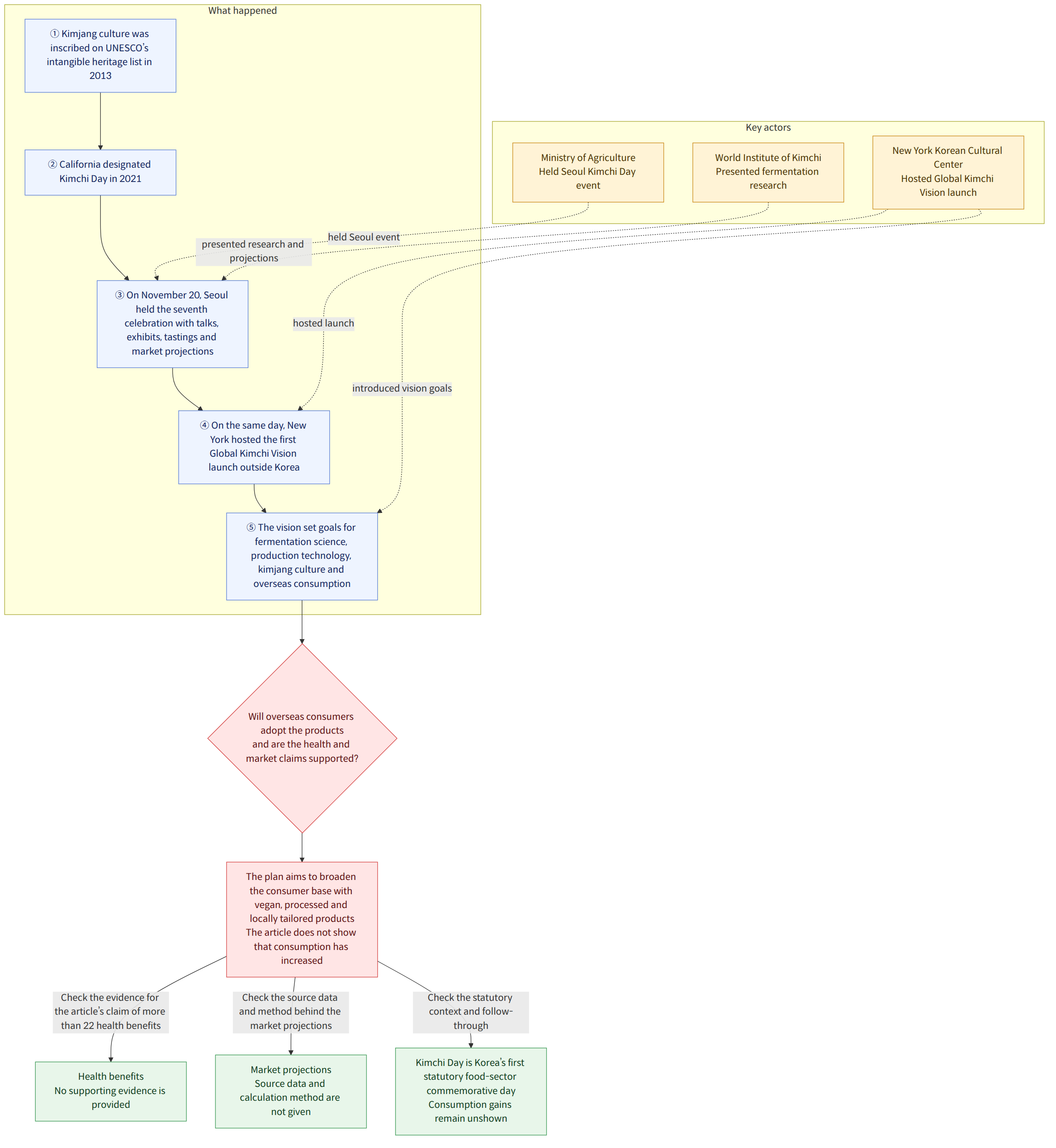
Efforts to promote kimchi’s traditions and fermentation science through overseas events and to expand consumption are continuing. The Ministry of Agriculture, Food and Rural Affairs (농림축산식품부) held the seventh Kimchi Day celebration on November 20 at the aT Center in Seocho-gu, Seoul. On the same day, the New York Korean Cultural Center (뉴욕 한국문화원) hosted the first-ever launch ceremony for the Global Kimchi Vision outside Korea. Kimchi Day is November 22.
Background and context
Kimchi Day is the first statutory commemorative day in Korea’s food sector. The article says that the ingredients come together to provide more than 22 health benefits, but it does not specify what those benefits are or provide evidence to support them. The figure can therefore be reported as a claim made in the article, but it is difficult to treat specific health effects as established facts.
At the Seoul event, Ms. Kim Hae-kyung said that kimjang—the making of kimchi for the winter—was both a way to prepare for the season and an opportunity to share warmth with neighbors. She also expressed a wish to reflect on the spirit of sharing and community embodied in kimjang and to see kimchi continue to spread in the daily lives of people around the world. The kimjang culture was inscribed on UNESCO’s Representative List of the Intangible Cultural Heritage of Humanity (유네스코 인류무형문화유산 대표목록) in 2013.
The event addressed not only kimchi’s traditional value but also its scientific strengths and commercial potential. Research into fermentation science by the World Institute of Kimchi (세계김치연구소) was presented through talks, exhibitions, and tastings, and there was also a kimchi tasting and an international recipe competition. Jang Hae-chun, head of the World Institute of Kimchi, said that kimchi’s scientific competitiveness lies in its distinctive fermentation process, and that advances in artificial intelligence and robotics have expanded the automation and standardization of manufacturing processes.
The event also presented market projections. Jang Hae-chun said the global kimchi market was worth 6.11 trillion won the previous year and was projected to grow by more than 6% annually, reaching 10 trillion won by 2034. However, the article does not include the source data or calculation method for the market size and growth projections.
What this news means
The globalization of kimchi encompasses both promoting cultural heritage and developing products for overseas consumers. The Global Kimchi Vision launched in New York set out key goals of validating kimchi’s scientific value, innovating production technology, spreading kimjang culture, and expanding overseas consumption. The plan includes developing and promoting vegan kimchi and related processed products, as well as kimchi dishes tailored to the food cultures of different countries, to broaden the consumer base.
The plan shows how cultural exchange and market expansion intersect. Kimjang experiences and exhibitions on fermentation science are ways to deepen understanding of kimchi, while developing products and dishes suited to local food cultures is a way to reach new consumers. However, this does not mean that both approaches were carried out together at every overseas event. The overseas examples cited were Kimchi Day celebrations and kimjang experiences in the United States, a talk on halal kimchi in Malaysia, and an exhibition on kimchi history and fermentation science at a museum in Munich, Germany.
For example, if consumers in a country are unfamiliar with kimchi’s taste or ingredients, developing and promoting kimchi dishes tailored to that country’s food culture could create more opportunities for them to try kimchi. This is a hypothetical illustration of the direction set out in the Global Kimchi Vision; it does not mean that the plan has already led to an increase in consumption.
The designation of Kimchi Day overseas is also one indicator of the extent to which kimchi is becoming culturally recognized. According to the World Institute of Kimchi, California was the first U.S. jurisdiction to designate Kimchi Day, in 2021; since then, 13 jurisdictions, including New York and Washington, D.C., have officially designated it. Argentina was the first country outside Korea to designate Kimchi Day as a national commemorative day, and Kimchi Day is also celebrated in 18 jurisdictions across six countries. This year’s Korea Kimchi Festival (코리아 김치 페스티벌), held in Korea, the United States, Malaysia, Germany, and elsewhere, shows that commemorations, hands-on activities, and exhibitions took different forms in different locations.
Confirmed facts and what remains unknown
Confirmed facts
- Kimchi Day is November 22, and the Ministry of Agriculture, Food and Rural Affairs held the seventh celebration in Seoul on November 20.
- Kimjang culture was inscribed on UNESCO’s Representative List of the Intangible Cultural Heritage of Humanity in 2013.
- The launch ceremony for the Global Kimchi Vision at the New York Korean Cultural Center was described as the first such event held outside Korea.
- The Global Kimchi Vision includes innovation in production technology, expanding overseas consumption, and developing and promoting kimchi dishes tailored to local food cultures.
- The article cited official designations in 13 U.S. jurisdictions, Argentina’s designation of Kimchi Day as a national commemorative day, and celebrations in 18 jurisdictions across six countries.
What remains unknown
- The article does not specify what the more than 22 health benefits it mentions are, or what evidence supports each one.
- It has not been confirmed what data and calculation methods underpin the global kimchi market size and the projection for 2034.
- The article does not say when or how the individual plans under the Global Kimchi Vision will be carried out, or what results they have had in expanding actual consumption.
What readers should check
- When reading material about health benefits, it is important to check exactly what effects are being claimed and whether the article or research material provides supporting evidence.
- When citing market size and long-term projections, it is useful to examine not only who made the projection but also the base year, calculation method, and data source.
- When checking overseas kimchi events, readers can distinguish official designation of a commemorative day from the holding of a one-off event, and separately verify the plans under the Global Kimchi Vision and examples of their actual implementation.