



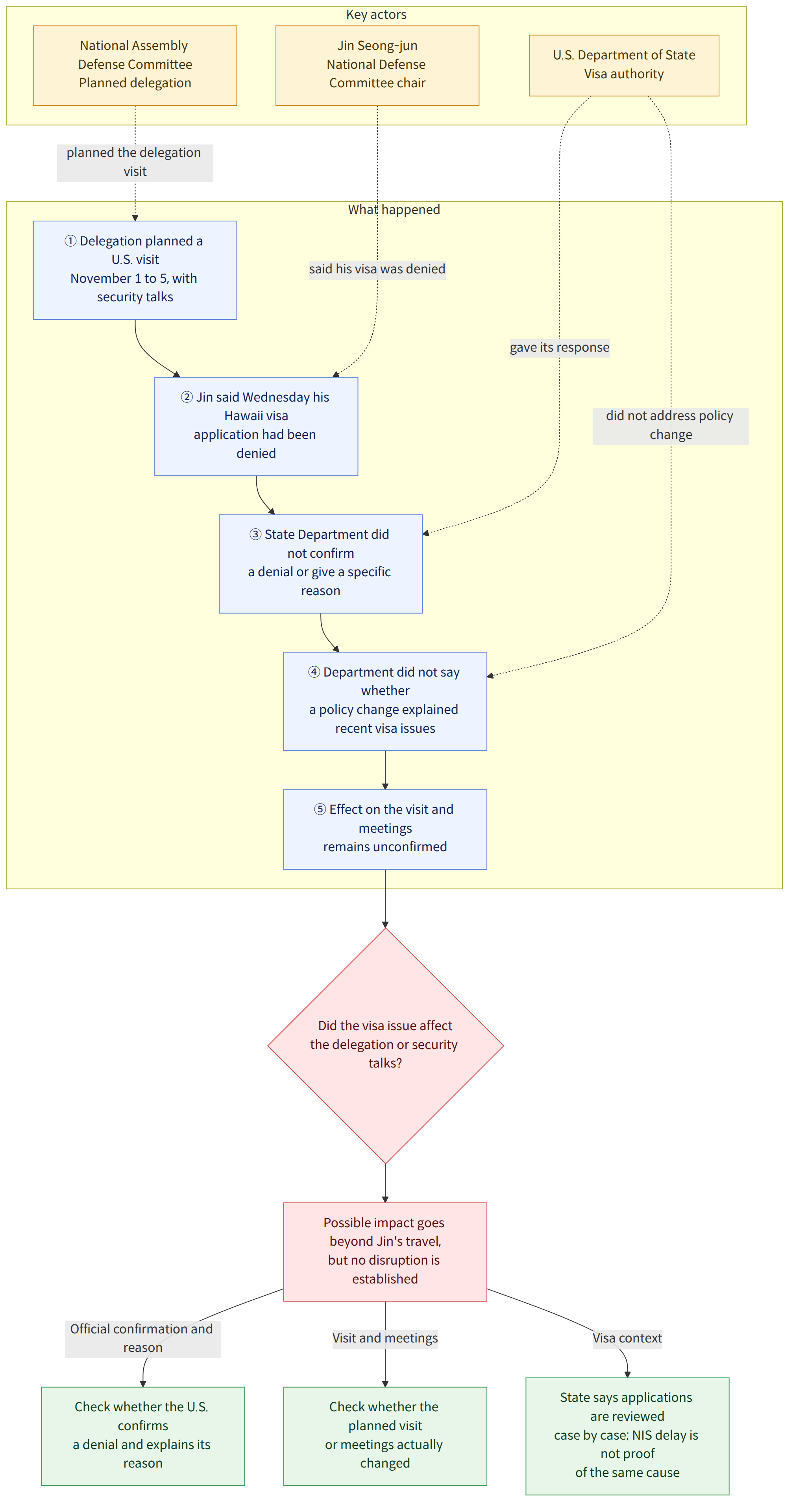
The U.S. Department of State did not confirm whether the visa application of Representative Jin Seong-jun of the Democratic Party of Korea (더불어민주당) to enter the United States had been denied or, if so, why. A department spokesperson said every visa application is reviewed on a case-by-case basis and that, as a matter of policy, the department does not comment on action taken in specific applications. Representative Jin, chair of the National Assembly’s National Defense Committee, expressed strong regret on Wednesday, saying that his visa application for a visit to Hawaii had been denied.
A delegation from the National Assembly’s National Defense Committee was scheduled to visit the United States from November 1 to 5 and discuss ways to strengthen security cooperation with military officials, including Commander Samuel Paparo. However, it has not been confirmed whether the visa issue actually changed the visit or meetings. The issue extends beyond an individual’s entry into the country: it is also a question of whether the planned activities of the National Assembly and discussions on South Korea-U.S. security cooperation were affected.
Background and context
A U.S. Department of State spokesperson said the Trump administration pursues policies that put the United States and its interests first, strictly enforces immigration laws, and ensures lawful entry through the visa issuance process. The spokesperson also said every application is reviewed individually, but did not disclose what decision had been made on Representative Jin’s application. The department’s explanation of general visa review principles should therefore not be taken as the specific reason for the decision in Representative Jin’s case.
The department also did not answer questions about whether recent visa denials and delays involving South Korean lawmakers and intelligence agency officials resulted from individual reviews or a policy change. Nor did it comment on concerns that visa actions could restrict the official activities of South Korea’s National Assembly. It has not been confirmed that a policy change has occurred, nor has it been confirmed that one has not.
Representative Jin said that denying a visa to the chair of the National Defense Committee does more than restrict an individual’s entry; it obstructs the official legislative activities of a lawmaker representing the people. This is the concern he has raised. It must be assessed separately from whether the delegation’s schedule was actually canceled or its meetings fell through.
What this means
Visa reviews apply to individual applicants, but if an applicant is a key member of a delegation, the outcome may also affect planned official or parliamentary activities. In this case, the plan included a visit to the United States by a National Defense Committee delegation and meetings with military officials. The issue is drawing attention because if the schedule changed due to a visa problem, the impact could extend beyond the lawmaker’s personal travel and disrupt discussions on security cooperation between the two countries. However, the information currently available does not establish that such disruption actually occurred.
For example, if Representative Jin’s visa problem remains unresolved and the delegation’s schedule or meeting attendees are adjusted, that could affect parliamentary activities and security cooperation discussions. This describes a possible scenario; it does not mean that an actual schedule change has been confirmed. That distinction is important for readers: the fact that the lawmaker says his visa was denied does not mean the U.S. government has officially confirmed the denial or its reasons.
The case of a National Intelligence Service employee whose visa was delayed is relevant context, but it does not explain the cause of this matter. According to media reports, the National Intelligence Service director told a National Assembly audit that the employee whose visa had been delayed recently received it, traveled to the United States, and is working normally at the Embassy of the Republic of Korea in Washington (주미한국대사관). The National Intelligence Service previously said that some delays involved personal information and visa processing issues arising from enhanced entry procedures, and were unrelated to South Korea-U.S. intelligence cooperation. This case is not evidence that the same reasons apply to Representative Jin’s visa problem.
Differences in how reports presented the matter
Reports included both Representative Jin’s side’s account that his visa had been denied and the U.S. Department of State’s position that it had not confirmed this. One report said the department does not comment on action taken in individual applications; another reported that Representative Jin submitted his application on October 12 and that former Democratic Party leader Jeong Cheong-rae also had a visa application denied ahead of a planned U.S. visit. This means the claims in the reports and the government’s confirmation are different; it does not mean the department has officially confirmed the denial.
What is confirmed and what remains unknown
Confirmed facts
- The U.S. Department of State said every visa application is reviewed on a case-by-case basis.
- The department did not confirm whether Representative Jin’s visa was denied or why, and said it does not comment on action taken in individual applications.
- The National Defense Committee delegation planned to visit the United States from November 1 to 5 and meet with military officials.
- The National Intelligence Service said an employee whose visa had been delayed recently received it and is working at the Embassy of the Republic of Korea in Washington.
What remains unknown
- Whether the United States actually denied Representative Jin’s visa and, if so, the specific reason.
- Whether a common policy change affected recent visa problems involving South Korean lawmakers and intelligence agency officials.
- Whether the delegation’s visit or meeting schedule, or its attendees, changed because of the visa issue.
What readers should look for
- It is worth checking whether the delegation’s U.S. visit and meetings with the commander and other military officials went ahead as planned.
- Representative Jin’s account should be distinguished from official confirmation by the U.S. government. The Department of State has not disclosed the action taken on an individual application or the reason for it.
- Visa delays or denials involving other South Korean officials should not automatically be treated as the cause of this case. Readers should check whether official explanations and outcomes have been confirmed for each case.
References
- Other coverage consulted: koreatimes.co.kr
- Other coverage consulted: hani.co.kr
















