



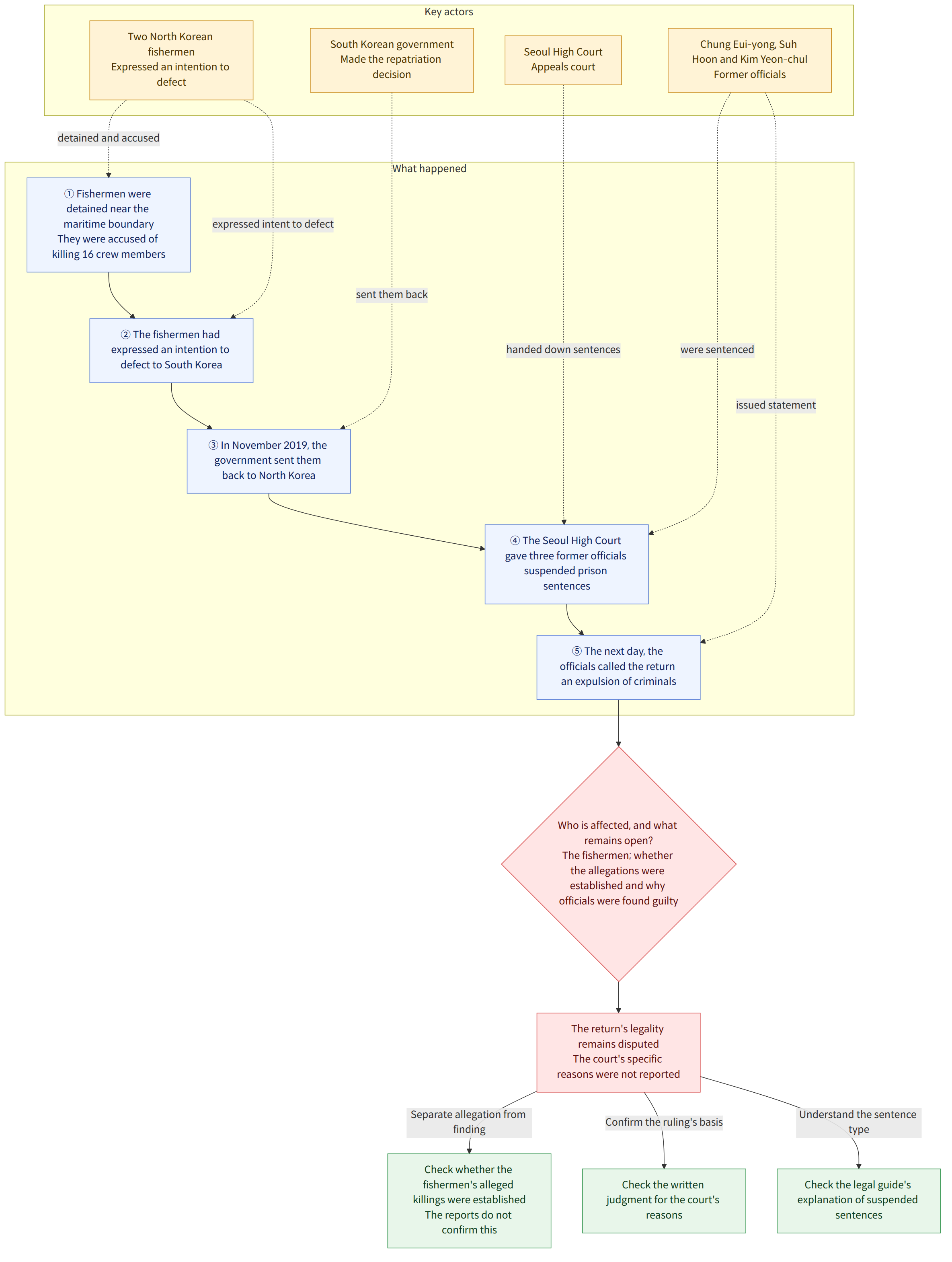
The Seoul High Court (서울고등법원) handed suspended prison sentences to Chung Eui-yong, former director of the National Security Office (국가안보실), Suh Hoon, former director of the National Intelligence Service (국가정보원), and Kim Yeon-chul, former Minister of Unification (통일부), who were indicted on charges related to the 2019 decision to send two North Korean fishermen back to North Korea. According to reports, Chung and Suh each received prison terms of 18 months, suspended for three years, while Kim received a one-year prison term, suspended for two years.
The three issued a statement the day after the ruling, arguing that the repatriation was not simply the forced return of North Korean defectors, but an expulsion of people who had committed serious inhumane crimes and then fled south. The case therefore leaves the legitimacy of the repatriation decision at issue, as the court’s guilty verdict is met with the defendants’ rebuttal.
Background and context
In November 2019, during the administration of former President Moon Jae-in, the South Korean government sent two North Korean fishermen back to North Korea after they were detained near the maritime boundary in the east. The fishermen were accused of killing 16 fellow crew members. The decision drew criticism because they were repatriated despite having expressed an intention to defect to South Korea.
It is important here to distinguish between an “allegation of killing” and a confirmed finding of guilt. Reports say the fishermen were accused of killing 16 people, but do not say whether the allegations were established through a trial or other proceedings. The guilty verdicts against the three former officials concerned their alleged involvement in the repatriation measure; those verdicts alone do not establish that the allegations against the fishermen were confirmed.
What this news means
The ruling shows that debate over the repatriation of the North Korean fishermen is not limited to the simple question of whether to accept them or send them back. The discussion also concerns the legality of repatriating people who have expressed an intention to defect, and what judgment the state should make when serious criminal allegations have been raised. However, the reported facts do not reveal the specific reasons the court gave for finding the officials guilty.
For example, readers encountering a similar case can examine separately what evidence established the intention to defect and the criminal allegations, and what the court actually ruled on. This distinction matters to avoid confusing the defendants’ claims with the court’s findings or with established facts about a crime.
Relevant legal and support information
A suspended sentence is a system under which the execution of a sentence is deferred for a set period. According to reports, the appeals court sentenced the three to prison terms with execution suspended, changing the first-instance sentences of deferred sentencing to suspended sentences. The legal guide provided explains the types of criminal penalties and the meaning of imprisonment, but does not give the specific reasons for applying suspended sentences in this case or explain the effect of the ruling.
The legal guide explains that whether a crime has been committed is assessed by considering whether the conduct constitutes a crime under the law, whether it is unlawful, and whether the person who committed it can be held responsible. These general principles can help distinguish the court’s judgment from the defendants’ claims, but do not explain how the court applied each element in the case against the three former officials. Specific materials, such as the written judgment, are needed to confirm the actual reasons for the ruling. (Sources used: L1, L2)
What reports covered differently
Reports differed in their focus while covering the same appeals court ruling. One focused on the statement the three former officials issued the day after the ruling and their claim that the action was an “expulsion of criminals.” Another also covered the objections of Lim Jong-seok, former presidential chief of staff, and Seo Young-kyo, chair of the Legislation and Judiciary Committee, along with the specific sentences handed down to the three officials. The reports did not present different outcomes of the ruling; they differed in the weight given to various details.
What is confirmed and what remains unknown
Confirmed facts
- The Seoul High Court handed suspended prison sentences to former officials Chung Eui-yong, Suh Hoon, and Kim Yeon-chul.
- The reported sentences were prison terms of 18 months, suspended for three years, for former director Chung and former director Suh, and a one-year prison term, suspended for two years, for former Minister Kim.
- The three argued that the repatriation was an expulsion measure targeting people who had committed serious crimes.
- The two fishermen repatriated in 2019 were accused of killing 16 crew members and faced criticism because they were sent to North Korea despite having expressed an intention to defect.
What remains unknown
- What specific reasons did the court give for finding the three former officials guilty?
- Were the allegations that the fishermen committed killings confirmed through a trial or other proceedings?
- Do reports say whether the appeals court ruling has become final?
What readers should check
- To assess the meaning of the ruling, check not only the outcome reported in the news but also the grounds for the guilty verdict set out in the written judgment.
- When reading about the fishermen, distinguish between “allegations of killing” and “confirmed facts.”
- Treat the defendants’ statement and the reactions of political figures as their respective claims, and do not confuse them with what the court actually ruled.
If you are dealing with a similar issue, attorney Ji-sun Ahn of Ijun Law Firm can review the procedural history, the specific facts or evidence in dispute, and the relevant court or agency notices with you. These details can help clarify which options apply to your situation.

















