


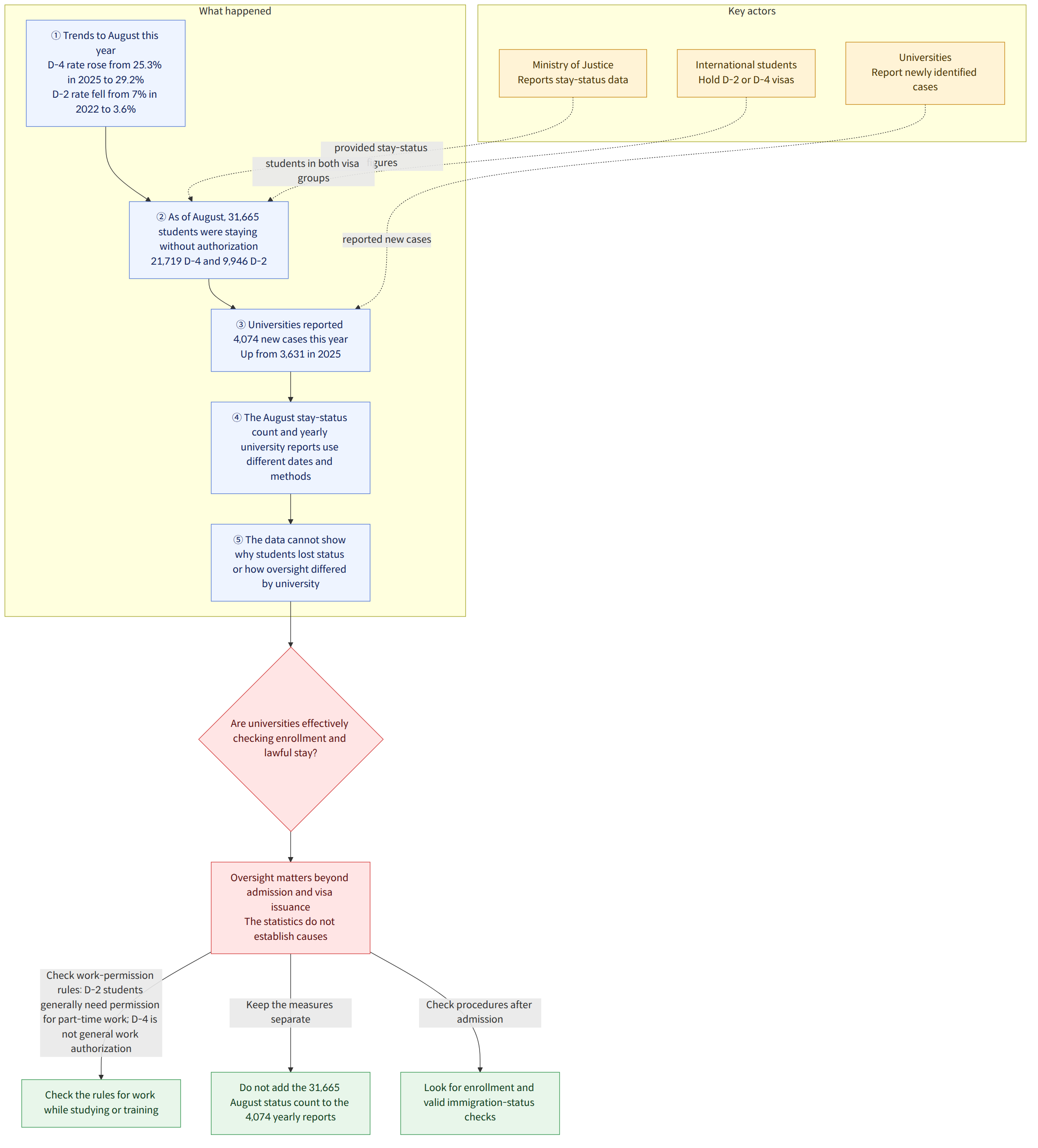
As of August, 31,665 foreign students who entered South Korea on D-2 or D-4 visas were staying without authorization. According to data from the Ministry of Justice (법무부), 21,719 of them entered on language-training visas (D-4), while 9,946 entered on degree-program visas (D-2). The unauthorized-stay rate among visa holders differed substantially: 29.2% for D-4 holders and 3.6% for D-2 holders.
Background and context
One notable point is that the trends differed between the two visa groups. The unauthorized-stay rate among D-4 holders rose from 25.3% in 2025 to 29.2% in August this year. By contrast, the rate among D-2 holders fell from 7% in 2022 to 3.6% in August this year, while the number of foreign nationals holding D-2 visas more than doubled over the same period.
The total number of language trainees, including those staying without authorization, declined from 89,267 last year to 74,450 in August this year. The decline in the overall number therefore does not, on its own, show that problems with immigration-status oversight have eased. The total number of students and the unauthorized-stay rate among visa holders are different measures. In this data, the number of language trainees fell even as the unauthorized-stay rate among D-4 holders rose.
Vietnamese nationals accounted for 82.8% of students staying without authorization. They were followed by 2,033 nationals of Uzbekistan, 1,353 of Mongolia, 731 of China, and 316 of Nepal. Data from the Ministry of Education (교육부) showed that Vietnamese students made up 46.1% of international students enrolled in non-degree programs in April 2026. The large share of Vietnamese students in non-degree programs is relevant context for understanding the nationality breakdown among students staying without authorization, but it does not explain why students lost their status or remained without authorization.
Universities also reported more new cases of students staying without authorization. The number rose 12.2%, from 3,631 in 2025 to 4,074 this year. Among this year’s cases, 1,872 involved degree-program students and 2,202 involved language trainees. Of the 344 universities nationwide, the number reporting cases involving degree-program students increased from 182 in 2025 to 190 this year. The number reporting cases involving language trainees also rose, from 186 to 208.
However, the Ministry of Justice’s figure of 31,665 reflects the status of students’ stays as of August, while the 4,074 cases in the university data are newly reported cases for this year. The figures have different reference dates and counting methods, so they should not be added together or interpreted as a change in the same population. Kim Hee-jung of the People Power Party (국민의힘) criticized universities for prioritizing international student recruitment without putting adequate systems in place to verify students’ enrollment and lawful stay.
What this news means
Oversight of international students does not end with admission or visa issuance. Given the substantial difference between the status of D-2 and D-4 holders and the increase in new cases reported by universities, the effectiveness of procedures for checking whether students are actually enrolled and maintaining valid immigration status may become more important. The statistics alone, however, do not make it possible to determine how oversight differed among universities or the specific reasons students lost their status.
Students need to understand the distinction between their visa type and the activities it permits. For example, a D-2 student who wants to work in addition to studying can generally take a part-time job only after obtaining permission, so they should check the conditions before starting work. D-4 is not a general work authorization, so anyone seeking to work while in training should check whether separate permission is required. This is guidance about work, not an explanation of the causes of the unauthorized stays shown in the statistics.
Relevant rules and support information
According to the Ministry of Justice’s visa guidance, D-2 is a status of stay for foreign nationals who intend to study in a regular program or conduct specific research at an eligible junior college or higher education institution, or an academic research institution. It includes associate, bachelor’s, master’s, and doctoral programs, as well as exchange students. Some institutions, such as online universities and lifelong education institutions, are excluded from the eligible institutions, so students should check the requirements for the institution and program rather than judging eligibility by the program name alone. The usual maximum period of stay granted at one time under D-2 is two years, or one year for research programs.
D-4 is a status for people receiving education, training, or conducting research at a place other than an institution or academic research institution eligible for D-2. As a general rule, D-4-1 students taking Korean-language courses at a university-affiliated language institute must have at least a high school diploma. The eligible applicants and period of stay differ by D-4 subcategory, and the maximum period of stay granted at one time under D-4 as a whole is two years. D-4-1 visas are listed as valid for six months or less, so students should check the period that applies to their specific status.
D-2 is granted for up to two years, and applicants need documents showing their academic progress, such as enrollment, grades, and attendance, as well as proof of financial capacity and residence. D-4-1 and D-4-7 applicants must prepare documents showing academic progress, including enrollment and attendance, along with proof of financial capacity and residence. Guidance states that, for extensions, proof of financial capacity is accepted only in the form of funds deposited in the applicant’s own bank account in South Korea. The stated application fee for an extension review is 60,000 won for both D-2 and D-4.
Extensions of stay and permission for part-time work must be applied for with the required documents and in accordance with the applicable conditions. D-2 students must check the conditions for permission to work part-time before starting a job; a new permission is required if the employer or workplace changes. D-4 is not a general work authorization, so students must check separately which activities are permitted.
What is known and what remains unknown
What is known
- As of August, 31,665 foreign students who entered on D-2 or D-4 visas were staying without authorization.
- The unauthorized-stay rate was 29.2% among D-4 holders and 3.6% among D-2 holders.
- New cases reported by universities increased from 3,631 in 2025 to 4,074 this year.
- Vietnamese nationals accounted for 82.8% of students staying without authorization.
What remains unknown
- What were the specific reasons the students came to be staying without authorization?
- What measures will universities and the government take in response to the increase in cases?
- To what extent does the increase in newly reported cases reflect an actual rise in unauthorized stays, changes in reporting and verification systems, or both?
What readers should check
- International students should check their specific visa type, the expiration date of their period of stay, and the enrollment, attendance, financial, and residence documents required for an extension.
- D-2 students who want to work should check the permission and conditions for part-time work before starting a job, and confirm whether new permission is needed if the employer or workplace changes. D-4 students should also check which activities are permitted under their specific status.
- Universities should review whether procedures for verifying students’ enrollment and lawful stay are actually in operation. However, the data do not specify what concrete measures the government and universities will take or when.
If you are dealing with a similar issue, attorney Ji-sun Ahn of Ijun Law Firm can review your current visa, enrollment or graduation records, and evidence of language ability, a job offer or local residence as applicable with you. These details can help clarify which options apply to your situation.

















