



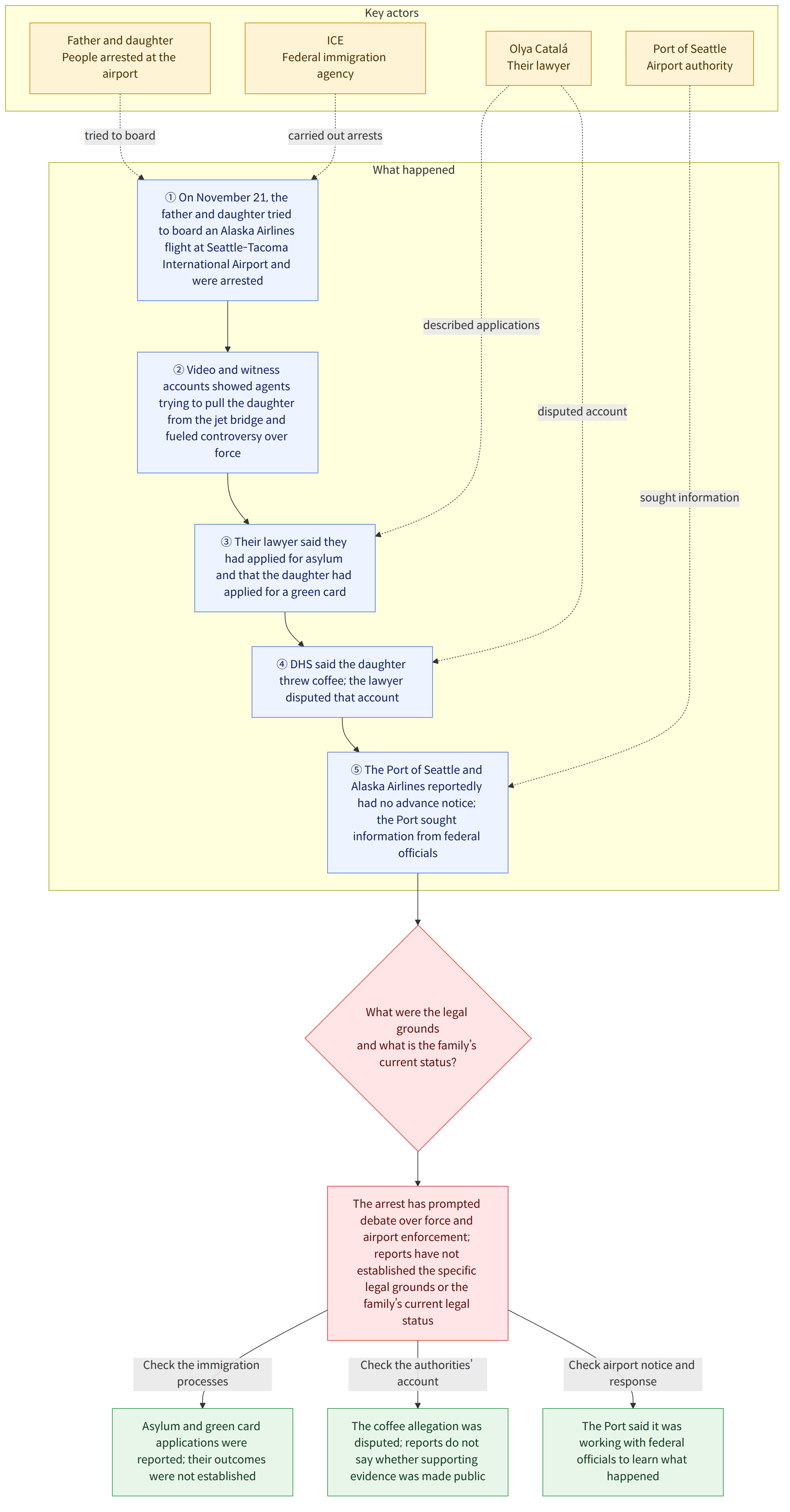
On November 21 (local time), a father and daughter from Mexico who were trying to board an Alaska Airlines flight to Los Angeles at Seattle-Tacoma International Airport in Washington state were arrested by U.S. Immigration and Customs Enforcement (이민세관단속국, ICE). Video that circulated on social media showed a woman who appeared to be the daughter crying out, “We have work permits,” and passengers shouting as agents tried to pull her off the jet bridge.
Background and context
The person who filmed the incident, John Gedecke, told The New York Times, The Associated Press and other outlets that two men in plain clothes pushed past passengers and then knocked a man who was with his family to the floor. Reports said the video then showed agents trying to pull the woman away. The video and witness accounts are part of the controversy over the use of force at the scene, but on their own they do not explain the legal basis for the arrest or the full circumstances.
According to the father and daughter’s lawyer, Olya Catalá, the two were on their way to a baptism in California. The lawyer said they had lived in the United States since 2015 and had applied for asylum, and that the daughter had applied for a green card after marrying a U.S. citizen. She told The Associated Press that both had followed the required procedures and had no criminal records. These are the lawyer’s statements; reports do not give the outcome of the relevant applications or the authorities’ specific reasoning connecting them to the arrest.
The issues include not only whether the enforcement action was forceful, but also whether people at the scene could identify the agents and understand what was happening. The Department of Homeland Security said the daughter threw coffee, but lawyer Catalá disputed that account, saying that when someone in plain clothes rushes at you, you cannot know who they are. Reports do not explain whether any evidence supporting this claim has been made public.
What this news means
In this case, the immigration proceedings involving the people arrested and the way the enforcement action was carried out have both become central to the debate. The fact that the father and daughter had applied for asylum and a green card, and the footage of the daughter mentioning a work permit, provide information about the processes they were pursuing. But reports alone do not establish how those processes affected the arrest or what grounds the authorities had for taking them into custody. Rather than concluding that the arrest was justified or unjustified solely on the basis of the woman’s statement that she had a permit, the authorities’ reasons and what happened afterward need to be established.
The location of the enforcement action and whether there was advance notice also matter to airport users. According to reports, the Port of Seattle (시애틀항만청) and Alaska Airlines were not notified before the operation. The Port of Seattle said the incident was distressing not only for the family but also for other passengers, and that it was working with federal officials to learn what happened. The case was reportedly one in which airport authorities had no advance knowledge of the situation, raising questions about how enforcement actions are carried out in public places and how people at the scene respond.
For example, if you witness someone in plain clothes restraining another person at an airport, as passengers did in this case, the person’s identity and reasons for acting may be unclear to those nearby. That is context for understanding what the video showed, not a conclusion about whether this arrest was justified.
Politicians also criticized the incident. In a statement, Washington Gov. Bob Ferguson condemned it as an example of ICE’s “profoundly un-American tactics.” Democratic Rep. Pramila Jayapal wrote on X that violent arrests are characteristic of a fascist state, not a democracy. These are political assessments of the incident and should be distinguished from the findings of any independent investigation into the circumstances of the arrest.
Reports said ICE had increased airport arrests since this summer, focusing on people who had overstayed their visas. According to Department of Homeland Security data obtained by CBS, ICE arrested 491,000 people in fiscal year 2026. This figure provides context on the overall scale of enforcement, but does not explain why the father and daughter were arrested. In an interview with CBS’s “60 Minutes” earlier this month, President Donald Trump appeared to acknowledge that the deportation policy may have been too harsh; according to reports, on the day the interview was taped, he appointed Stephen Miller as White House chief of staff. Both developments also show the political tensions surrounding immigration policy.
What is confirmed and what remains unknown
Confirmed facts
- On November 21, a father and daughter from Mexico who were trying to board an Alaska Airlines flight to Los Angeles at Seattle-Tacoma International Airport were arrested by ICE.
- Reports said video showed the woman shouting that she had a work permit and agents trying to pull her away.
- The lawyer said the father and daughter had applied for asylum and that the daughter had applied for a green card, and said neither had a criminal record.
- The Department of Homeland Security claimed the daughter threw coffee, while the lawyer disputed the account, saying it was difficult to identify someone in plain clothes.
- Reports said the Port of Seattle and Alaska Airlines were not notified before the enforcement action.
What remains unknown
- What specific legal grounds and reasons ICE had for arresting the father and daughter.
- Where the father and daughter were detained after the arrest and what procedures are now underway.
- Whether evidence related to the coffee-throwing claim or the arrest has been made public.
What readers should watch for
- In following further coverage, readers should distinguish between the authorities’ stated reason for the arrest and the lawyer’s account.
- Video and witness accounts can show what happened at the scene, but readers should separately consider whether they establish the legal basis for the arrest or what happened afterward.
- Whether the family’s place of detention and legal proceedings are disclosed, and whether evidence concerning the coffee-throwing claim is made public, will be important to understanding the circumstances.
















