



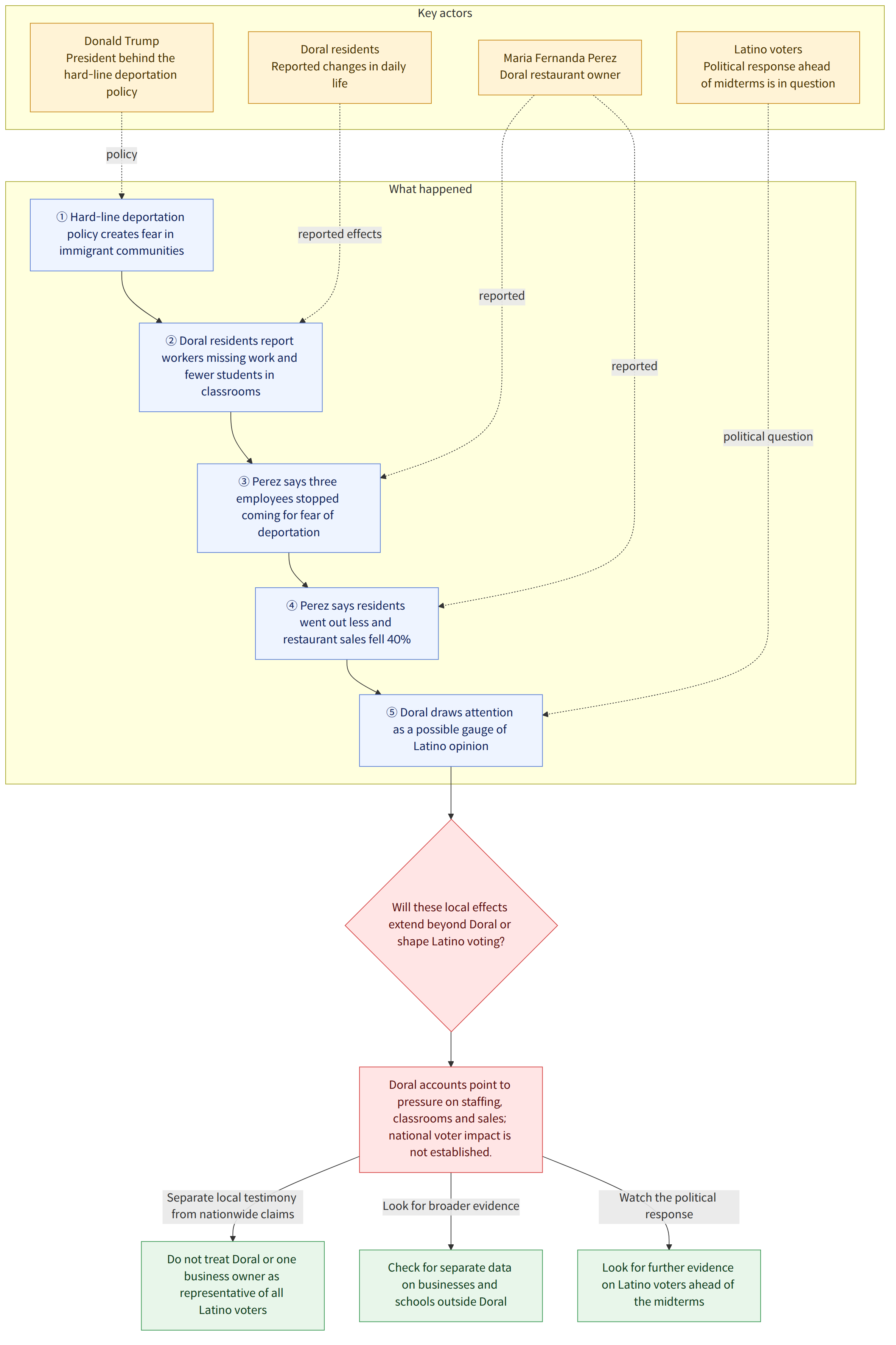
Residents of Doral, in southern Florida, said concerns about immigration enforcement were affecting daily life at businesses and schools. They said the fear of enforcement had left businesses short of employees and reduced the number of students in classrooms. The accounts come amid reports that many Latino voters who helped Donald Trump and the Republican Party take power in 2024 have grown tired of immigration enforcement, ahead of the midterm elections.
Background and context
Doral, near Miami, is an area with a large Latino population and is home to one of Trump’s golf clubs. It is also known as “Doralzuela” because many Venezuelan-born residents live there. The area has been suggested as a possible place to gauge shifts in Latino opinion nationwide.
The report says President Trump’s hard-line deportation policy has created fear in immigrant communities for nearly two years. What emerges is not just abstract support or opposition to the policy. The report also presents local experiences of residents going out less and employees not showing up for work.
Maria Fernanda Perez, 32, who runs a restaurant in Doral, said she voted for Trump because she thought the economy would improve. But Perez said three employees had stopped coming to work for fear of being deported, and that restaurant sales had fallen 40% as local residents went out less. Perez described her situation as sad and disappointing.
What this news means
If concerns about immigration enforcement lead people to withdraw from everyday life, the effects may not be limited to immigrant communities. Businesses whose employees do not show up may struggle to operate, and when residents go out less, local stores may also face pressure on sales. Residents’ accounts that student numbers at schools have fallen suggest that fears of enforcement may also reach into homes and classrooms.
Politically, Perez’s account stands out because she voted for Trump expecting the economy to improve. The business difficulties she described show how economic expectations and the perceived effects of immigration enforcement can both shape voters’ experiences in one community. But testimony from a single area cannot establish the choices of Latino voters as a whole or predict the outcome of the midterm elections. Doral has been presented as a possible gauge of changes in national opinion, but its representativeness has not been established.
For example, if a business owner in Doral has experienced employees missing work and falling sales, that case can serve as a point of reference for how fears of enforcement might affect a local economy. But that alone does not support the conclusion that businesses in other areas have experienced the same changes.
What is confirmed and what remains unknown
Confirmed facts
- Doral residents said fears of enforcement had left businesses short of employees and reduced the number of students in classrooms.
- Perez said three employees had stopped coming to work for fear of being deported.
- Perez said restaurant sales had fallen 40% as residents went out less.
- Perez said she voted for Trump because she expected the economy to improve.
What remains unknown
- Perez’s quote cuts off at “My whole family, all my friends are,” so it is not known what she said next.
- The report does not say whether concerns about enforcement have reduced staffing at businesses or student numbers at schools in areas outside Doral.
- The article provides no separate figures or data to substantiate the link between fears of enforcement and falling sales.
- It has not been established what period Perez’s reported decline in sales covers.
What readers should watch for
- Avoid interpreting this case as the views of all Latino voters nationwide; distinguish between testimony from Doral residents and the account of one restaurant owner.
- Looking for separate figures or data on businesses and schools in other areas in subsequent reporting may help determine whether Doral’s experience reflects a broader trend.
- It is worth watching whether further evidence emerges about Latino voters’ political response ahead of the midterm elections, and how that response is connected to concerns about immigration enforcement.

















