



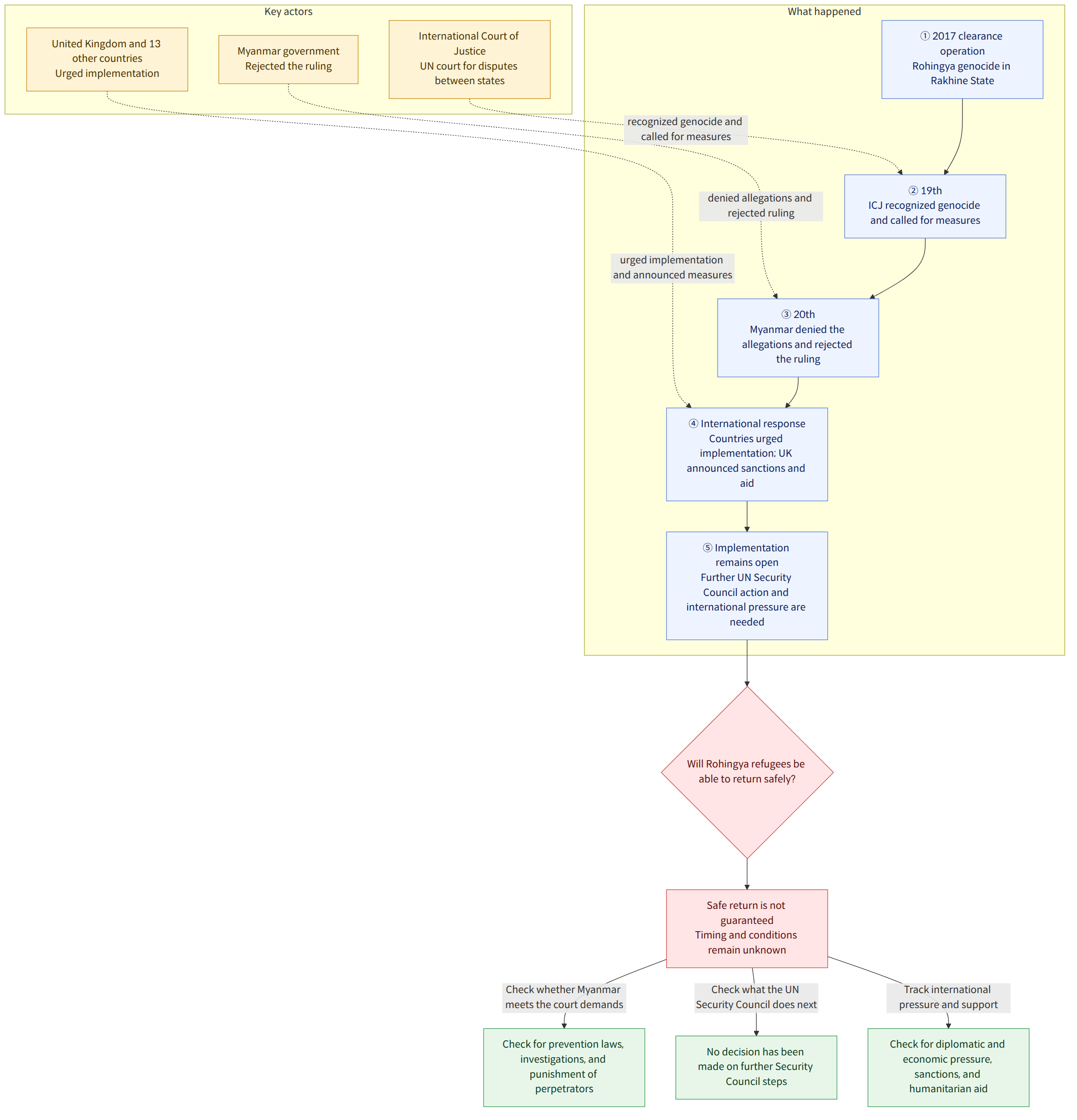
Rohingya residents of a refugee camp in Cox’s Bazar, Bangladesh, watched the International Court of Justice (ICJ, the United Nations’ highest court for disputes between states) ruling together via a live broadcast on the 19th. The ICJ recognized that genocide of the Rohingya took place during the Myanmar government forces’ 2017 clearance operation in Rakhine State. But the Myanmar government denied the allegations and rejected the ruling the following day. The reality became clear: a ruling recognizing genocide does not, by itself, guarantee the refugees’ return.
Background and context
Mohammad Toyab, 40, who lives in the refugee camp, could not understand the ruling, which was broadcast in English, but cheered with other residents when it was announced. The moment the ruling was received as recognition of justice was one thing; whether its contents were adequately conveyed to the refugees was another. Tufaira Bibi, 15, who came to Cox’s Bazar after losing her parents and younger sibling at age 6, said she knew nothing about what had happened at the trial.
According to reports, this ruling is the first time in the ICJ’s 80-year history that it has recognized a state’s act of genocide. The court called on the Myanmar government to adopt domestic legislation to prevent genocide from recurring and punish those responsible, investigate and punish perpetrators, guarantee the safe return of Rohingya living abroad, and compensate victims, among other measures. A step remains between the responsibility established by the ruling and the sense of safety experienced by refugees: implementation.
In an official statement on the 20th, the Myanmar government said it was being unfairly accused, denied the genocide allegations, and rejected the ruling. Reports said this rejection means it will be difficult for the court’s demands—such as punishing those responsible and enabling a return—to be fulfilled easily. The ICJ has no police force or military to enforce its ruling directly.
What this news means
The ruling matters because an international court recognized responsibility for genocide, but the more immediate question for refugees is whether they can actually return home. Abdurr Rahim, a 39-year-old refugee, asked what good the ruling would do if the Myanmar military continued to drive out the Rohingya. His concern illustrates the gap between the legal judgment and the realities of return.
The ruling has been issued, but the refugees’ safe return is still not guaranteed.
For example, if a refugee expects to be able to return home soon because the ruling has been issued, the facts currently available do not allow anyone to determine when a return might happen or under what conditions. The Myanmar government rejected the ruling, and the ICJ has no means to enforce it directly. Reports explained that implementation depends on further action by the United Nations Security Council (유엔 안전보장이사회; the UN body responsible for peace and security issues) and diplomatic and economic pressure from the international community.
The foreign ministers of 14 countries, including the UK, said in a joint statement that the ruling is binding on Myanmar and urged it to meet its obligations under international law. The UK government announced sanctions against five senior Myanmar military officials and humanitarian aid for refugees, and pledged £8 million (about 1.4 billion won) for the Rohingya and victims of human rights abuses across Myanmar. Reports said the UK also announced sanctions on senior Myanmar military officials, including asset freezes and travel bans, and plans to advance legislation restricting the export and supply of aviation fuel.
What is confirmed and what remains unknown
Confirmed facts
- On the 19th, the ICJ recognized the Myanmar government forces’ 2017 genocide of the Rohingya.
- The court called for measures to prevent a recurrence, domestic legislation, investigations and punishment of perpetrators, guarantees of safe return, and compensation for victims, among other steps.
- On the 20th, the Myanmar government denied the genocide allegations and rejected the ruling.
- The ICJ has no police force or military to enforce its ruling.
- The UK and 13 other countries called for the ruling to be implemented, and the UK announced sanctions and humanitarian aid.
What remains unknown
- It is not known whether the Myanmar government will actually meet the court’s demands.
- No decision has been made on what further steps the United Nations Security Council will take to implement the ruling.
- The timing and conditions under which Rohingya refugees could safely return home have not been confirmed.
What readers should watch for
- When assessing whether the ruling is being implemented, distinguish the Myanmar government’s actual actions from its official statements, and check the progress of investigations and punishment of those responsible.
- If the United Nations Security Council announces further action or the international community announces pressure, examine what has been announced separately from whether it is actually carried out.
- When considering the possibility of return, do not assume that the ruling itself guarantees a timetable or safety. Watch for confirmation of concrete measures for a safe return.
















