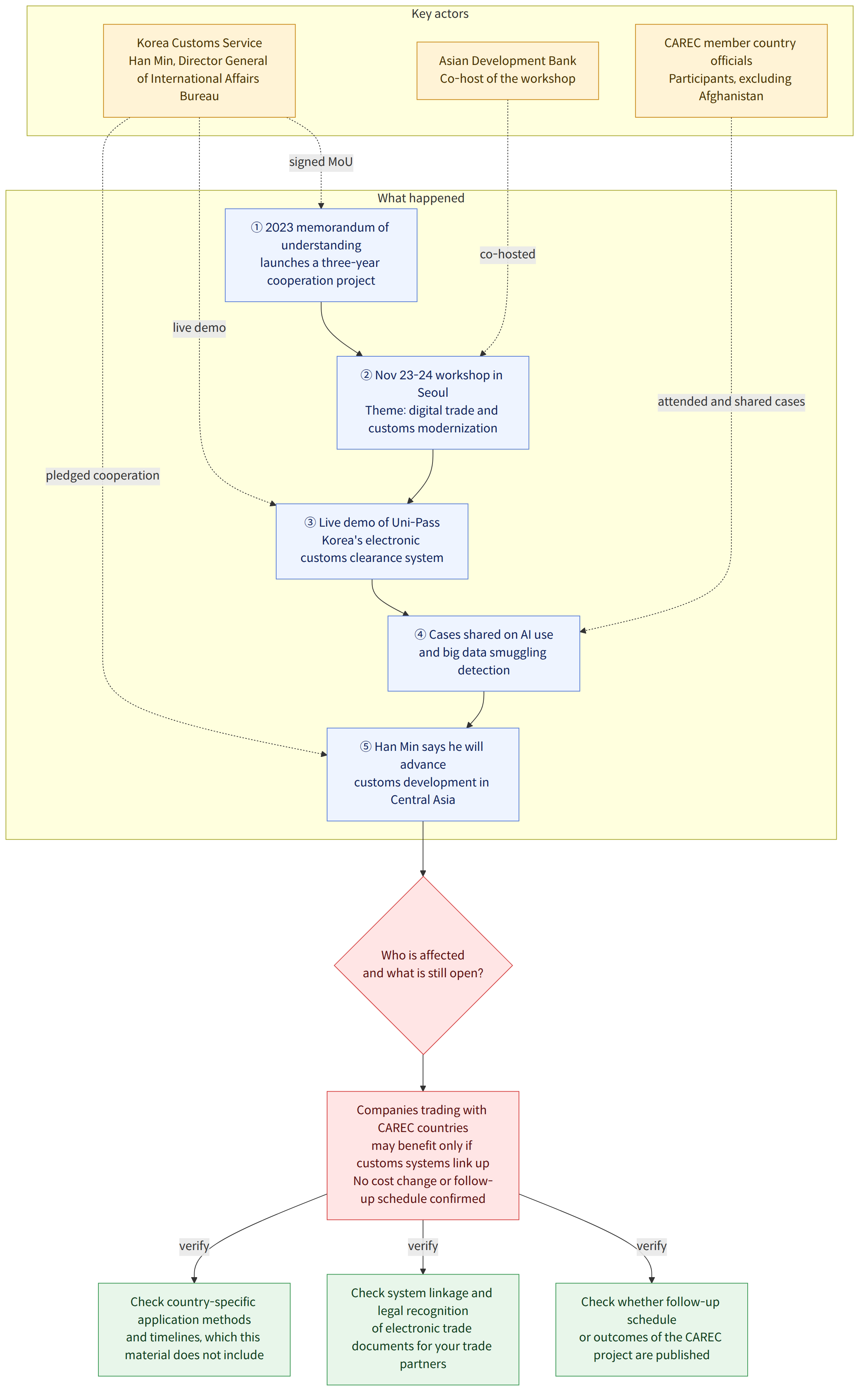
The Korea Customs Service, together with the Asian Development Bank (ADB), held a workshop for member countries of the Central Asia Regional Economic Cooperation (CAREC) Program from November 23 to 24 at Hotel President in Jung-gu, Seoul. The theme was "Promoting Digital Trade and Customs Modernization in CAREC Countries." Participants saw a live demonstration of Uni-Pass (유니패스), Korea's electronic customs clearance system, and shared cases of AI use in customs operations and smuggling detection through big data analysis.
Background and Context
CAREC includes five Central Asian countries, namely Kazakhstan, Uzbekistan, Kyrgyzstan, Tajikistan and Turkmenistan, as well as China, Mongolia, Azerbaijan, Georgia, Pakistan and Afghanistan. The workshop was part of a three-year cooperation project launched under a memorandum of understanding signed in 2023.
The 26 participants included officials from 10 CAREC member countries, excluding Afghanistan, as well as representatives of the ADB, the Asian Development Bank Institute (ADBI), and the International Chamber of Commerce (ICC), which is headquartered in Paris. The workshop agenda covered trade facilitation among member countries, digital trade, data interoperability (the ability of different systems to exchange and use data with one another), international standards, legal recognition of electronic trade documents, and strategies for building cross-border trust.
What This News Means
When customs work is digitized, the way systems and data are used in clearance procedures can change. The sharing of Uni-Pass demonstrations and cases of AI and big data use at this workshop is notable as an occasion for Korea to share its customs administration experience with CAREC member countries. However, sharing cases or giving system demonstrations alone does not mean that any country's institutions have changed or that companies' clearance costs have actually fallen.
Han Min, Director General of the International Affairs Bureau at the Korea Customs Service, said that linking systems and exchanging data between customs authorities is important for lowering companies' trade costs and expanding trade. This remark shows that customs modernization may connect not only to changes in internal customs operations but also to the conditions under which companies conduct cross-border transactions. For example, if a company exports and imports with different countries, the burden of clearance may be reduced when customs systems in each country link up and exchange data smoothly. However, this material does not specify any actual cost changes or the concrete scope of system linkage.
Director General Han said he would work to advance customs administration development in Central Asia and to strengthen cooperation for an environment in which companies can trade smoothly. This signals a willingness to cooperate, but it cannot be interpreted as confirmation of any follow-up project schedule or outcomes.
Confirmed Facts and Unknowns
Confirmed facts
- The workshop was co-hosted by the Korea Customs Service and the ADB in Seoul on November 23–24.
- There were 26 participants, including officials from 10 CAREC member countries excluding Afghanistan, as well as representatives of international organizations and institutions.
- At the workshop, Uni-Pass was demonstrated live, and cases of AI use and smuggling detection based on big data were presented.
- The event was part of a three-year cooperation project launched under a 2023 memorandum of understanding.
Unknowns
- Which 10 CAREC member countries attended has not been confirmed.
- The specific follow-up schedule and outcomes of the cooperation project have not been presented.
- It is not known what changes the cases shared at the workshop will bring to each country's customs systems or to companies' clearance costs.
What Readers Should Check
- Checking whether follow-up schedules or outcomes of the CAREC cooperation project are made public will show whether this workshop leads to actual institutional or system changes.
- Companies need to verify how system linkage between customs authorities and the scope of recognition for electronic trade documents are specifically determined for the countries they trade with. This material does not include country-specific application methods or timelines.