



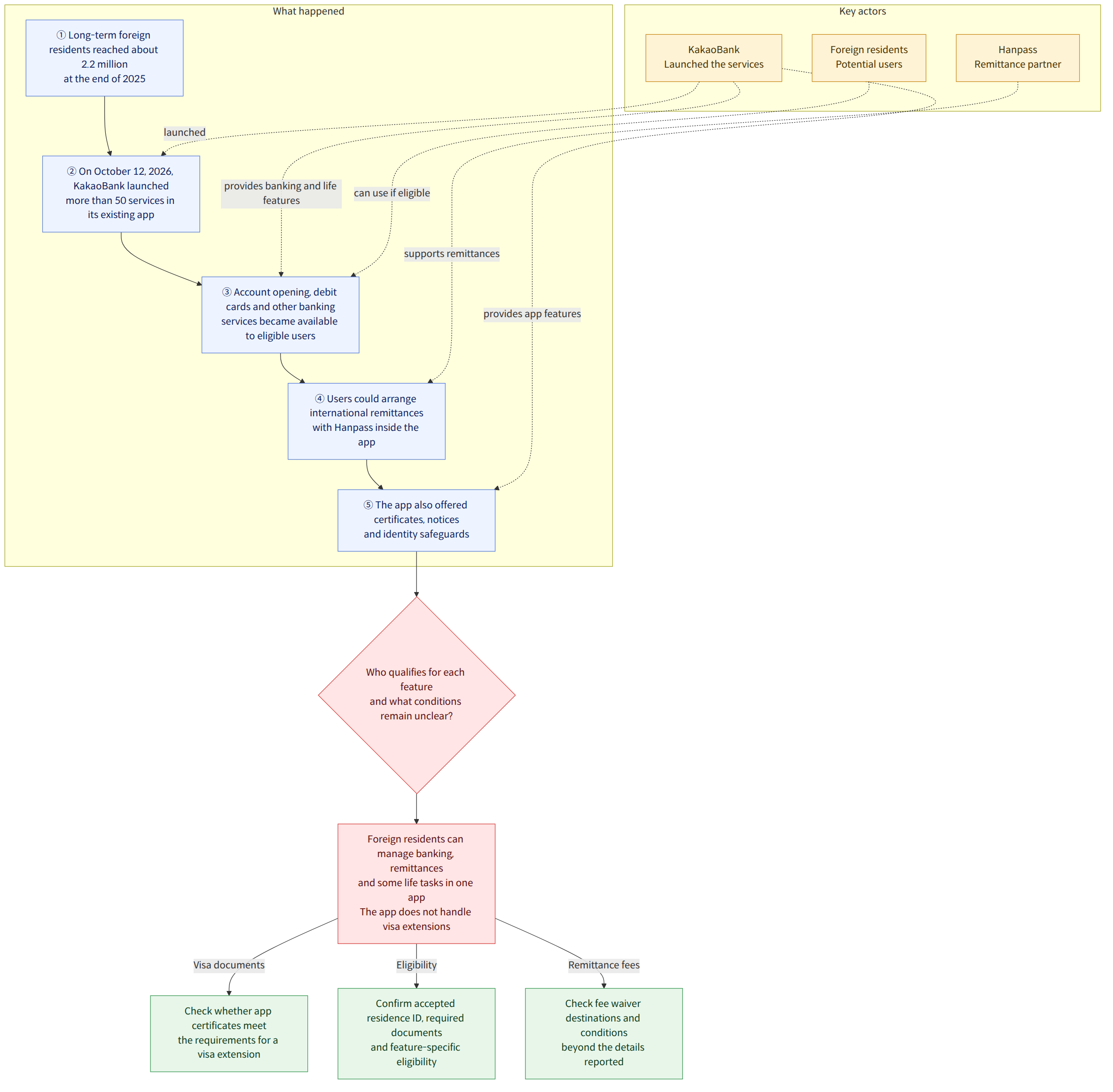
On October 12, 2026, KakaoBank (카카오뱅크) launched more than 50 financial and lifestyle services for foreign residents. The key feature is that they can open accounts, get debit cards and send international remittances through the same app used by Korean customers. Initially, the services are available to foreign residents aged 19 or older who have a valid residence ID and a mobile phone registered in their own name.
Background and context
The number of foreigners staying in South Korea long term is increasing. According to the Ministry of Justice (법무부), there were about 2.2 million long-term foreign residents at the end of 2025, a 38% increase from 2021. Against this backdrop, KakaoBank has added services for foreigners to the app already used by domestic customers, rather than creating a separate app for foreigners.
The initial services include checking accounts, group accounts (모임통장) and a Safe Box (세이프박스), where customers can temporarily deposit funds and earn interest. Transfers and ATM transactions are free, and the domestic debit card offers the same cashback benefits as cards provided to Korean customers. Customers can also compare and apply for credit cards through the app, including co-branded products with Shinhan Card (신한카드).
KakaoBank said that an account can be opened on a mobile phone in about five minutes and that required documents can also be submitted through the app. However, the claim that opening an account takes little time does not mean that every applicant is guaranteed approval or an account. Eligibility depends on meeting the requirements and submitting the required documents.
International remittances are offered in partnership with Hanpass (한패스). Hanpass supports 200 countries and more than 50 currencies, and customers can set up and send remittances without leaving the KakaoBank app. Remittance fees are waived for some destinations, including the United States and China. KakaoBank directly processes incoming international remittances and charges no receiving fee.
The app also includes features for life in South Korea beyond financial transactions. Users can obtain balance certificates and transaction history certificates needed for visa extensions, and receive government notifications, such as notices of fines. They can also view their balance converted into nine currencies and use AI search and remittance features, as well as a rewards service. AI translation is available in English, Chinese and Vietnamese, and dedicated customer support for foreigners is provided in English.
What this news means
An important change for foreign residents is that they can now handle not only accounts, cards and remittances but also some certificates and notifications in one app. For users who have had to take different routes to manage financial tasks and other needs related to living in South Korea, finding and using the services they need within the app may make the process simpler. However, the certificate feature means that users can obtain the documents through the app; it does not mean the app handles the visa extension process itself.
Using the same app is also notable in terms of access to services. If services are not split across separate channels, Korean and foreign customers may face less difficulty finding features in different apps. However, it is important to distinguish between the range of services available in the app and whether every foreign resident can use every feature. Eligibility, the scope of accepted documents and language support each need to be checked separately.
For example, someone preparing to extend a visa can obtain a balance certificate and transaction history certificate through the app, but must separately confirm whether the documents meet the format and requirements for their application. Likewise, when sending an international remittance, the published information does not specify whether fee waivers apply to destinations other than the United States and China or what conditions apply.
KakaoBank has introduced monitoring of permitted periods of stay and facial verification as security measures for foreign customers. It also offers text message scam detection and identity theft prevention services. These features both expand the services available to foreign customers and show that identity verification and the management of residency information are being treated as important.
Differences in how reports described the service
Reports differ in how they describe eligibility. One said the service is for foreign residents with a valid residence ID, while another described it as being for residents who hold an accepted ID. Neither report specified exactly which IDs or residence statuses are accepted.
What is confirmed and what remains unknown
Confirmed facts
- On October 12, 2026, KakaoBank launched services for foreign residents in the same app.
- The initial services include account opening, debit card issuance and international remittances, as well as group accounts and Safe Box.
- Users can obtain balance certificates and transaction history certificates needed for visa extensions through the app and receive government notifications.
- International debit card payments are scheduled to launch in early December, and deposit products, open banking, loan comparison services and expanded language support are planned for 2027.
What remains unknown
- The published reports do not specify which types of residence IDs or residence statuses qualify for the service.
- The reports do not say which destinations besides the United States and China qualify for remittance fee waivers or what conditions apply.
- It has not been confirmed what format of certificate is accepted for visa extension applications or whether applicants need to prepare additional documents.
What readers should check
- Before trying to open an account, check whether your residence ID and status qualify. The basic requirements stated in the reports are that applicants be at least 19, have a valid residence ID and use a mobile phone registered in their own name.
- Before sending an international remittance, check the applicable fee in the app, as fee waivers may vary depending on the destination and transaction conditions. The published information confirms waivers only for some destinations, including the United States and China.
- If you plan to submit a certificate with a visa extension application, check which documents are required and what formats are accepted before obtaining them through the app. The fact that the app can issue a certificate does not, by itself, establish that it meets the submission requirements.
If you are dealing with a similar issue, attorney Ji-sun Ahn of Ijun Law Firm can review your identity and residence documents, any verification request, and the institution’s written response with you. These details can help clarify which options apply to your situation.
References
- Other coverage consulted: koreatimes.co.kr

















