


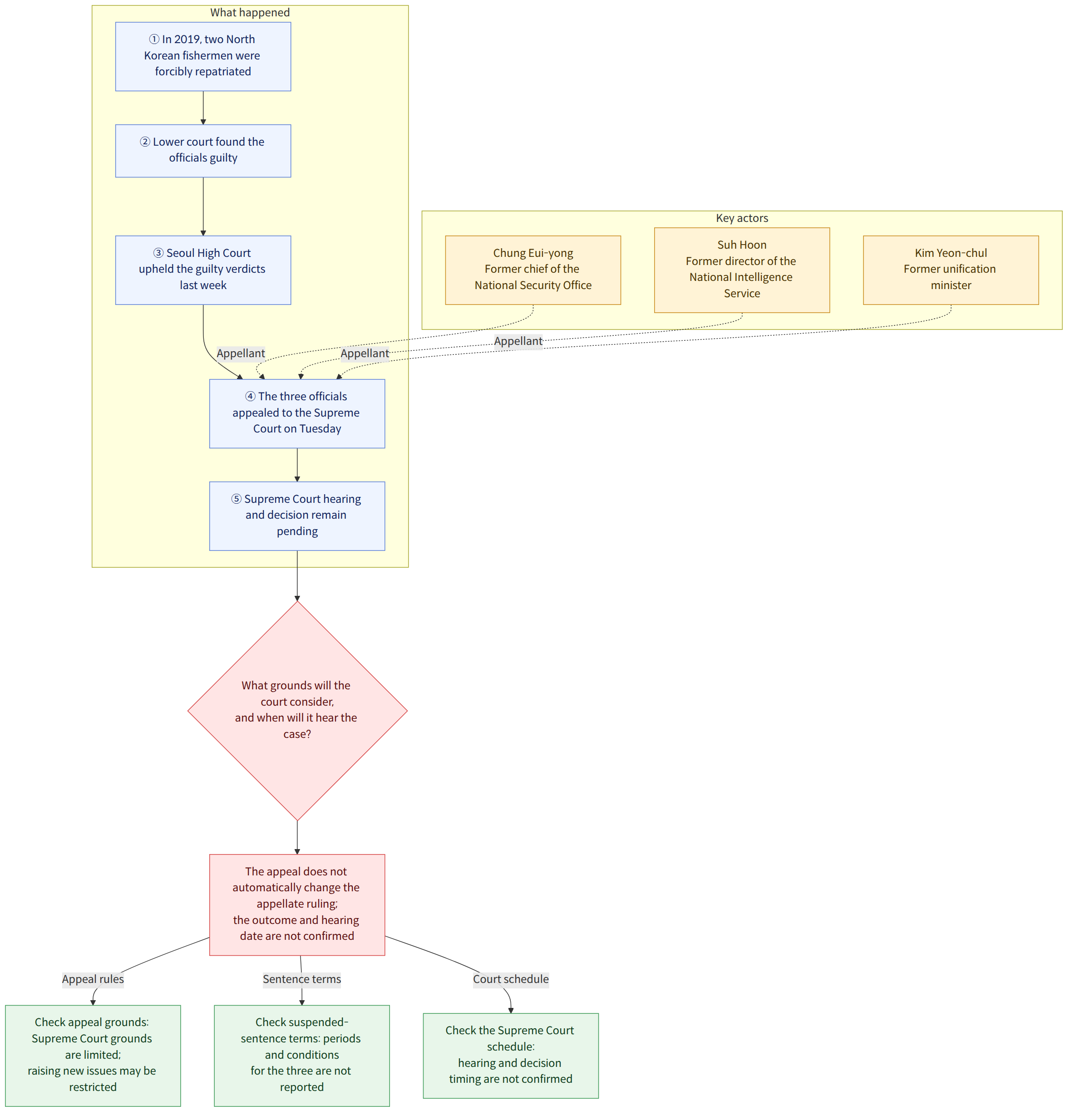
Three former government officials who received suspended sentences over the 2019 forced repatriation of two North Korean fishermen appealed the appellate court’s ruling to the Supreme Court (대법원) on Tuesday. The appellants are Chung Eui-yong, former chief of the National Security Office; Suh Hoon, former director of the National Intelligence Service; and Kim Yeon-chul, former unification minister. The Seoul High Court (서울고등법원) upheld the lower court’s guilty verdicts last week.
Background and context
What has been confirmed so far is that the three appealed and that the appellate court upheld the lower court’s guilty verdicts. Reports do not say what grounds the three cited for their appeals, or the sentences and suspended-sentence periods the appellate court imposed on each of them.
All three served in the government during former President Moon Jae-in’s term. However, the reporting provided does not establish what role each played in this case or the specific issues raised in their appeals. This news should therefore not be read as meaning that particular legal arguments or details of individual responsibility have already been considered by the Supreme Court.
What this news means
An appeal to the Supreme Court is a procedure for challenging an appellate court ruling. In this case, the parties appealed after the appellate court upheld the guilty verdicts, so the focus now is on what grounds the Supreme Court will consider and what conclusion it will reach. An appeal does not automatically change the appellate court’s ruling, however, and it has not yet been confirmed when the Supreme Court will hear or decide the case.
The issues that can be considered at the appeal stage may be limited. A guide based on consultation cases from the Korea Legal Aid Corporation (법률구조공단) explains that the grounds for an appeal to the Supreme Court are limited and that the court may issue a ruling without oral arguments based on the case record. This is general guidance on criminal cases; it is not known what issues the three actually raised or how the Supreme Court will consider this case.
A suspended sentence is a system that postpones the execution of a sentence for a specified period. Therefore, the fact that suspended sentences were imposed in this case does not mean that no sentences were handed down. According to a legal guide, if the suspension period passes without being revoked or invalidated, the sentence loses its effect, but the historical fact that it was imposed does not disappear. The available information does not specify the periods or conditions that apply to the three men.
This is an explanation of the system in general; it does not mean that any such situation has occurred or that any related issue applies to the three men.
Related legal procedures and support information
According to a guide to appeals in criminal proceedings, the grounds for an appeal to the Supreme Court are limited, and there may be restrictions on raising new grounds based on issues that were not addressed by the appellate court. The guide explains that grounds for appeal may include violations of law, errors of fact, and an unduly harsh or lenient sentence, but that, in principle, it is difficult to raise as a new ground for appeal an issue that was not argued before the appellate court. This explanation alone, however, cannot establish the grounds the three actually raised or the scope of the Supreme Court’s review.
The effects of a suspended sentence also depend on the specific terms of the ruling. According to the guide, an existing suspended sentence may lose effect if, during the suspension period, a person is sentenced to imprisonment or a more severe punishment for an intentional crime and that sentence becomes final during the period. Probation, community service, or an order to attend classes may also be imposed. The information provided does not establish whether any such conditions or orders applied in this case. For a specific case, the applicable laws at the relevant time and the terms of the court’s ruling must be checked.
If the issues discussed under “Related legal procedures and support information” apply to your situation, attorney Ji-sun Ahn of Ijun Law Firm can review the procedural history, the specific facts or evidence in dispute, and the relevant court or agency notices with you to help clarify your options.
What is known and what remains unknown
Confirmed facts
- Three former government officials appealed the appellate court’s ruling to the Supreme Court on Tuesday.
- The case concerns the 2019 forced repatriation of two North Korean fishermen.
- The Seoul High Court upheld the lower court’s guilty verdicts last week.
- The appellants are Chung Eui-yong, Suh Hoon and Kim Yeon-chul, all of whom served in the government during former President Moon Jae-in’s term.
What remains unknown
- What legal or factual issues the three raised as grounds for their appeals.
- The specific sentence and suspended-sentence period imposed on each person, and whether any conditions were imposed alongside them.
- When the Supreme Court will hear or decide the case, and what procedure it will use to consider it.
What readers should check
- Follow-up reporting and publicly available court materials should be checked for details on the grounds for appeal and the issues before the Supreme Court.
- Reports omit each person’s sentence and suspended-sentence period, so anyone assessing the specific legal effects should check the terms and conditions of each individual ruling separately.
- The grounds that can be raised at the Supreme Court appeal stage may be limited. To assess the issues in this case, it is important to establish what arguments were made before the appellate court and what is being considered at the Supreme Court.

















