



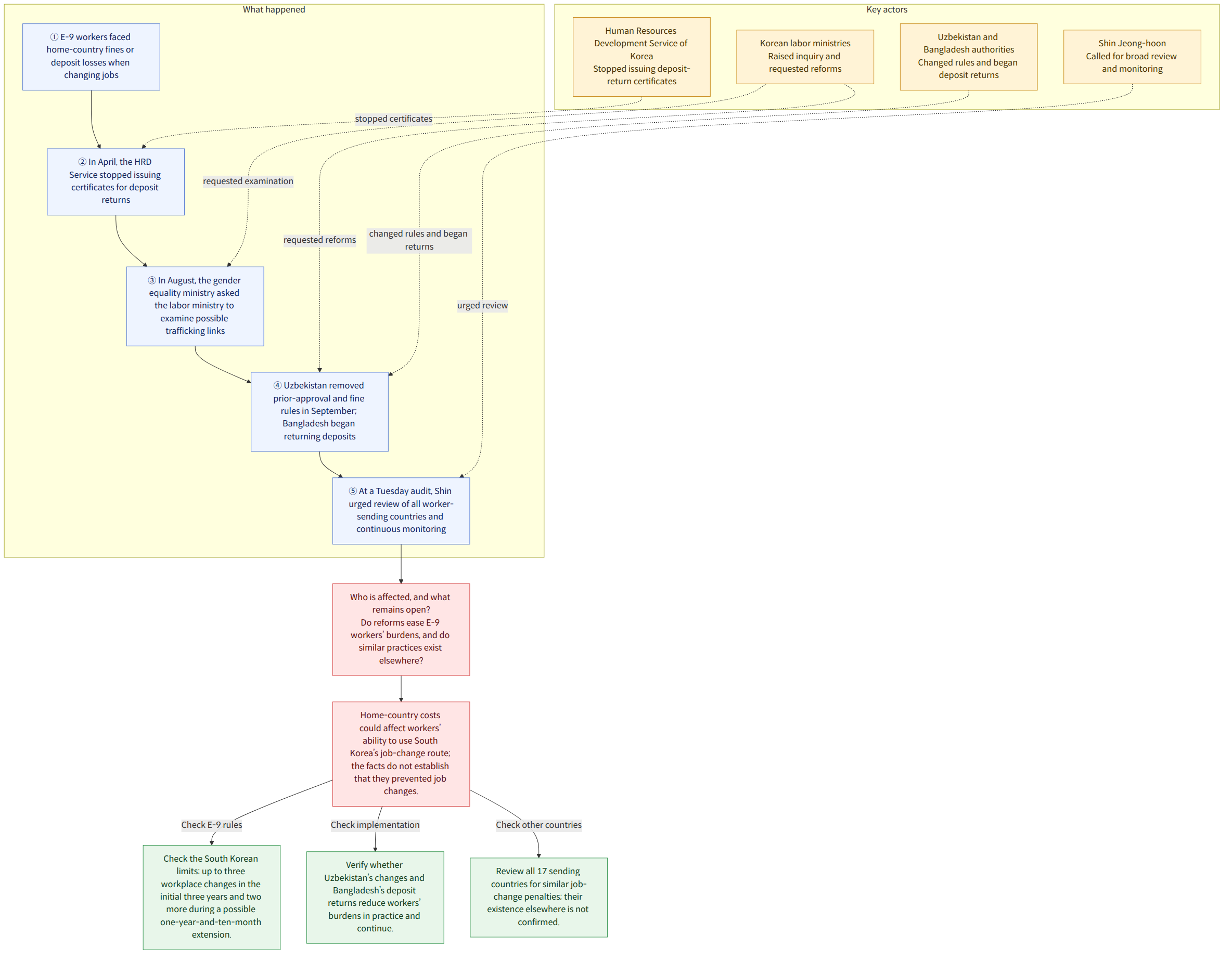
At Tuesday’s audit of the Ministry of Employment and Labor (고용노동부) by the National Assembly Environment and Labor Committee (국회 환경노동위원회), Shin Jeong-hoon of the Democratic Party of Korea (더불어민주당) urged a comprehensive review of all countries that send workers to South Korea and the establishment of a system for continuous monitoring. Uzbekistan has removed provisions requiring prior approval for a change of workplace and imposing fines, and Bangladesh has begun returning deposits. Shin said, however, that it was necessary to check whether these changes are being implemented in practice and will be sustained.
Background and context
At the center of the controversy are financial penalties workers with E-9 visas in South Korea faced in their home countries when changing jobs. According to Shin, Uzbekistan imposed a fine of $2,000 per month on workers who changed jobs without approval from their home country, and also imposed fines for overstaying visas or leaving without authorization. Bangladesh required workers to pay a deposit before coming to South Korea and, in some circumstances, including a change of workplace, did not return part or all of it.
In August, the Ministry of Gender Equality and Family (여성가족부) asked the Ministry of Employment and Labor to cooperate in examining whether these practices involving fines and deposits could constitute human trafficking. Shin also expressed concern that financial penalties that could restrict job changes might be a means of human trafficking. The information presented does not establish that these practices constitute human trafficking; rather, it raises the question of whether they are connected and should be investigated.
Under South Korea’s Employment Permit System (고용허가제), E-9 workers may change workplaces up to three times during their initial three-year period of employment, and up to two more times during a possible extension of one year and 10 months. The Employment Permit System recruits nonprofessional foreign workers from 17 countries, including Uzbekistan and Bangladesh, to address labor shortages in permitted sectors such as manufacturing, agriculture, and construction.
At the request of the Ministry of Employment and Labor, Uzbekistan removed in September the provisions requiring workers to obtain approval before changing workplaces and imposing fines for violations. Bangladesh began returning deposits. However, it has yet to be confirmed how much these measures have actually reduced workers’ burdens or whether they will continue.
What this news means
There is concern that even when South Korea’s system provides a process for changing workplaces, separate approval requirements or financial burdens imposed by workers’ home countries could affect their ability to use the opportunities available to them under the system. The confirmed facts alone, however, do not establish that fines or deposits actually prevented workers from changing jobs. The key is to consider South Korea’s workplace-change procedures alongside practices in workers’ home countries, and examine the combined burden the two systems place on workers’ choices.
For example, if an E-9 worker is considering applying to change workplaces, they may need to check both the reasons and application deadlines set in South Korea and whether their home country requires approval or charges fees. This is a hypothetical example and does not mean that all workers face the same restrictions.
The audit also highlighted that the review cannot be limited to the two countries. Since the Employment Permit System recruits workers from 17 countries, Shin called for an examination of whether other labor-sending countries impose financial penalties linked to changing jobs. Whether similar practices actually exist has not yet been confirmed.
The role of the Human Resources Development Service of Korea (한국산업인력공단) is also at issue. The agency issued employment history certificates requested by the Bangladeshi government when it returned deposits to its citizens, and told Shin that it had not been aware of a potential link between these practices and human trafficking. The agency said it stopped issuing certificates for deposit returns in April. Citing more than 100 billion won in revenue over five years from the agency’s foreign worker employment management program, Shin called for stronger government oversight to protect foreign workers’ rights.
Related systems and support information
According to the company’s visa guide, E-9 is a status of stay that allows a person to work on the condition that they are employed by an employer with an employment permit. Changing workplaces is not a procedure workers can use freely at any time; they must apply for a specified reason, such as the suspension or closure of a workplace. Apart from the limits on the number of changes described in this article, workers must also check the reasons and application procedures.
The guide says that after an employment contract ends, workers must apply to an employment center to change workplaces within one month, and obtain permission to change workplaces from the relevant immigration office or other authority within three months of the application date. The stated fee is 120,000 won. Applications require an application form, passport and foreign resident registration card, documents proving the place of residence, copies of the employment permit and standard employment contract, and documents related to the new workplace, among other items.
Workers must check the permitted reasons for changing workplaces and the application and approval deadlines. If their home country separately requires approval or payment, it is important to distinguish those requirements from South Korea’s procedures and keep a record of what was required and by which institution.
A period of stay may be granted for up to three years at a time, and the maximum permitted employment period under the Employment Permit System is four years and 10 months. According to the guide, applying for an additional extension of up to one year and 10 months through reemployment requires a confirmation document issued by the Ministry of Employment and Labor. This is general procedural information from the visa guide; whether it applies in an individual case depends on the circumstances and documents involved.
What is confirmed and what remains unknown
Confirmed facts
- Shin Jeong-hoon called for a comprehensive review of all labor-sending countries and the establishment of a system for continuous monitoring.
- In September, Uzbekistan removed provisions requiring prior approval for a change of workplace and imposing fines for violations.
- Bangladesh began returning deposits, and Shin said it was necessary to check whether the returns are being carried out and will continue.
- The Human Resources Development Service of Korea said it stopped issuing employment history certificates used for deposit returns in April.
What remains unknown
- How many workers were affected by the practices involving fines or deposits.
- Whether Uzbekistan’s removal of the provisions and Bangladesh’s deposit returns will be implemented in practice and continue.
- Whether other labor-sending countries impose similar financial penalties that restrict workers from changing jobs.
What readers should check
- E-9 workers considering a change of workplace should check the specified reasons for changing workplaces, the deadline to apply to an employment center, the deadline for approval from immigration authorities, and the required documents.
- If they receive information about requirements from their home country for approval, fines, deposits, or deposit returns, they should keep separate records of what was required and any payments or returns. This information alone does not establish a right to a refund or determine whether the practice constitutes human trafficking.
- In follow-up reviews by the government and relevant agencies, check whether Uzbekistan’s removal of the provisions and Bangladesh’s return measures continue in practice, and whether similar practices in other labor-sending countries are also investigated.
If you are dealing with a similar issue, attorney Ji-sun Ahn of Ijun Law Firm can review the E-9 employment contract, any request for a workplace change, and records of any fees demanded or paid with you. These details can help clarify which options apply to your situation.

















