TWICE’s Dahyun became the target of appearance-based insults in comments related to a video posted in September on the group’s official social media account. The video was deleted after recently drawing renewed attention, and the comments asked whether Dahyun’s appearance had changed or questioned her looks and suitability as an entertainer. According to reports, a sneering comment asking, “Is this person really a celebrity?” received nearly 5,000 likes.
In the video, Dahyun performed simple moves to IU’s song “Unknown Planet.” She wore a pink zip-up cardigan and had long, straight hair with bangs. Some users claimed that her face looked different, while fans countered that someone’s appearance on screen can vary depending on their hairstyle, makeup and camera angle.
Background and Context
The fact that the controversy took place on TWICE’s official account added weight to fans’ calls for a response. Fans said that differences in someone’s appearance were no reason to insult them personally, and urged JYP Entertainment to do more to protect its artists from personal attacks.
In May, JYP Entertainment announced that it would pursue criminal complaints and civil lawsuits against those who create and distribute malicious content targeting its artists. The company said it was monitoring online communities and social media platforms in South Korea and abroad, and collecting evidence of defamatory and insulting content. However, it has not publicly announced any separate legal action regarding these comments targeting Dahyun.
Dahyun continues to pursue acting alongside her music career. She is set to appear with Cha Woo-min in the upcoming film “Cloud Roll,” and previously starred with Jinyoung in the Korean remake of the Taiwanese romance film “You Are the Apple of My Eye.” She also appeared in the sports drama “Run to You.” TWICE, which debuted in October 2015, celebrated its 11th anniversary last month with the fan event “Once Upon a Thri11.”
What This News Means
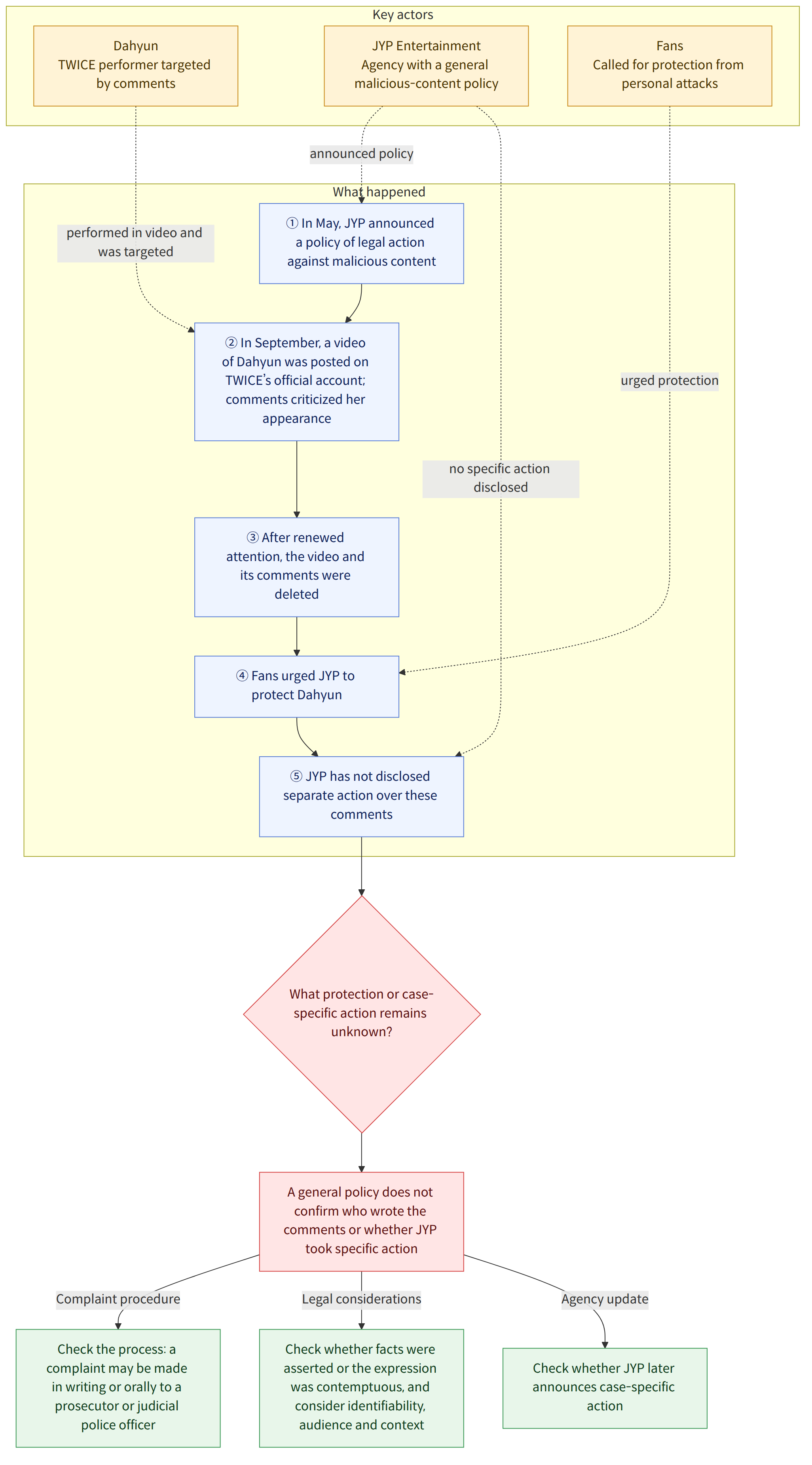
The controversy shows that having a policy for responding to malicious content is separate from publicly disclosing whether action has been taken over an individual post. Even though the company has said it monitors online content and collects evidence, that policy alone does not confirm who wrote these comments or whether any specific response has been made. Fans’ calls for action may draw attention to what protections the company provides when attacks occur on its official accounts.
The fact that someone used appearance-shaming language online does not automatically determine legal liability. In a defamation case, an issue may be whether specific facts that could damage a person’s social reputation were disclosed in a way that made them accessible to multiple people. In an insult case, the question may be whether the expression was contemptuous without stating specific facts. The context of the expression, whether the target can be identified, and whether other people could see it must also be considered.
For example, if someone receives similar comments, the issues to consider may vary depending on whether the comment was simply an opinion about their appearance or asserted specific facts, who the post referred to, and how widely it was made public. This is an example illustrating possible considerations; it does not mean that the legal nature of these comments has been established.
Relevant Procedures and Support Information
A criminal complaint is a procedure in which a victim or another person informs an investigative authority of an alleged crime and requests punishment. A complaint may be filed with a prosecutor or a judicial police officer in writing or orally; if it is made orally, a written record must be prepared. A person who is not entitled to file a complaint may also report an alleged crime to the authorities.
Whether an online expression amounts to defamation or insult cannot readily be determined by looking at the wording alone. In a defamation case, issues may include whether specific facts were stated, whether the victim was identifiable, and whether the information was accessible to multiple people. In an insult case, the question is whether the expression was contemptuous and could lower someone’s social standing, without stating specific facts. An actual determination must consider the content and context of the expression, its audience, and the possibility that it could be further circulated.
The fact that JYP Entertainment has announced a policy of taking legal action over malicious content does not mean that a complaint or lawsuit concerning the comments about Dahyun is underway. No specific action regarding these comments has been disclosed.
The effect of withdrawing a complaint can vary depending on the type of case and when the withdrawal occurs. Signing a settlement agreement does not, by itself, count as communicating an intention to withdraw a complaint to an investigative authority or court. In an actual case, the laws in effect at the relevant time and the specific facts must be checked.
Confirmed Facts and What Remains Unknown
Confirmed facts
- The September video featuring Dahyun was posted on the group’s official account and later deleted.
- The comments included questions about changes in her appearance and remarks insulting her looks or questioning her suitability as an entertainer.
- Fans countered that differences in someone’s appearance were no reason for personal attacks and called on the agency to protect her.
- In May, JYP Entertainment announced a policy of filing criminal complaints and civil lawsuits over malicious content, as well as online monitoring and evidence collection.
- No specific legal action regarding the comments about Dahyun has been publicly announced.
What remains unknown
What Readers Should Check
- If you have experienced a similar online attack, you can consider the facts relevant to a legal assessment, including the exact wording of the comment, the context of the post, how the target is identified, and the scope of its audience.
- If you are considering filing a criminal complaint, it is worth noting that one can be filed in writing or orally, and that the effect of withdrawing a complaint may vary depending on the type of offense and the stage of the proceedings.
- Signing a settlement agreement alone does not withdraw a complaint, so it is important to check the procedures that apply to the case before deciding to settle or withdraw a complaint.
If you have been harmed by an actual comment or post, you can review the materials you have, including the wording, the context in which it was posted, and how the target is identified, with attorney Ji-sun Ahn of Ijun Law Firm, and discuss the issues related to defamation and insult and what to check in the complaint process.