



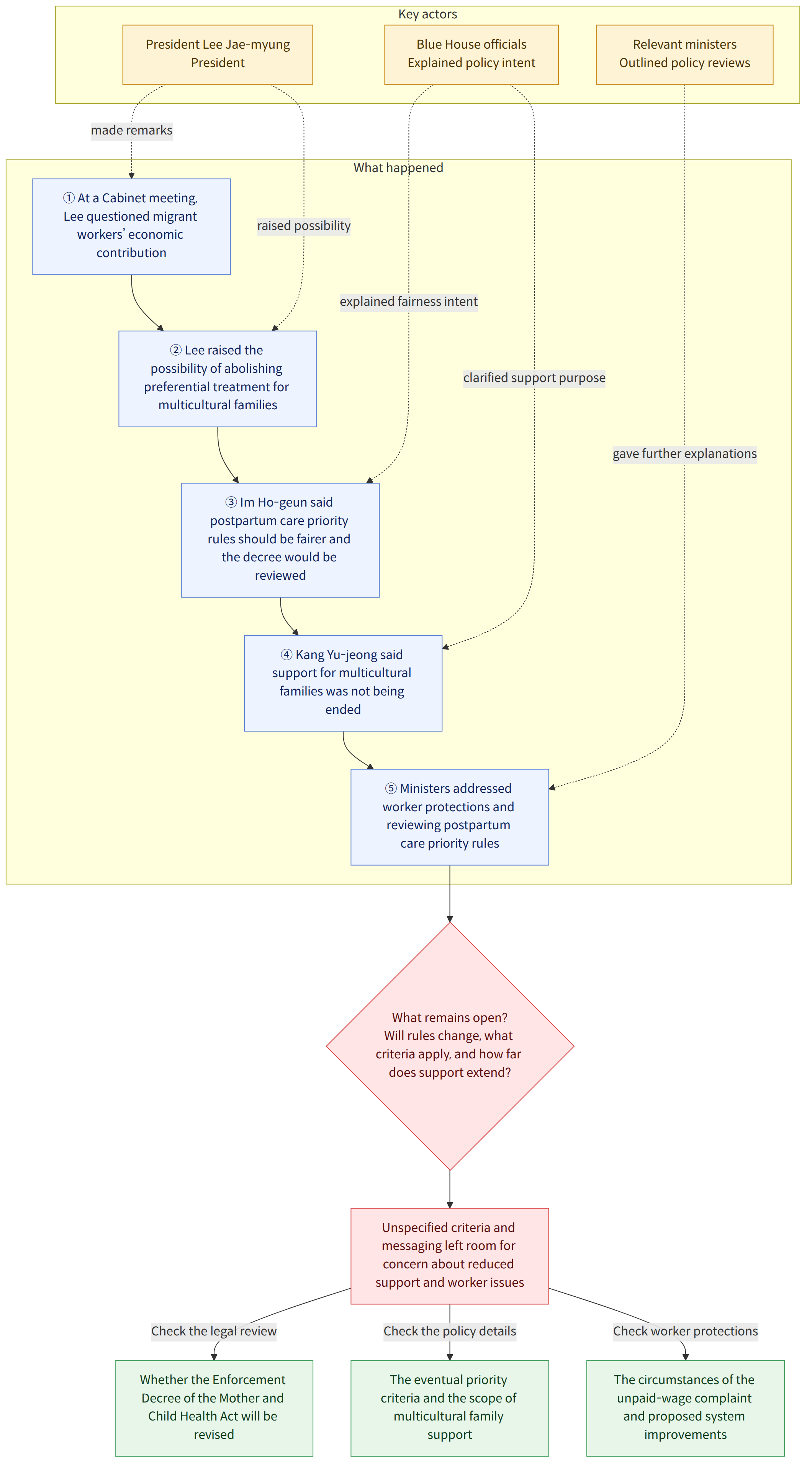
After President Lee Jae-myung raised the possibility of abolishing the preferential treatment system for multicultural families and discussed the contribution to South Korea’s economy of wages earned by migrant workers in rural areas, the Blue House (청와대) and ministers from relevant government agencies offered a series of explanations. The Blue House said the intent was not to eliminate support for multicultural families, but to make the criteria for priority use of postpartum care centers fairer and more reasonable. It also said the key point of the remarks on migrant workers was not foreign workers, but inadequate support in agriculture and fisheries and the creation of jobs with guaranteed wages.
The government has said it will consider revising the regulations on priority access to postpartum care centers, but has not yet announced whether the regulations will actually be revised or what the specific criteria would be.
Background and context
According to news reports, at a Cabinet meeting on the 27th, the president said that migrant workers in rural areas send all their wages back to their home countries and therefore do not contribute much to the South Korean economy. The following day, the 28th, he mentioned on X the possibility of considering the abolition of the preferential treatment system for multicultural families. The two remarks sparked debates about migrant workers’ economic contributions and the justification for supporting multicultural families, respectively.
On the morning of the 29th, Im Ho-geun, the Blue House senior secretary for population policy, said the president’s post about postpartum care centers was intended to make the priority rules for using them fairer and more reasonable. He also said the government would consider revising the Enforcement Decree of the Mother and Child Health Act (모자보건법 시행령) so that benefits go to mothers with greater needs. Later, Kang Yu-jeong, the Blue House senior spokesperson, said the aim was not to end support for multicultural families. She added that the focus of the president’s remarks at the Cabinet meeting was on inadequate support in agriculture and fisheries and on creating jobs with guaranteed wages.
Later, Kim Gyeong-ja, senior secretary for social affairs, and Ryu Deok-hyeon, senior adviser for fiscal planning, also posted on X, saying that respect for labor should not depend on nationality, and that the government intended to respect the contributions of foreign workers while expanding opportunities for Korean citizens to work in agriculture. Kim Young-hoon, Minister of Employment and Labor (고용노동부 장관), said the president had ordered improvements to the system after receiving a report that migrant workers who went to report unpaid wages were themselves reported to their employers because they were undocumented. Jeong Eun-kyung, Minister of Health and Welfare (보건복지부 장관), also said the government would review the regulations to make priority rankings for public postpartum care centers fairer and more reasonable.
What this news means
The controversy shows that not only the purpose of support policies matters, but also how their criteria are explained and translated into actual systems. However, when specific criteria have not been made public, language such as “abolishing preferential treatment” can prompt concerns about whether support for multicultural families itself is being reduced. This suggests there could be a gap between the policy’s intent and the message received by those it affects.
On the issue of migrant workers, government officials emphasized inadequate support and wage levels in agriculture and fisheries, but the president’s remarks triggered debate about foreign workers’ economic contributions. Since a case involving an unpaid-wage complaint and undocumented status was mentioned, workers’ wage issues and the difficulties they face when filing complaints should be examined separately from the government’s explanation of its policy. However, the reports did not include details about the circumstances of that case or the proposed system improvements.
The policymaking process and the presidential office’s management of its messaging have also become points of contention. A Blue House official quoted in the article said that whenever a new post by the president appears on X, their first reaction is to worry about what it will say. A senior lawmaker from the Democratic Party of Korea (더불어민주당) criticized the aides for appearing to step in only after the president’s remarks had caused controversy. These are the assessments of the individuals quoted; the full process of actual policy coordination has not been confirmed. Still, the issue is noteworthy because when explanations come mainly after the fact, the controversy itself can take precedence over the policy’s goals and detailed criteria.
For example, if a mother is waiting to use a public postpartum care center, whether her chances of receiving support change may depend on whether the priority ranking is revised and what needs are used to determine the order. This is a hypothetical example; the reports available so far do not establish what criteria would apply or when any changes might take effect.
Relevant systems and support information
For migrant workers dealing with unpaid wages, it is important to check employment contracts alongside wage records when seeking unpaid wages or severance pay. An internal legal guide advises against delaying a claim, noting that a three-year period is given in an example involving wage claims. However, how any specific time limit applies may depend on the nature of the claim and the circumstances, so an individual’s situation cannot be determined from this guidance alone.
If you suspect you have not been paid properly or that your pay does not match your working hours, you can gather and compare your employment contract, payslips or deposit records, and documents showing your actual working hours. The guide also states that, as a general rule, severance pay becomes due when employment ends, and that the statutory minimum is an average wage equivalent to at least 30 days for each year of continuous service. An agreement that severance pay is included in the monthly salary does not, by itself, remove the obligation to pay it, but the specific circumstances must be considered in light of the employment relationship and how the payments were made.
Regarding the case of an undocumented migrant worker who filed a complaint mentioned in these reports, neither the articles nor the internal materials explain the complaint process or the specific effect of undocumented status on a wage claim. The case therefore should not be assumed to apply to all migrant workers, and no conclusions should be drawn about the rights or procedures that apply after a complaint is filed.
What differed between the reports
Both reports covered the president’s remarks, the Blue House’s explanations, and the review of regulations concerning postpartum care centers, but their emphasis differed. One report gave greater prominence to the migrant worker’s case involving an unpaid-wage complaint, the unease within the Blue House, and criticism of its messaging coordination. The other covered in greater detail Seoul Mayor Oh Se-hoon’s announcement that he would conduct a comprehensive review of the preferential treatment system for multicultural families, as well as reactions from the ruling and opposition parties and other political figures. This reflects differences in the reports’ focus; it does not mean that the central remarks and the Blue House’s explanations were reported differently.
What is confirmed and what remains unknown
Confirmed facts
- On the 28th, the president mentioned on X the possibility of considering the abolition of the preferential treatment system for multicultural families.
- The president was reported to have discussed migrant workers in rural areas sending their wages home and their economic contribution at a Cabinet meeting on the 27th.
- The Blue House said the aim was not to end support for multicultural families, but to make the criteria for priority use of postpartum care centers fairer and more reasonable.
- Government officials emphasized inadequate support in agriculture and fisheries and the creation of jobs with guaranteed wages, and said they would review the Enforcement Decree of the Mother and Child Health Act and the current regulations.
What remains unknown
- Whether the enforcement decree setting priority rules for postpartum care centers will actually be revised, and, if so, what the new criteria and timeline would be.
- The scope of the review of the possible abolition of the preferential treatment system for multicultural families and which groups it would specifically cover.
- The full text of the president’s related posts on X and remarks at the Cabinet meeting, and the specific circumstances of the case involving the unpaid-wage complaint.
What readers should check
- Families considering using a public postpartum care center should check the current priority rules in their area and watch for announcements of any future changes. The reports available so far do not establish that new criteria have been finalized.
- People who receive support for multicultural families should check whether the assistance they receive will continue and look for specific guidance on which programs, if any, are under review.
- Workers with unpaid-wage or severance-pay issues should check their employment contracts, wage records, and work-hour records, and avoid delaying a claim. In particular, reports alone are not enough to determine the procedures in cases involving undocumented status; workers should seek guidance suited to their individual circumstances.
If you are dealing with a similar issue, attorney Ji-sun Ahn of Ijun Law Firm can review the local program’s eligibility notice, the documents you submitted, and any written explanation of the decision with you. These details can help clarify which options apply to your situation.
References
- Guide to Claims for Wages and Severance Pay and Their Calculation
- Other coverage consulted: chosun.com
















