
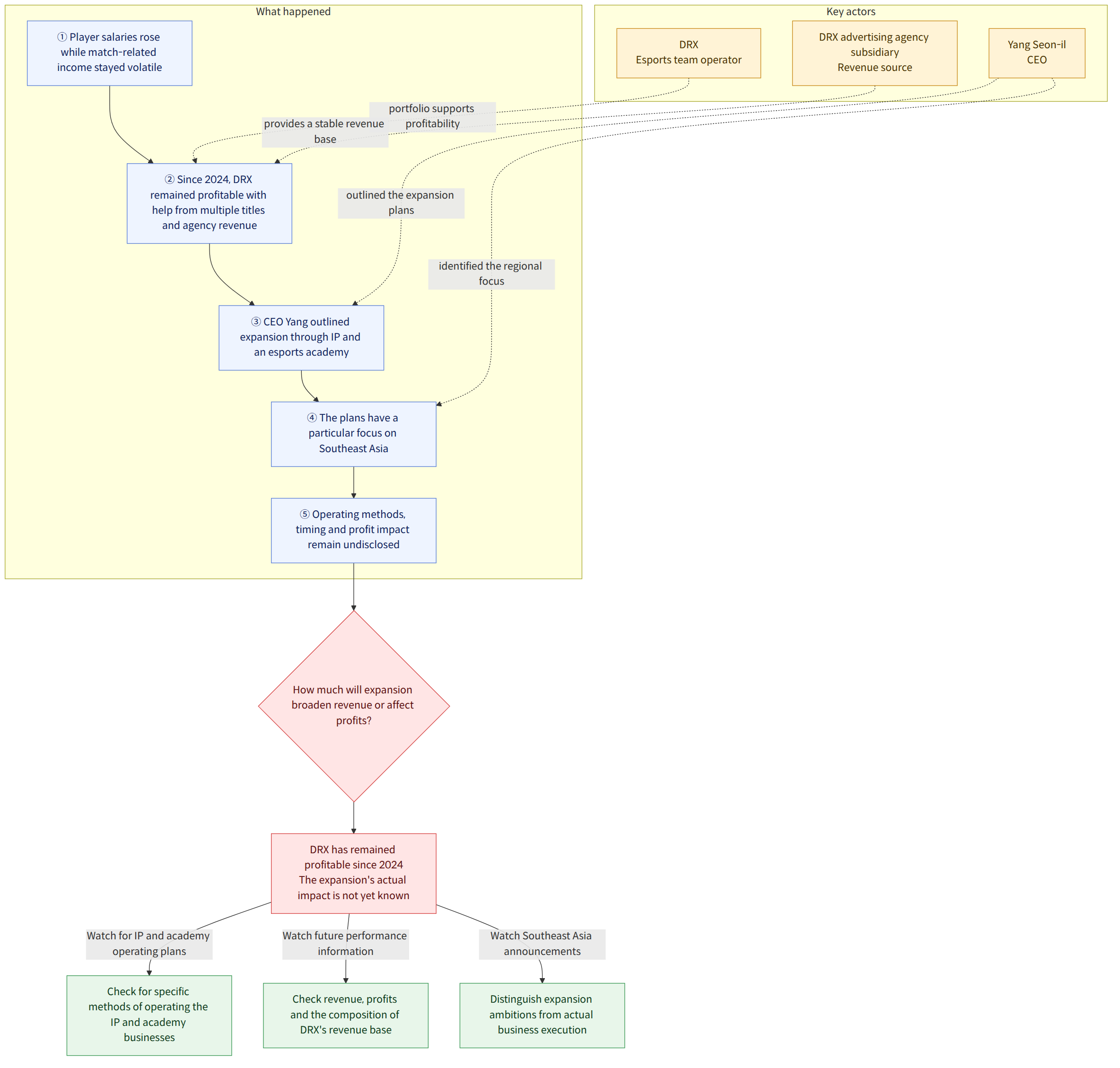
DRX is seeking to expand beyond esports into digital entertainment. DRX CEO Yang Seon-il said the company plans to expand through intellectual property (IP—the content and rights owned by a company or creator) and an esports academy, with a particular focus on Southeast Asia. DRX has remained profitable since 2024.
Background and context
A bright growth outlook for the esports market does not guarantee that team operators will be profitable. The Business Research Company (비즈니스 리서치 컴퍼니) forecasts that the global esports market will grow from $3.02 billion in 2025 to $7.71 billion in 2030, with an annual growth rate of about 20%.
However, according to the article, player salaries continue to rise, while match-related income—such as prize money and revenue sharing from leagues—is volatile. In other words, market growth and an individual team operator’s ability to make a profit are separate issues. The article reports that few esports team operators have been profitable.
In this environment, DRX has remained profitable with the help of a diversified portfolio spanning multiple esports titles and a stable revenue base built by its advertising agency subsidiary. However, the available information does not show how much each factor contributed to profits or which business accounted for the largest share.
What this news means
DRX’s strategy can be seen as an effort to broaden its revenue base so that the success of its business is not determined solely by match results and prize money. However, there is no basis for concluding that the company’s plans to expand through IP and an academy are specifically intended to reduce its reliance on match-related income. What is established is that portfolio diversification and the revenue base of its advertising agency subsidiary have helped DRX remain profitable, and that it plans to expand beyond esports.
IP and an academy are business areas distinct from competing in tournaments and match results. For example, if DRX expands its academy business, it could create business opportunities separate from tournament performance or prize money. But the available information does not disclose specific operating methods or monetization plans, so it is difficult to assess how much the business will actually broaden its revenue base.
CEO Yang said Korean culture has become much more sophisticated and valuable than it was 10 years ago.
What is confirmed and what remains unknown
Confirmed facts
- The Business Research Company forecasts that the global esports market will grow from $3.02 billion in 2025 to $7.71 billion in 2030.
- According to the article, player salaries are rising, while match-related income such as prize money and league revenue sharing is volatile; few team operators have been profitable.
- DRX has remained profitable since 2024, helped by its portfolio spanning multiple titles and the revenue base of its advertising agency subsidiary.
- CEO Yang Seon-il outlined plans to expand through IP and an esports academy, with a particular focus on Southeast Asia.
What remains unknown
- The available information does not say how DRX will expand its IP business and esports academy.
- Figures for DRX’s revenue and profits since 2024 have not been provided.
- It is not known what businesses DRX plans to pursue in Southeast Asia or when, or how the expansion plans will affect profits.
What readers should watch for
- Readers should watch for future DRX announcements setting out specific operating methods or plans for its IP and academy businesses.
- If future performance information is released, assessing the impact of the expansion will require looking not only at whether DRX remains profitable, but also at the scale of its revenue and profits and the composition of its revenue base.
- If announcements about Southeast Asia are made, it will be important to distinguish the company’s expansion ambitions from actual business execution.