



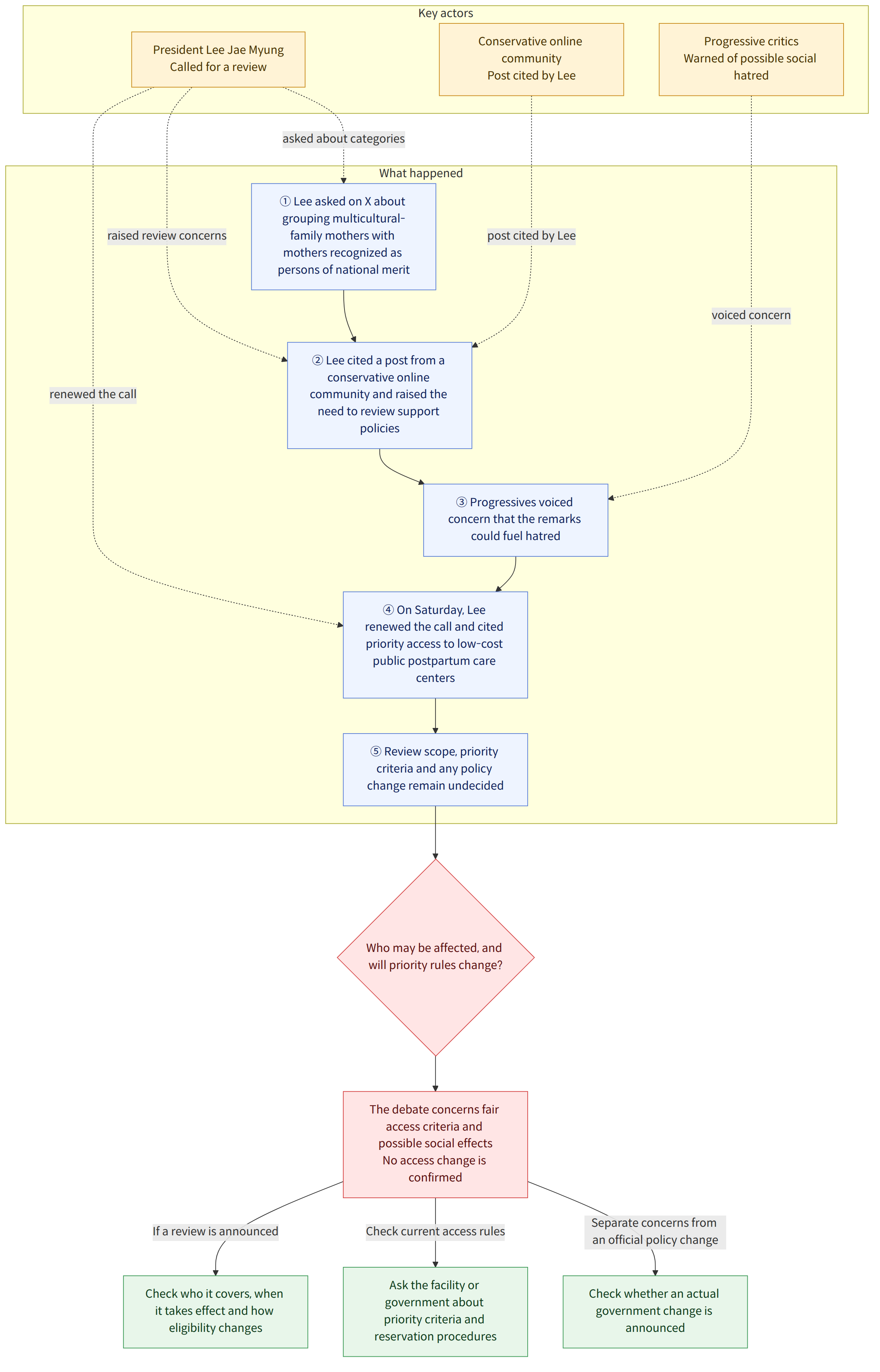
President Lee Jae Myung on Saturday renewed his call to review multicultural family support programs (다문화가족 지원 프로그램). Citing priority access to low-cost public postpartum care centers (저비용 공공 산후조리원) as an example, he said preferential policies that could lead to reverse discrimination cannot be justified. He did not say that support for multicultural families itself is unnecessary.
Background and context
The debate flared after Lee earlier asked on X whether it was appropriate to place mothers from multicultural families in the same category as mothers recognized as persons of national merit (국가유공자) when making reservations at government-supported postpartum care centers. After citing a post from a conservative online community site, he raised the need to review support policies.
The remarks also prompted a backlash from progressives, who expressed concern that the move could fuel hatred in society. The current debate is therefore about not only the need for support itself, but also whether the criteria for giving certain groups priority access are fair and what social effects discussions about changing those criteria might have.
Lee wrote on X, in substance:
“It is true that support for multicultural families is necessary, but that does not mean specific policies that are unreasonable or could lead to reverse discrimination can be justified.”
The statement distinguishes the need for support from the legitimacy of individual policies. However, the reported information does not establish specific criteria for determining which support measures are unreasonable or could lead to reverse discrimination.
What this news means
If a policy review takes place, discussion could follow about who qualifies for priority access and what the criteria should be. Taking priority access to public postpartum care centers as an example, who receives priority and why is connected to how access is allocated. However, what has been confirmed so far is the president’s call for a review and the concerns he raised; this does not mean that the priority reservation criteria have changed or that a change has been decided.
The people who could be affected are not limited to one group. Access to support could be an issue for mothers from multicultural families, while fairness in allocation criteria could be an issue for other priority groups, such as mothers recognized as persons of national merit. This is an analysis based on the possibility that the system could actually change; there is no confirmed information that access has changed for any group.
For example, a mother considering using a low-cost public postpartum care center cannot conclude from these remarks alone that her eligibility for priority access or her ability to make a reservation has changed. She should check whether actual criteria or procedures are announced.
What is confirmed and what remains unknown
Confirmed facts
- On Saturday, President Lee renewed his call to review multicultural family support programs.
- He said preferential policies that could result in reverse discrimination cannot be justified.
- He cited priority access to low-cost public postpartum care centers as an example and asked on X whether mothers from multicultural families and mothers recognized as persons of national merit should be placed in the same reservation category.
- The concerns and criticism prompted by his remarks included worries from progressives that they could fuel hatred in society.
What remains unknown
- Which support programs the government would actually review, and what the review would cover.
- The criteria and procedures under which priority reservations at postpartum care centers are operated.
- Whether the timing of a review and specific follow-up measures have been decided.
What readers should check
- Distinguish between the president raising concerns and the government making an official policy change. The information currently available does not say that an actual change has been decided.
- If you are considering using a postpartum care center, check whether the facility or government separately announces priority-access criteria and reservation procedures. This report does not provide specific criteria.
- If a review is announced in the future, check who it applies to, when it will take effect and how it will change the existing eligibility criteria.
If you are dealing with a similar issue, attorney Ji-sun Ahn of Ijun Law Firm can review the local program’s eligibility notice, the documents you submitted, and any written explanation of the decision with you. These details can help clarify which options apply to your situation.
References
- Other coverage consulted: en.yna.co.kr
- Other coverage consulted: m.koreaherald.com
















