
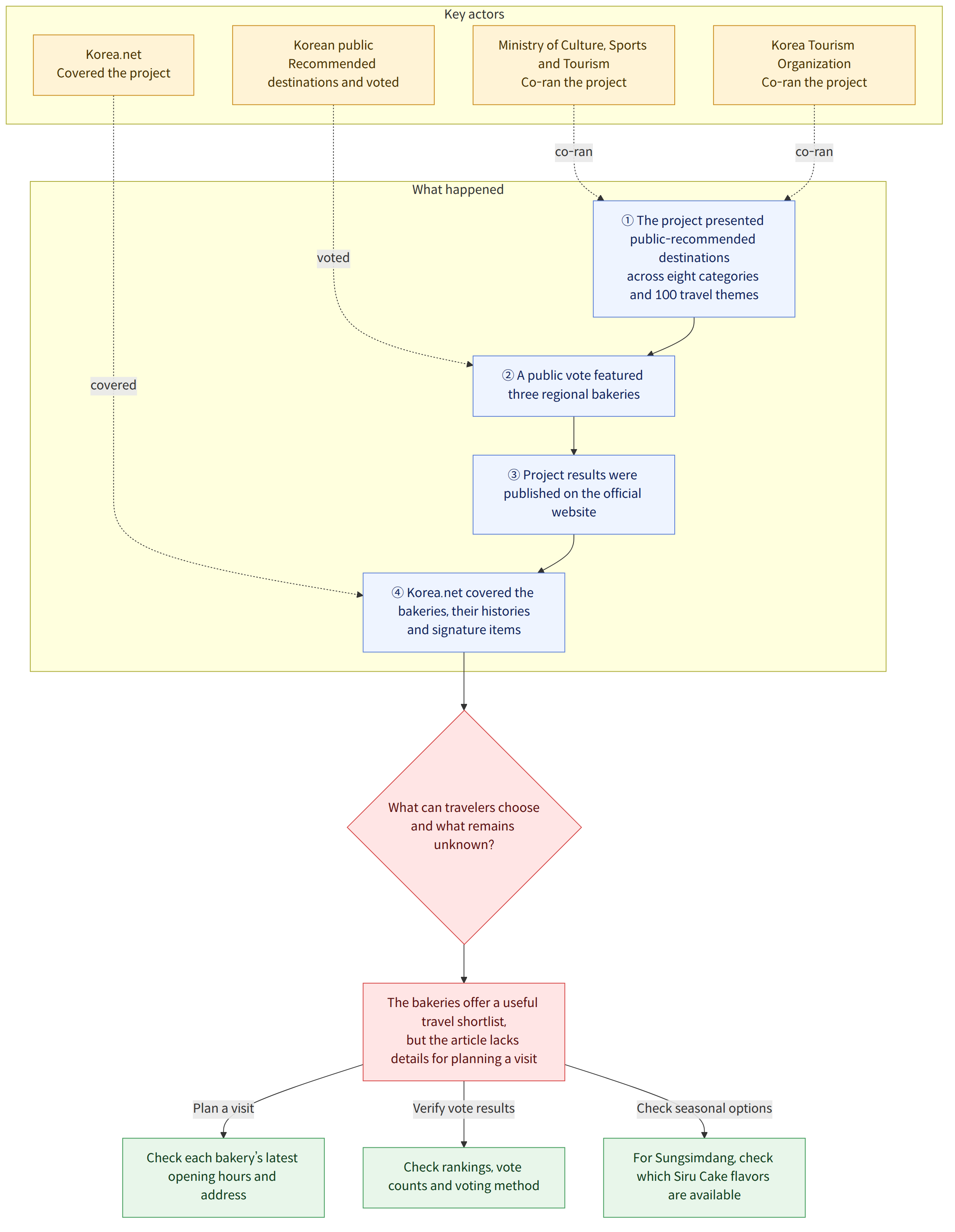
The results of the “100x100 Project” (100x100 프로젝트), jointly run by the Ministry of Culture, Sports and Tourism (문화체육관광부) and the Korea Tourism Organization (한국관광공사), were published on the project’s official website. Korea.net covered the project, which presents tourist destinations recommended by the Korean public to foreign visitors across eight categories and 100 travel themes, and featured three popular bakeries selected through a public vote. The bakeries named in the article are Sungsimdang in Daejeon, Iseongdang in Gunsan and PNB Pungnyeon Bakery in Jeonju.
The three are all bakeries that represent their regions, but the featured items and each shop’s history differ. For travelers visiting a city for its bread, they can serve as a starting point for comparing each region’s signature offerings.
Background and context
The “100x100 Project” introduces, by theme, tourist destinations recommended by the Korean public to foreign visitors. This article covered three bakeries, presenting them in the order in which they were featured based on the public vote. However, the article does not give the specific ranking or vote count for each shop, so their voting results cannot be determined from the order in which they appear alone.
Sungsimdang began in 1956 as a steamed-bun shop in a tent in front of Daejeon Station. The article says the bakery marks its 70th anniversary this year. Its signature item, fried soboro bread, is deep-fried on the outside, filled with sweet red bean paste and topped with soboro made from flour, butter and sugar. Another signature item, Siru Cake, gets its name from its chewy texture, which evokes sirutteok, a Korean steamed rice cake, and comes in new flavors each season.
Iseongdang in Gunsan was founded in 1945 and is described in the article as the oldest bakery in South Korea still in operation. Its signature items are red bean buns and vegetable buns. According to the article, the main store sells about 7,000 red bean buns and 6,000 vegetable buns on an average weekday, and more than 11,000 and 10,000, respectively, on weekends.
PNB Pungnyeon Bakery in Jeonju opened in 1920 as the first business in Korea to sell jeonbyeong, a traditional wafer-like confection, and is now run by the founder’s family’s third generation. According to the article, it was the first to introduce peanut jeonbyeong in 1940, a soft-serve ice cream machine in 1958 and air conditioning in 1959. In 2013, it became the first regional bakery to open a branch inside a department store. Its popular item is a thick, handmade chocolate jeonbyeong, which is baked for eight hours.
What this news means
The three bakeries show that “what to eat” can be a way to choose a travel destination. Sungsimdang offers fried soboro bread and seasonal Siru Cake, Iseongdang has red bean and vegetable buns, and PNB Pungnyeon Bakery features handmade chocolate jeonbyeong. Looking at signature items alongside each shop’s history can help travelers connect a city they want to visit with the food they want to try.
For example, travelers planning a bread-focused visit to Daejeon could consider fried soboro bread and Siru Cake, and check which seasonal flavors are available. The article does not provide the shops’ opening hours or addresses, however, so it is not enough to plan an actual visit time or route.
The published feature is a useful reference for choosing bakeries and signature items, but it does not provide the detailed voting results or practical information needed for a visit.
Confirmed facts and what remains unknown
Confirmed facts
- The project was jointly run by the Ministry of Culture, Sports and Tourism and the Korea Tourism Organization, and its results were published on the official website.
- Korea.net said the project presents tourist destinations recommended by the Korean public to foreign visitors across eight categories and 100 travel themes.
- The article featured Sungsimdang in Daejeon, Iseongdang in Gunsan and PNB Pungnyeon Bakery in Jeonju, based on a public vote.
- The article included information about the three bakeries’ signature items and founding histories, as well as sales figures for red bean and vegetable buns at Iseongdang’s main store.
What remains unknown
- The published article does not reveal the bakeries’ voting rankings or the number of votes for each.
- It is also unclear what criteria and method were used for the vote.
- The article does not provide the bakeries’ opening hours or addresses.
What readers should check
- Before visiting, check each bakery’s latest opening hours and address separately. The article does not include this information.
- If you have a particular item in mind, it is a good idea to check whether it will be available when you visit and what seasonal offerings are on the menu. The article says Sungsimdang’s Siru Cake comes in new flavors each season.
- If you want to see the voting results themselves, check whether the rankings and vote counts are available on the project’s official website. The article does not include the detailed results.