



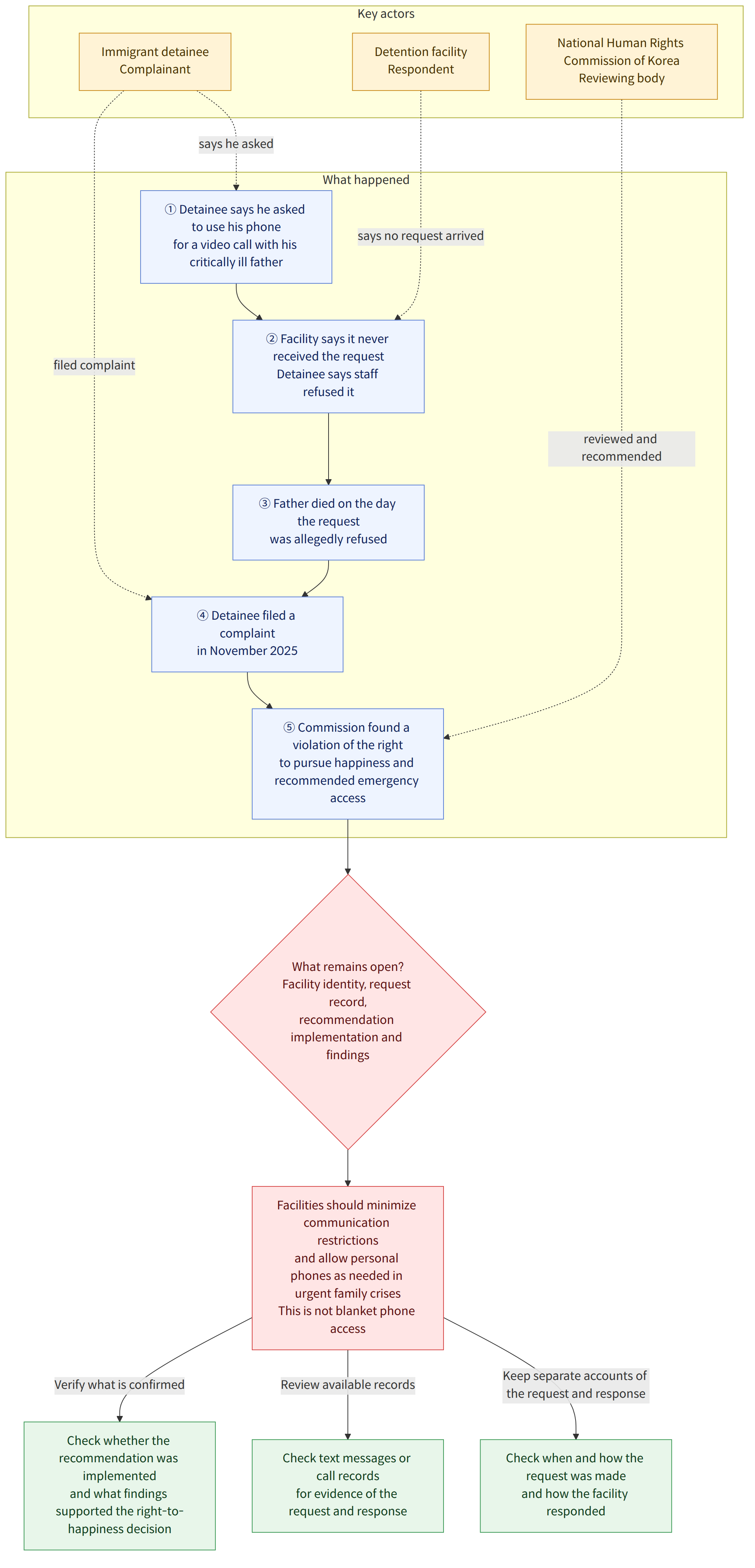
The National Human Rights Commission of Korea recommended last week that an immigrant detention facility minimize restrictions on detainees’ freedom to communicate, it said Monday. The Commission found that the facility violated a detainee’s right to pursue happiness by not allowing a video call with his dying father, and urged facilities to guarantee the use of personal mobile phones to the extent necessary when a family member is critically ill or nearing death.
The foreign national who filed the complaint said he asked a staff member to use his personal mobile phone to see his critically ill father one last time by video call, but was refused. His father died on the day the request was refused. The facility said it had never received the request and that, had one been made, it would have considered taking the necessary steps.
Background and context
The complainant filed the case with the National Human Rights Commission of Korea in November 2025. He said that being denied his request had deprived him of the most basic right to pursue happiness. The Commission found in this case that not allowing the video call amounted to a violation of the right to pursue happiness.
However, the complainant and the facility give different accounts of whether the request was actually conveyed to the facility. The complainant says he asked a staff member and was refused, while the facility says it never received the request. The reports provided do not identify the immigrant detention facility where this happened or specify the detailed findings on which the Commission based its decision.
What this news means
The recommendation highlights the importance of how restrictions on communication in detention facilities are applied even when a family is facing a serious crisis. The Commission cited a family member’s critical condition or impending death as examples of urgent and serious humanitarian circumstances, and said facilities should guarantee the use of personal mobile phones to the extent necessary. This is not a recommendation to allow mobile phone use in all circumstances, but to minimize restrictions in emergencies.
For example, when a detainee’s family member is nearing death, the recommendation underscores the need for a facility to consider necessary means of communication, such as a video call. However, it has not been confirmed whether the recommendation was implemented or whether the facility plans to change its operating procedures. The case is therefore noteworthy not only for the recommendation itself, but also because records verifying the parties’ requests and the facility’s response may be important.
What is known and what remains unclear
What is known
- The National Human Rights Commission of Korea recommended last week that an immigrant detention facility minimize restrictions on detainees’ freedom to communicate.
- The Commission found that not allowing a video call with a detainee’s dying father violated the detainee’s right to pursue happiness.
- The complainant filed the case in November 2025, and his father died on the day the complainant says his request for a video call was refused.
- The facility said it had never received the request and that, had it received one, it would have considered taking the necessary steps.
What remains unclear
- What is the name of the immigrant detention facility where the incident occurred?
- Has the facility implemented the Commission’s recommendation, or does it plan to do so?
- What specific findings did the Commission rely on in making its recommendation?
What readers can check
- If you have experienced a similar situation, keeping separate records of each party’s account—including when and how the request was made and how the other party responded—may help establish the facts.
- If relevant materials are available, such as text messages or call records, you can check what they show about the request and the response.
- When checking the facility’s response or whether it has implemented the recommendation, it is useful to distinguish between what has been confirmed and what remains unanswered.
If accounts differ in a similar situation about whether a request was conveyed and whether it was refused or answered, you can review relevant materials, such as text messages, call records, and the facility’s response, with attorney Ji-sun Ahn of Ijun Law Firm to establish the facts.
















