


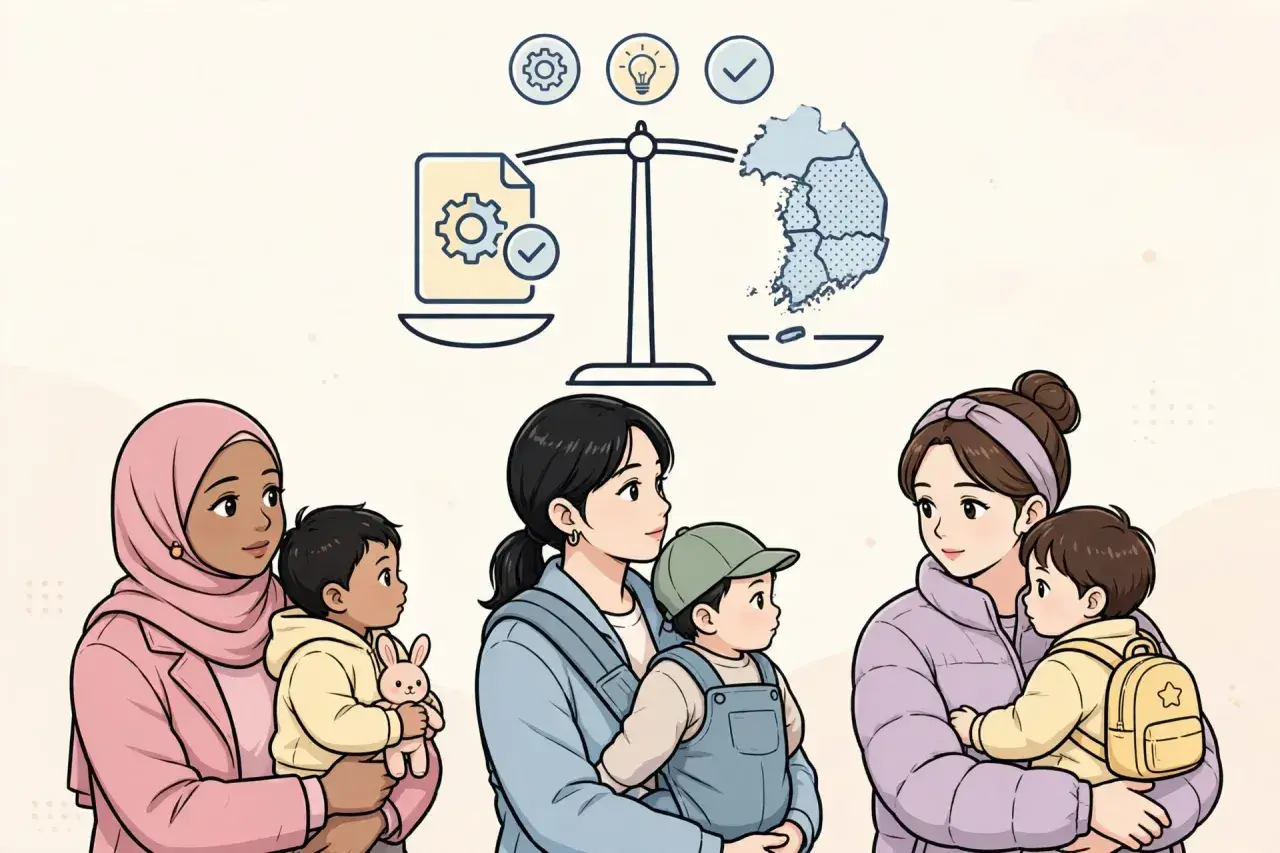
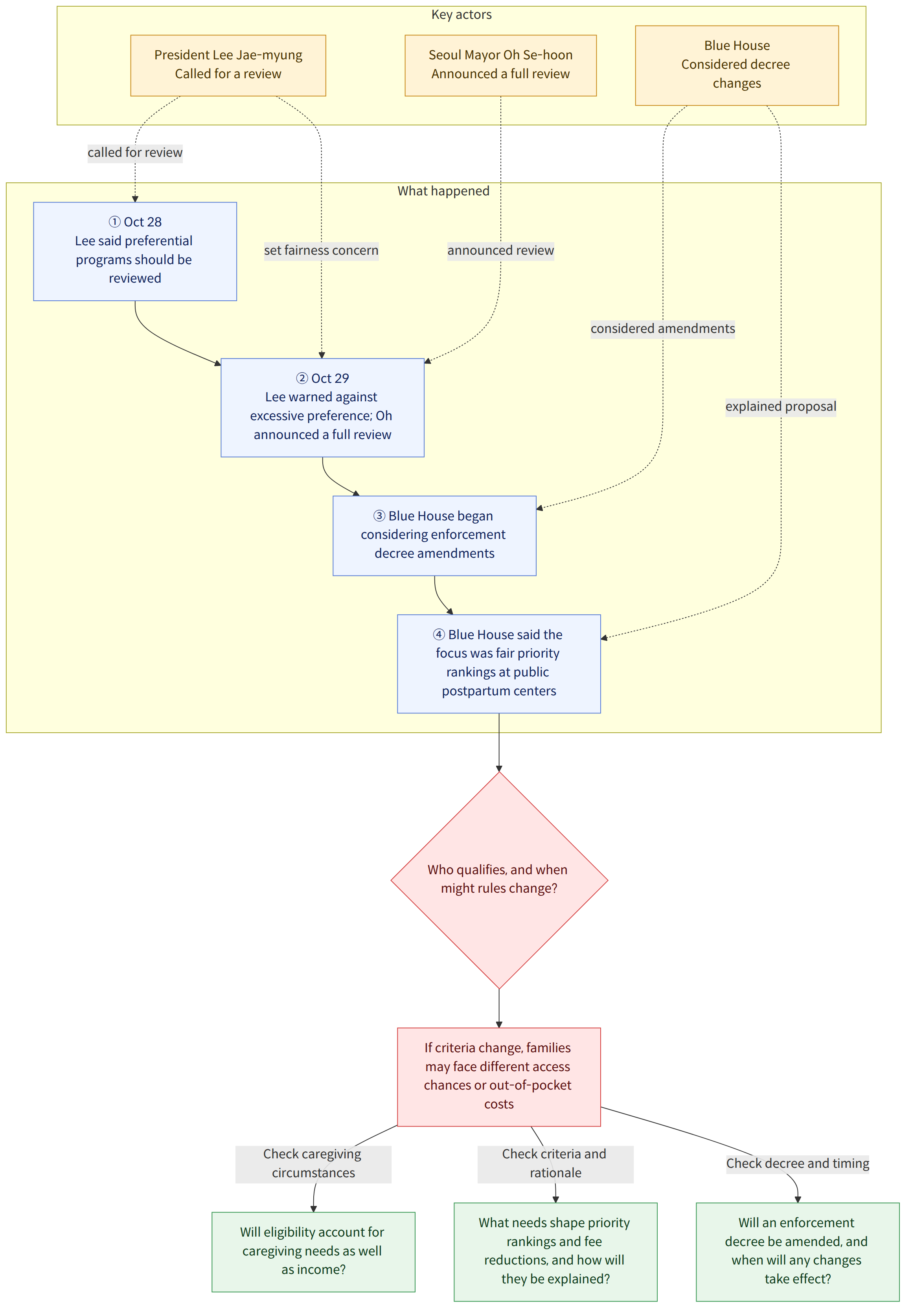
President Lee Jae-myung said he would consult local governments on whether support programs for multicultural families were necessary and should be abolished, and review possible changes, including amendments to an enforcement decree. Seoul Mayor Oh Se-hoon then said he would review the programs in full. The Blue House began considering amendments to the enforcement decree. However, the specific scope of the policy and the timing of any changes have not been made public, so it cannot be said at this stage that the programs’ abolition has been decided.
Background and context
On October 28, President Lee wrote on X that he would review whether preferential treatment programs for multicultural families were necessary and whether they should be abolished. On October 29, he also stressed that support should not go beyond its original purpose and become excessive preferential treatment or reverse discrimination against native-born families. Mayor Oh said on October 29 at a briefing on Seoul’s budget proposal for the coming year that he would review the programs in full. He said policy investment in and consideration for multicultural families were necessary, but that giving them additional consideration in support allocated through competition could make people feel relatively deprived.
The specific issue behind the debate is priority access to public postpartum care centers (공공산후조리원). Kang Yoo-jung, a senior spokesperson for the Blue House, explained that the proposal was not to eliminate support for multicultural families, but to raise the fairness and reasonableness of priority rankings for using postpartum care centers and create a support system that all families who have given birth could accept. The issue, then, is not only whether to maintain support, but also which circumstances should be reflected in the eligibility criteria and how to make those criteria understandable and acceptable.
Political reactions were divided. The Justice Party (정의당) criticized the president’s remarks, saying they could lend support to hostility toward multicultural families. A spokesperson for the Rebuilding Korea Party (조국혁신당) also warned that it was dangerous to divide people over human rights by framing support as a “privilege” or “preferential treatment.” Media cameras also captured a Telegram message that Park Hae-cheol, chair of the Democratic Party’s (민주당) multicultural affairs committee, sent to an aide, expressing concern about the president’s position.
The debate extends beyond support for multicultural families. Reports said President Lee also remarked at a Cabinet meeting on October 27 that foreign workers did not make a significant contribution to the national economy. As remarks about foreign workers and multicultural families continue, concerns have also been raised that discussion of the need for these policies cannot easily be separated from broader social attitudes toward people with immigrant backgrounds.
What this news means
If the eligibility criteria change, the people directly affected will be mothers and families seeking to use public postpartum care centers. Changes to priority rankings could affect their chances of accessing the facilities, while adjustments to fee reductions could change their out-of-pocket costs. Conversely, even if the criteria are revised to make them more reasonable, a lack of explanation about the needs taken into account could increase distrust in the system or anxiety among those affected. This makes both the criteria and the explanation of them important.
Marriage migrant women are concerned about more than just the amount of support. One woman interviewed for a report said she was worried that support might be reduced when she had few people around her who could help care for her child. The Ministry of Health and Welfare’s (보건복지부) 2024 Postpartum Care Survey report, based on in-depth interviews with 12 marriage migrant women, reportedly found that some women gave birth at home because of the cost of postpartum care centers and had difficulty getting help from family. This raises the question of whether eligibility criteria should take caregiving circumstances into account, as well as income.
For example, if a family applies to use a public postpartum care center, changes to the priority criteria or fee reductions could affect its chances of using the facility or the cost. This is a hypothetical example to illustrate possible effects; it does not describe the actual content or timing of any changes currently under consideration.
Related policies and support information
Support at public postpartum care centers is operated under the Maternal and Child Health Act Enforcement Decree (모자보건법 시행령), but reports say the details vary by local government. Some regions reduce fees rather than assigning priority for admission.
Fee reductions also differ. Cases cited in reports included reductions of 70% in South Jeolla Province, 60% in Jeju, and 50% in South Chungcheong Province. These figures refer to examples from those regions; they are not standards that apply to all local governments. Therefore, the phrase “preferential treatment for multicultural families” should not be taken to mean that support is provided through a single, uniform national program.
Usage figures have also been reported by region. At the public postpartum care center in Hongseong, South Chungcheong Province, 40 of the 779 users from its opening in 2022 through September 2026 were from multicultural families, or about 5%. At the public postpartum care center in Buk District, Ulsan, 35 of the 2,951 users from July 2021 through September 2026 were mothers from multicultural families, or just over 1%. At seven public postpartum care centers in South Jeolla Province, 74 of the 1,549 users from January through September 2026 were from multicultural families, or 4.8%. These figures alone cannot establish whether the programs are necessary or effective, but they show that actual usage levels and support criteria need to be considered together.
Reports said the government plans to complete an initial survey of the situation before amending the enforcement decree, then gather local governments’ views. However, the full list of programs under review, the outcome of any amendments, and the timing of their implementation have not yet been confirmed. It is also not known whether the reported examples of priority access and fee reductions at postpartum care centers will be reflected as they are in the final amendments.
Differences in how reports covered the issue
Reports focused on different aspects of the issue. One covered the sequence of events in which the Seoul mayor backed the president’s call for a review, along with reactions from political parties and other political figures and concerns within the ruling party. Another emphasized criticism that the president’s remarks could fuel hostility and prejudice toward migrants. On-the-ground reporting focused in detail on gaps in caregiving faced by marriage migrant women and the regional differences in support at postpartum care centers.
However, no report said that changes to the programs had been finalized. What has been reported is that the Blue House has begun considering amendments to the enforcement decree and that plans are in place to consult local governments and survey the current situation. The outcome and implementation date remain undecided.
What is confirmed and what remains unknown
Confirmed
- On October 28 and 29, President Lee said he would review whether support programs for multicultural families were necessary and whether preferential treatment should be provided or the programs abolished.
- On October 29, Mayor Oh said he would review the preferential treatment programs for multicultural families in full, and the Blue House began considering amendments to the enforcement decree.
- A Blue House spokesperson said the aim was not to eliminate support, but to make priority access to postpartum care centers fairer and more reasonable.
- Local governments operate support at public postpartum care centers in different ways, including through priority access or fee reductions.
- The Justice Party and Rebuilding Korea Party criticized the president’s remarks, and reports indicated that concerns were also expressed within the Democratic Party.
What remains unknown
- Which specific policies are included among the support programs for multicultural families under review.
- What criteria will be used to change the enforcement decree or local government programs, and how those changes would affect current users or applicants.
- When the outcome of any amendments will be finalized and when they will take effect.
- How consultation with local governments and the survey of the current situation will be conducted.
What readers should check
- Anyone considering using a public postpartum care center should check the latest information from their local area on both admission priorities and fee-reduction eligibility. The system differs by region.
- When checking whether a policy has changed, distinguish the start of a review from actual implementation. What is currently confirmed is that a review is under way and amendments to the enforcement decree are being considered—not that any changes or implementation date have been finalized.
- In future announcements, look for specific details about the purpose and recipients of support, criteria that take caregiving circumstances into account, and how the policy will be applied by each local government.
If you are dealing with a similar issue, attorney Ji-sun Ahn of Ijun Law Firm can review the local program’s eligibility notice, the documents you submitted, and any written explanation of the decision with you. These details can help clarify which options apply to your situation.
References
- Other coverage consulted: hani.co.kr
- Other coverage consulted: hani.co.kr

















