



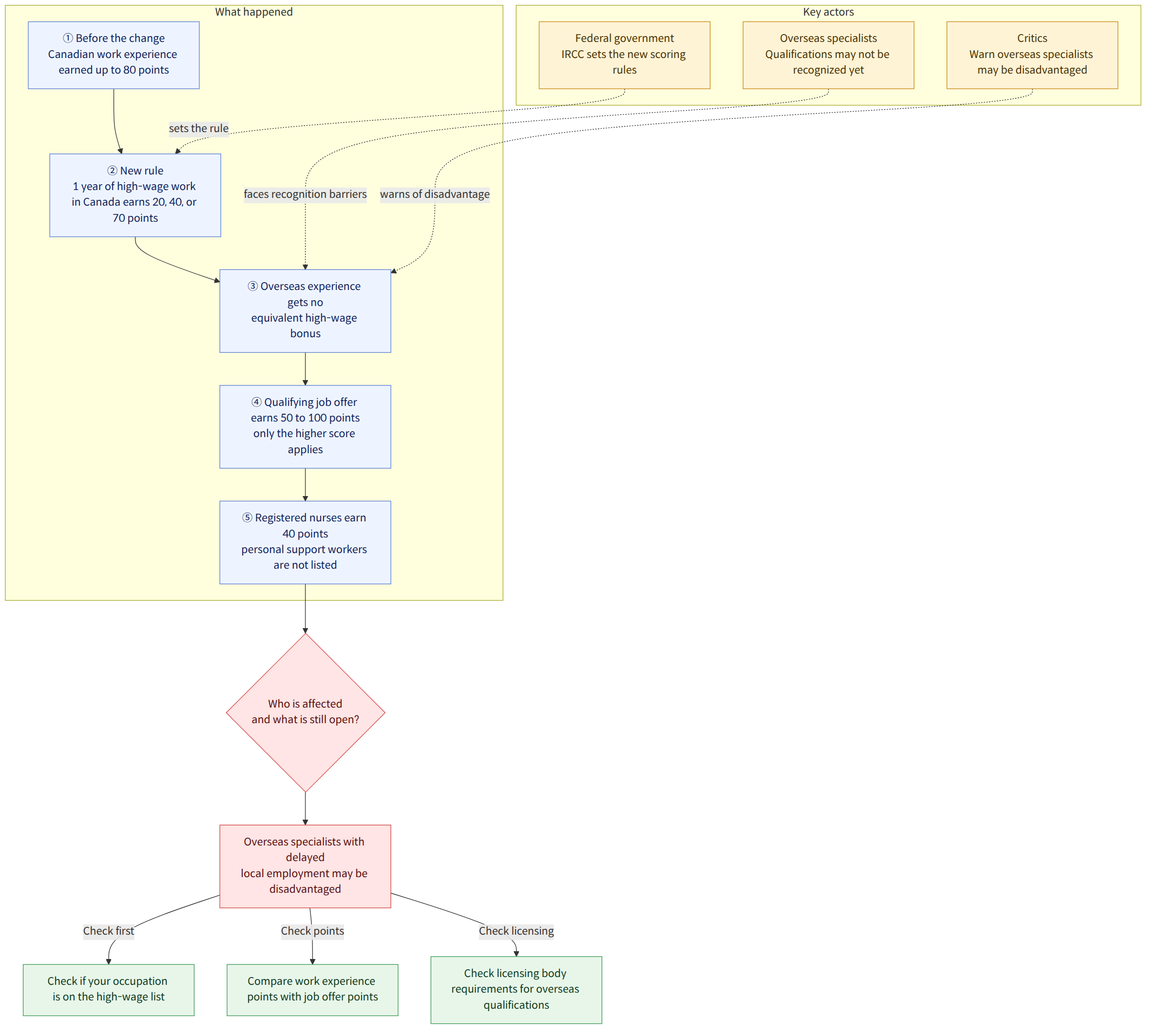
A new scoring rule has taken effect for Express Entry (캐나다 연방의 주요 경제 이민 신청 시스템), Canada's immigration pathway. The core change is that at least one year of work in a high-wage occupation inside Canada now earns 20, 40, or 70 points. Experience gained overseas receives no equivalent bonus, and critics say this could disadvantage overseas specialists who face barriers to recognition of their qualifications.
Background and Context
Express Entry ranks candidates based on factors such as education, language ability, and work experience. Previously, Canadian work experience could earn up to 80 points. Under this change, work experience in high-wage occupations in Canada has become a separate bonus category.
Under the new rules, qualifying experience is, in principle, work performed in a qualifying occupation in Canada within the past 10 years. Occupations are classified by the typical wage level of the occupation, meaning its median wage, rather than an individual's salary. A qualifying job offer in a high-wage occupation can earn 50 to 100 points. Candidates receive only the higher of their work experience points or job offer points, not both.
The federal government said the change emphasizes factors linked to stronger economic outcomes. According to research by Immigration, Refugees and Citizenship Canada (IRCC, 이민성), immigrants with more Canadian work experience generally had higher employment income and wages after obtaining permanent residence. On this point, the logic of the policy can be considered to have some basis.
However, Canadian local experience is not equally open to everyone.
What This News Means
The contrast is clear in nursing. A registered nurse earns an additional 40 points after one year of work in Canada, but personal support workers are not on the list of high-wage occupations.
Consider, for example, two nurses with the same clinical experience from overseas. One obtained a Canadian license and worked one year as a registered nurse. The other worked as a personal support worker while preparing to meet licensing requirements. In this case, the points the two earn for their Canadian work history could differ greatly. The issue is that what makes the difference is not expertise, but whether one was able to access professional jobs in Canada.
In addition, overseas experience has no equivalent high-wage bonus beyond the existing skill transferability points. This means that no matter how much overseas experience someone has, it does not count toward the new additional bonus.
This change also sits in tension with healthcare workforce policy. This doctor category requires Canadian work experience. In effect, a goal of attracting overseas-trained specialists operates alongside a standard that favors people who have already built professional experience in Canada.
How Reports Differed
This news has only one confirmed source text, so no comparison of differences among reports is made.
Confirmed Facts and Unknowns
Confirmed Facts
- Work experience in high-wage occupations in Canada earns 20, 40, or 70 points for a minimum of one year, with the amount depending on the occupation's median wage.
- A qualifying job offer can earn 50 to 100 points. It does not stack with work experience points, and only the higher single score applies.
- Previously, Canadian work experience could earn up to 80 points.
- Registered nurses earn an additional 40 points, but personal support workers are not included in the high-wage occupation list.
- Overseas experience has no equivalent high-wage bonus beyond the existing skill transferability points.
Unknowns
- The source text does not show how the new scoring system actually changed invitation outcomes across occupations.
- The source text does not say when or how qualification recognition procedures for regulated-occupation immigrants will be improved.
What Readers Should Check
- First, check whether your occupation is on Express Entry's high-wage occupation list, using the official guidance page's occupation list and score calculator.
- Calculate whether Canadian work experience points or qualifying job offer points would be higher for you, and remember that the two do not stack.
- If your occupation requires recognition of overseas qualifications in Canada, check the requirements and procedures of the relevant licensing body directly. The source text does not state when these procedures will improve, so rely on the latest official announcements.
















