



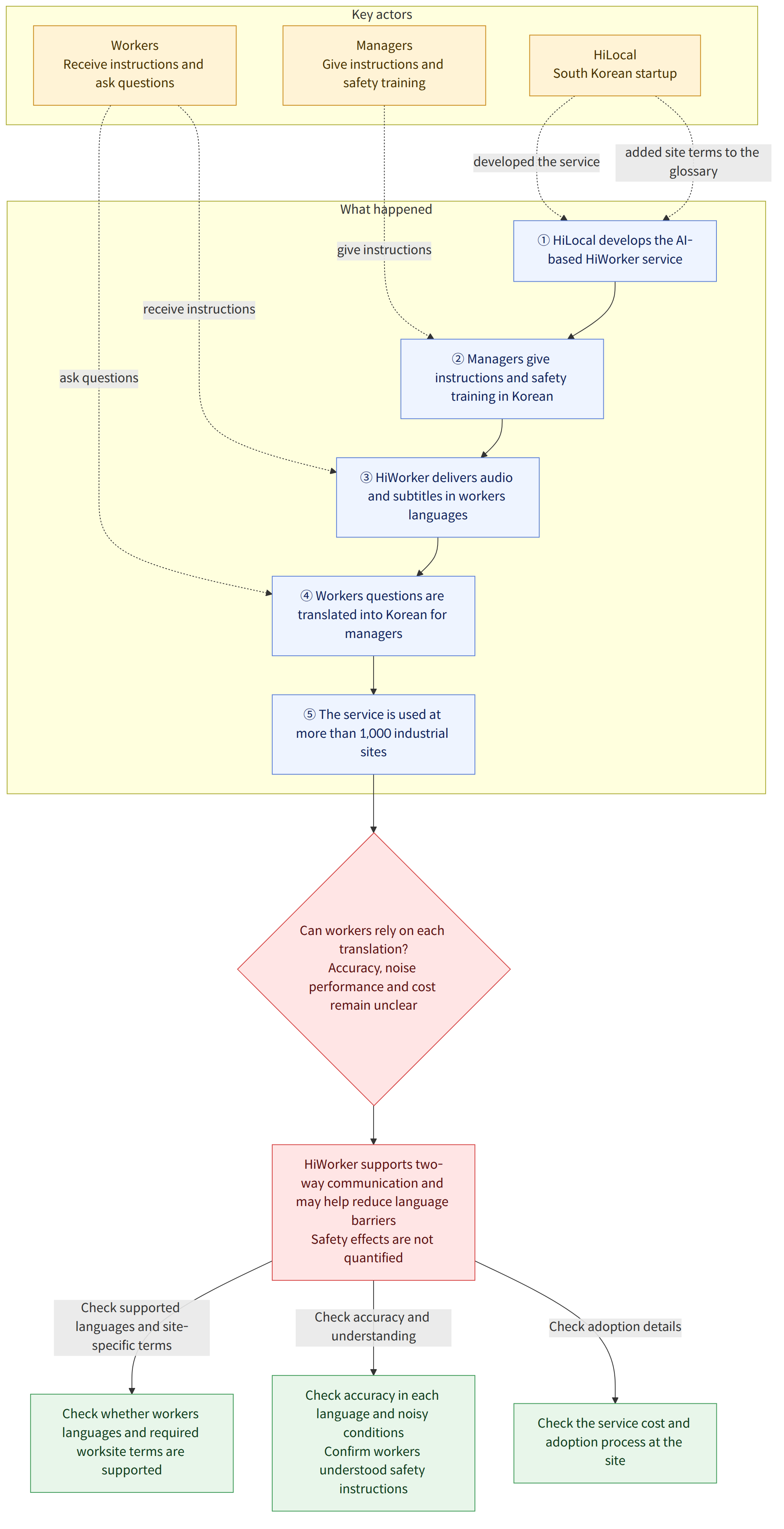
South Korean startup HiLocal has developed HiWorker, an artificial intelligence-based real-time interpretation and translation service aimed at construction sites and other workplaces, where it is now in use. Managers’ work instructions and safety training in Korean are delivered to workers as audio and subtitles in their respective native languages, including Chinese, Nepali and Russian. When workers ask questions in their native languages, those questions are conveyed to managers in Korean. It is a two-way communication tool that supports up to 40 languages.
Background and context
According to the article, as of 2024 there were 220,000 foreign construction workers in South Korea, close to 15% of all construction workers. When workers who speak different languages work together at the same site, it can be difficult to share not only work instructions but also precautions and explanations of work areas given during pre-work briefings.
In the past, a team leader who spoke Korean would relay managers’ instructions to other workers, and information was sometimes lost in the process, a construction industry representative said. The representative said it was helpful for workers to receive real-time explanations in their own languages. However, this is an account of one industry representative’s experience; no data was presented to quantify the service’s effects on safety.
HiLocal said it added construction-site terms such as “o-hamma” (오함마) and “narasi” (나라시), as well as names of work processes and equipment, to the model’s glossary, and improved speech recognition and translation quality to account for noise at worksites. “O-hamma” is a site term for a large hammer, while “narasi” refers to leveling work. The effort is notable for trying to handle these terms in their worksite context rather than relying solely on their general definitions.
What this news means
HiWorker’s main function is not limited to delivering something a manager has said in multiple languages. Workers’ questions are also translated into Korean and conveyed to managers, creating a structure that allows questions and confirmation rather than just one-way announcements. In particular, it can help workers understand safety rules and work details before starting a job.
However, the fact that a translation is provided does not mean every instruction is conveyed accurately. The claim that HiLocal has incorporated worksite terminology into the model and made improvements to account for noisy environments comes from the company; publicly available evidence does not establish accuracy by language or performance at different noise levels. For safety-related information in particular, it may also be important to have a process for confirming that workers have understood the translation.
For example, if workers at a site speak several languages and a manager gives a briefing on precautions before work begins, HiWorker can provide each worker with audio and subtitles in their language and convey questions to the manager in Korean. In that situation, the site would need to consider whether the workers’ languages are supported, whether the message can be understood amid the noise, and whether workers have understood the key instructions.
What is known and what remains unclear
What is known
- HiLocal developed HiWorker, an artificial intelligence-based real-time interpretation and translation service aimed at construction sites and other workplaces.
- HiWorker supports up to 40 languages. It delivers managers’ instructions in multiple languages and conveys workers’ questions in their native languages to managers in Korean.
- It is designed to be accessed via QR code without installing a separate app or creating an account.
- According to the article, the service is used at dozens of sites belonging to large and mid-sized South Korean companies, and at more than 1,000 industrial sites.
- GPT-4o-Transcribe was used for transcription (converting speech into text), while GPT Realtime was used to convert speech into audio in another language without first turning it into text.
What remains unclear
- The accuracy of interpretation and translation by language, and the service’s performance in noisy workplaces, have not been established.
- The article does not provide the cost of using the service or the process for adopting it at individual sites.
- The launch date and specific features of the helmet-mounted equipment in development have not been disclosed.
What readers can check
- Sites considering adoption can check whether the languages their workers use are supported and whether the service properly handles the site-specific terminology needed for work instructions and safety training.
- They can assess whether audio and subtitles come through clearly in noisy environments, and consider ways to confirm that workers understand key safety-related instructions.
- The article does not provide the cost, adoption process or launch schedule for the helmet-mounted equipment, so sites should contact HiLocal directly before deciding to adopt the service.
















