In an online article published on October 23, CNN spotlighted Busan as an emerging travel destination. The article’s headline asked, in effect, “How one of the world’s largest ports became Asia’s next great coastal city.” Comparing the cities by saying, “If Seoul is New York, Busan is Los Angeles,” CNN reported that Busan has undergone major changes as it seeks to become a destination in its own right rather than a miniature version of Seoul.
The coast and beaches, slower pace of life, and lively people were presented as features that set Busan apart from Seoul. Rebecca Barry, South Korea manager at Inside Travel Group, said Busan offers a different experience from Seoul in these respects.
Background and context
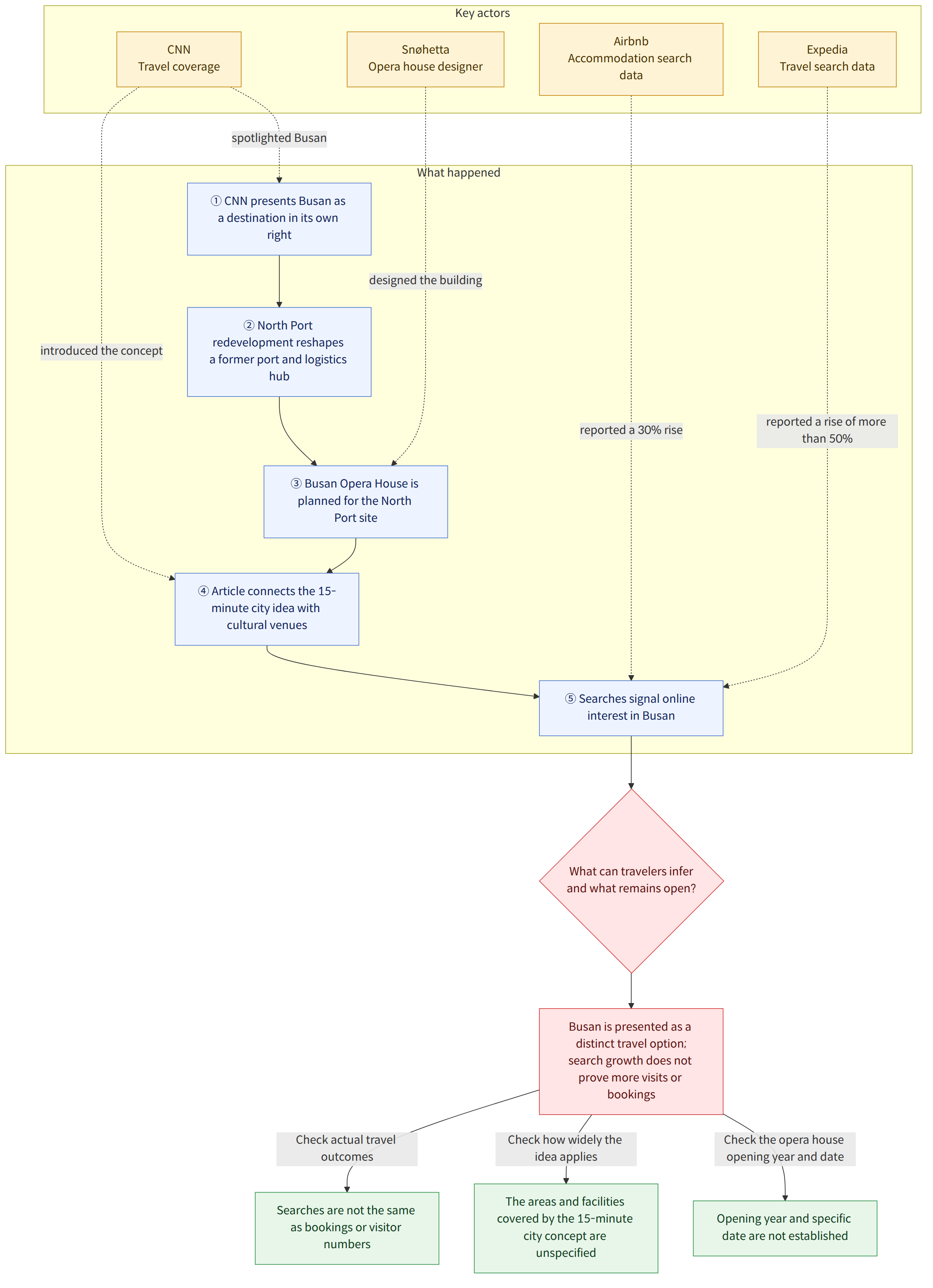
One aspect of the transformation CNN highlighted is the redevelopment of Busan’s North Port, formerly a hub for port and logistics operations. This redevelopment can be seen not only as a way to promote Busan as a travel destination, but also as an example of how the city is seeking to change the use and layout of its spaces.
The Busan Opera House (부산 오페라하우스) is planned for the North Port site. CNN reported that the opera house was due to open “next year,” and Emily Yan, Asia managing director at the architecture firm Snøhetta, which designed the building, said it would act as a catalyst for development in the surrounding area. However, the information provided does not establish which year “next year” refers to, and no specific opening date was given.
Another key term is the “15-minute city” (‘15분 도시’). This is the idea of making everyday amenities and cultural infrastructure accessible within 15 minutes by walking, cycling, or public transit. CNN introduced the concept in connection with Busan, but the article does not specify which areas or facilities can actually be reached within 15 minutes, or how extensively the concept is being applied across the city.
The Busan International Film Festival (부산국제영화제), the Busan Cinema Center (부산 영화의전당), and the Busan Museum of Contemporary Art (부산현대미술관) were cited as part of the city’s cultural scene. These examples support the portrayal of Busan not only as a place to visit for its coastline, but also as a city where visitors can experience cultural activities such as film and art.
What this news means
For travelers, this suggests that Busan could be considered a destination in its own right, rather than just a brief addition to a trip to Seoul. The fact that the article discusses the coast and beaches, cultural venues, and urban-renewal spaces together means that Busan’s travel image does not rely solely on natural scenery or particular tourist attractions. This describes how CNN presented Busan; it does not establish that all visitors will have the same experience or that the city’s growing popularity has led to an actual increase in visits.
According to the article, Airbnb named Busan one of its trending destinations of the year, and searches for accommodations in Busan rose 30% over the past year. Expedia named Busan one of its “2027 Destinations of the Year,” and searches for Busan on the site increased by more than 50%. These figures can be viewed as signs of growing online interest in Busan, but search volume is not the same metric as actual visitor numbers or bookings.
For example, a traveler considering a trip to Busan might look up both beaches and cultural venues and compare the city as a destination offering a combination of experiences, rather than simply as a seaside resort. This is a hypothetical illustration of how the attractions described in the article might factor into travel plans.
What is confirmed and what remains unknown
Confirmed facts
- In an online article published on October 23, CNN introduced Busan as an emerging travel destination and highlighted its urban appeal as distinct from Seoul.
- The article covered the redevelopment of Busan’s North Port, formerly a hub for port and logistics operations, and the planned Busan Opera House on the North Port site.
- CNN introduced the “15-minute city” concept, under which everyday amenities and cultural infrastructure are accessible within 15 minutes by walking, cycling, or public transit.
- According to the article, Airbnb searches for accommodations in Busan rose 30% over the past year, while Expedia searches for Busan increased by more than 50%.
What remains unknown
- The exact year meant by “next year” in reference to the Busan Opera House, and its specific opening date, are unknown.
- The article does not state whether the increase in searches has led to more actual accommodation bookings or visitors.
- The extent to which the “15-minute city” concept applies to particular areas and facilities in Busan cannot be confirmed.
What readers should check
- If planning to visit the Busan Opera House, do not finalize plans based on the word “next year” alone; check whether its opening year and date have been confirmed specifically.
- Do not immediately interpret increased search volume as indicating actual crowding or the likelihood of being able to book; it is safer to check accommodation and venue information for the intended travel dates separately.
- If interested in the “15-minute city” concept, identify the areas and destinations you have in mind, then check actual transportation options and travel times. The concept as described in the article is not enough to determine the accessibility of individual routes.