



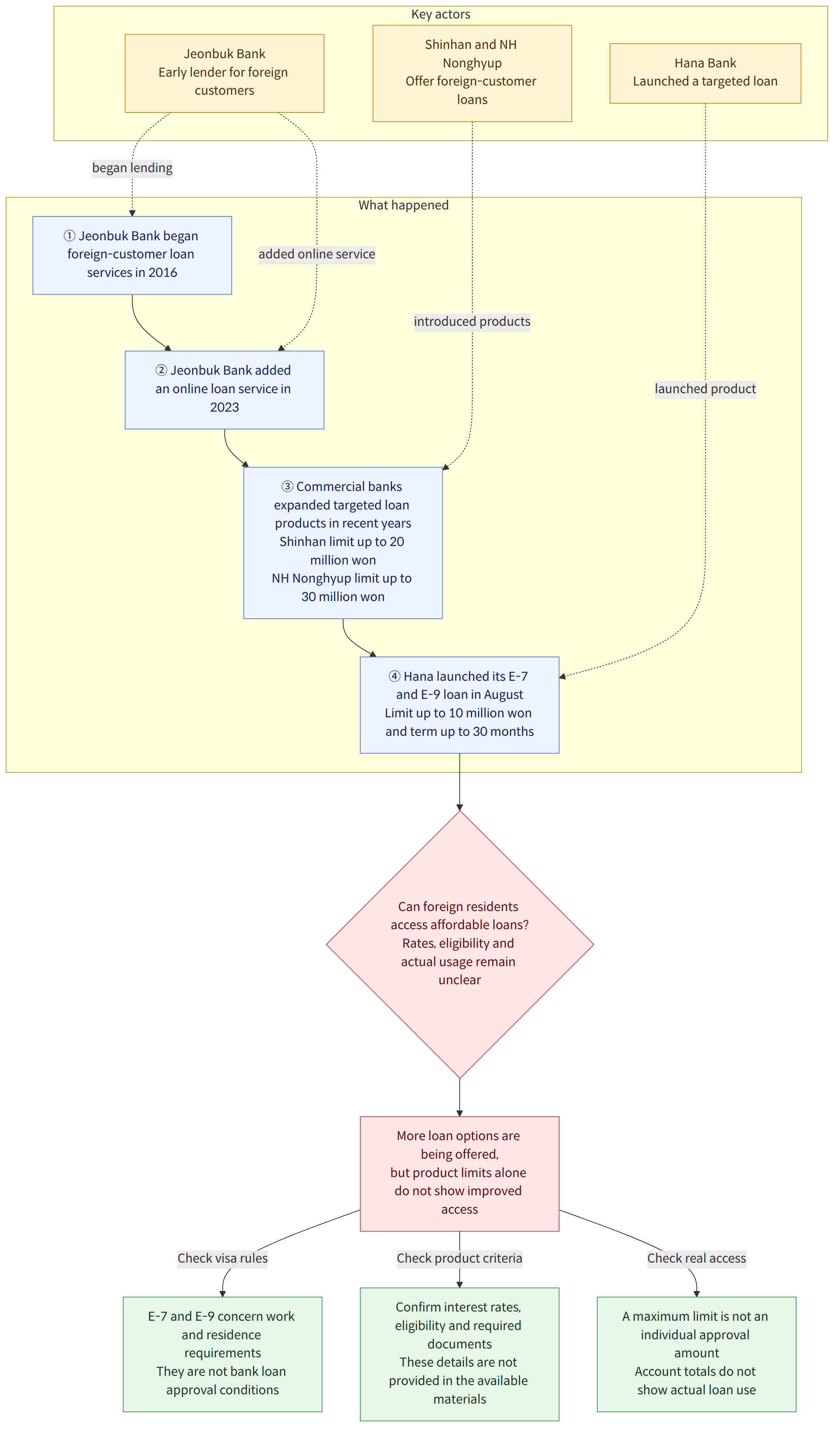
South Korean banks are expanding loan products for foreign customers, following services such as opening accounts and sending money overseas. As competition intensifies among banks for foreign customers, including migrant workers and international students, major commercial banks have introduced products targeting foreign borrowers in recent years. Loan limits vary by bank, and the available materials do not specify interest rates or detailed application requirements.
Background and context
Banks’ efforts to attract foreign customers are expanding from services such as accounts and remittances to loans. Loan products can add financial services that customers need while also serving as one way banks compete to broaden their relationships with foreign customers.
In August, Hana Bank (하나은행) launched the Hana Foreigner EZ Loan (하나 외국인 EZ 대출) for holders of E-7 and E-9 visas. The loan limit is up to 10 million won, and the term is up to 30 months. Shinhan Bank’s (신한은행) SOL Global Loan (SOL 글로벌 대출) has a limit of up to 20 million won, while NH Nonghyup Bank’s (NH농협은행) K-Foreign Resident Credit Loan (K-외국인 신용대출) was described as offering loans of up to 30 million won.
There are also cases in which regional banks moved first in the foreign-customer financial market. Jeonbuk Bank (전북은행), headquartered in Jeonbuk, began offering loan services to foreign customers in 2016 and introduced an online loan service in 2023. This shows that the foreigner loan market did not begin only with commercial banks’ recent product launches; it is also an area in which regional banks have prior experience.
Separate reporting also cited figures on banks’ foreign customer bases. According to Financial Supervisory Service (금융감독원) data cited in that report, as of September 21, Hana Bank had 4.2 million deposit accounts held in the names of foreign individuals, while Woori Bank had 2.56 million. The excerpt provided does not state the reference year, and the number of deposit accounts is a different measure from the scale of loan use.
What this news means
The expansion of loan products points to the possibility of more options for foreign residents. However, the mere existence of a product does not mean that it is easy to use or that borrowing costs are low. A loan limit indicates only the maximum amount that can be borrowed; it does not tell borrowers how much an individual may be approved for or what interest rate will apply.
For example, a foreign national with an E-7 visa may fall within the stated target group for Hana Bank’s product, but actual eligibility to apply, the interest rate, and required documents must be checked against the bank’s product-specific criteria. Holding a visa and passing a loan assessment are separate matters.
For banks, providing foreign customers with loans as well as accounts and remittance services can be an opportunity to broaden their relationships with them. At the same time, without information on interest rates, eligibility, and actual usage, the number of products or their maximum limits alone cannot show how much access to finance for foreign customers has improved.
Related rules and support information
E-7 and E-9, which are mentioned as categories targeted by the loan products, are residence statuses for foreign nationals working in South Korea. According to a visa guide, E-7 (Specific Activities, 특정활동) is a status for people seeking to work in an occupation designated by the Ministry of Justice (법무부) after entering into a contract with a public or private institution in South Korea. Qualifications and employer requirements vary by occupation, and holding an E-7 status does not by itself allow someone to work in every occupation.
E-9 (Non-professional Employment, 비전문취업) is a status for foreign workers employed by a business that has received employment authorization to work in permitted industries. As a general rule, they must continue working at the workplace for which the initial employment authorization was granted; changing workplaces is subject to specified reasons and procedures. For both visas, the requirements for residence status concern employment and residence; they are not loan approval conditions set by banks.
Meeting visa requirements or holding the relevant visa does not mean that a loan will be approved. The available materials do not provide the interest rates, detailed application requirements, or loan documents required by the banks for each product.
If you need to check visa procedures, E-7 applications may require documents such as an employment contract, proof of academic qualifications or work experience, and a letter of employment recommendation, depending on the occupation and procedure. E-9 visa issuance procedures include documents such as an employment permit and a standard employment contract; separate procedures and documents are also specified for changing workplaces or extending a period of stay. This information concerns visa procedures, so applicants should not confuse it with loan application documents and should confirm those separately with the bank.
What is known and what remains unclear
What is known
- Hana Bank has launched a loan for E-7 and E-9 visa holders, with a limit of up to 10 million won and a term of up to 30 months.
- The limits for Shinhan Bank’s and NH Nonghyup Bank’s products for foreign customers are up to 20 million won and 30 million won, respectively.
- Jeonbuk Bank began offering loans to foreign customers in 2016 and introduced an online loan service in 2023.
- Banks are extending competition to attract foreign customers beyond accounts and remittances to include loan services.
What remains unclear
- The materials do not specify the interest rates, detailed application requirements, required documents, or underwriting criteria for each product.
- The actual usage and delinquency rates of loan products for foreign customers have not been confirmed.
- There is not enough information to assess how much the launch of these products has changed foreign customers’ access to finance or their borrowing outcomes.
What readers should check
- Before applying, check with the bank for the applicable interest rate, repayment terms, detailed eligibility requirements, and required documents. The maximum limit may differ from the amount an individual is actually approved for.
- If you have an E-7 visa, check whether your occupation and employment contract meet the residence-status requirements. If you have an E-9 visa, check the permitted industries and workplace conditions. Visa procedures should be reviewed separately from loan underwriting.
- If your period of stay or workplace is about to change, check the deadlines and documents for the relevant visa procedures, and ask the bank whether the change could affect your loan repayment schedule.
References
- Specific Activities (E-7) Visa — Eligible Occupations, Qualification Requirements, Period of Stay, and Application Documents
- Non-professional Employment (E-9) Visa — Eligible Sectors, Period of Stay, and Procedures for Changing or Extending the Period of Stay
- Other coverage consulted: m.koreaherald.com

















