


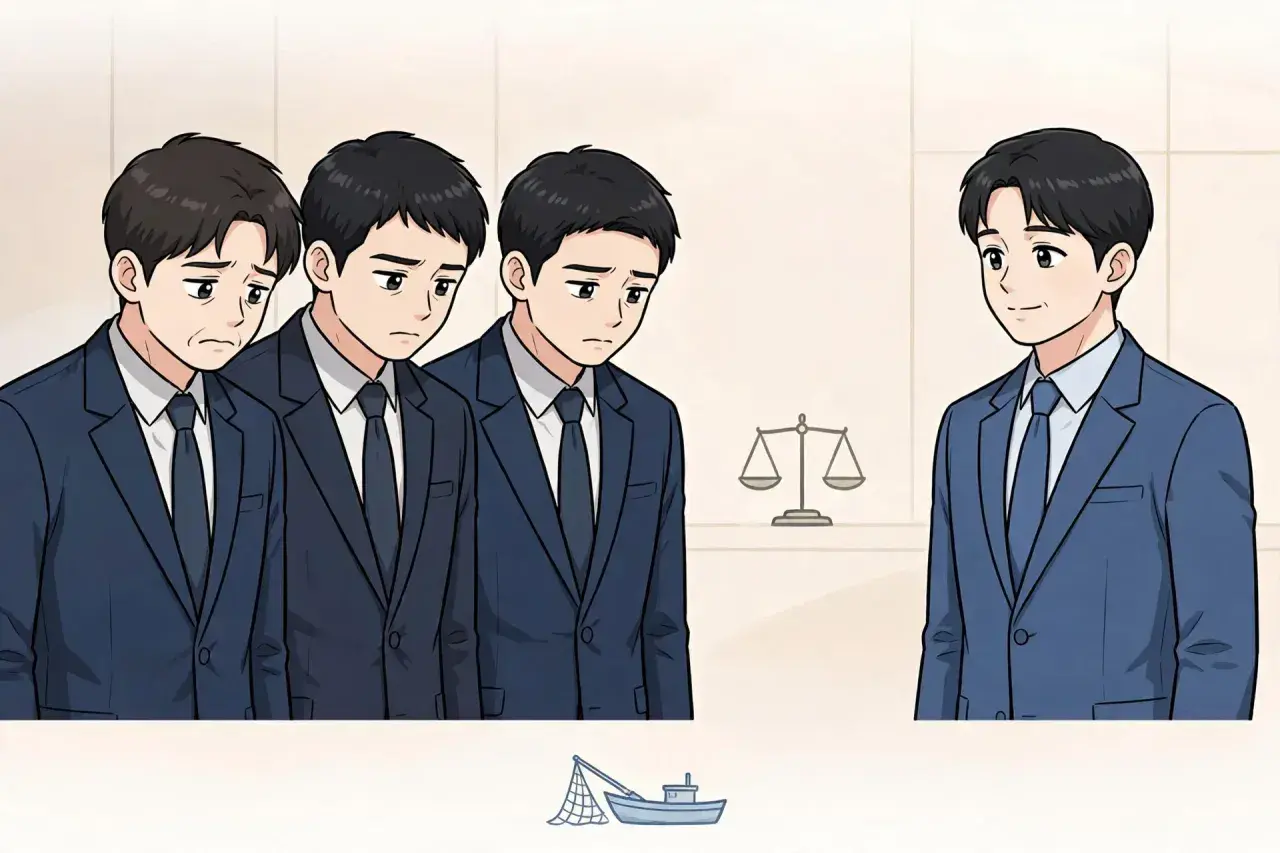
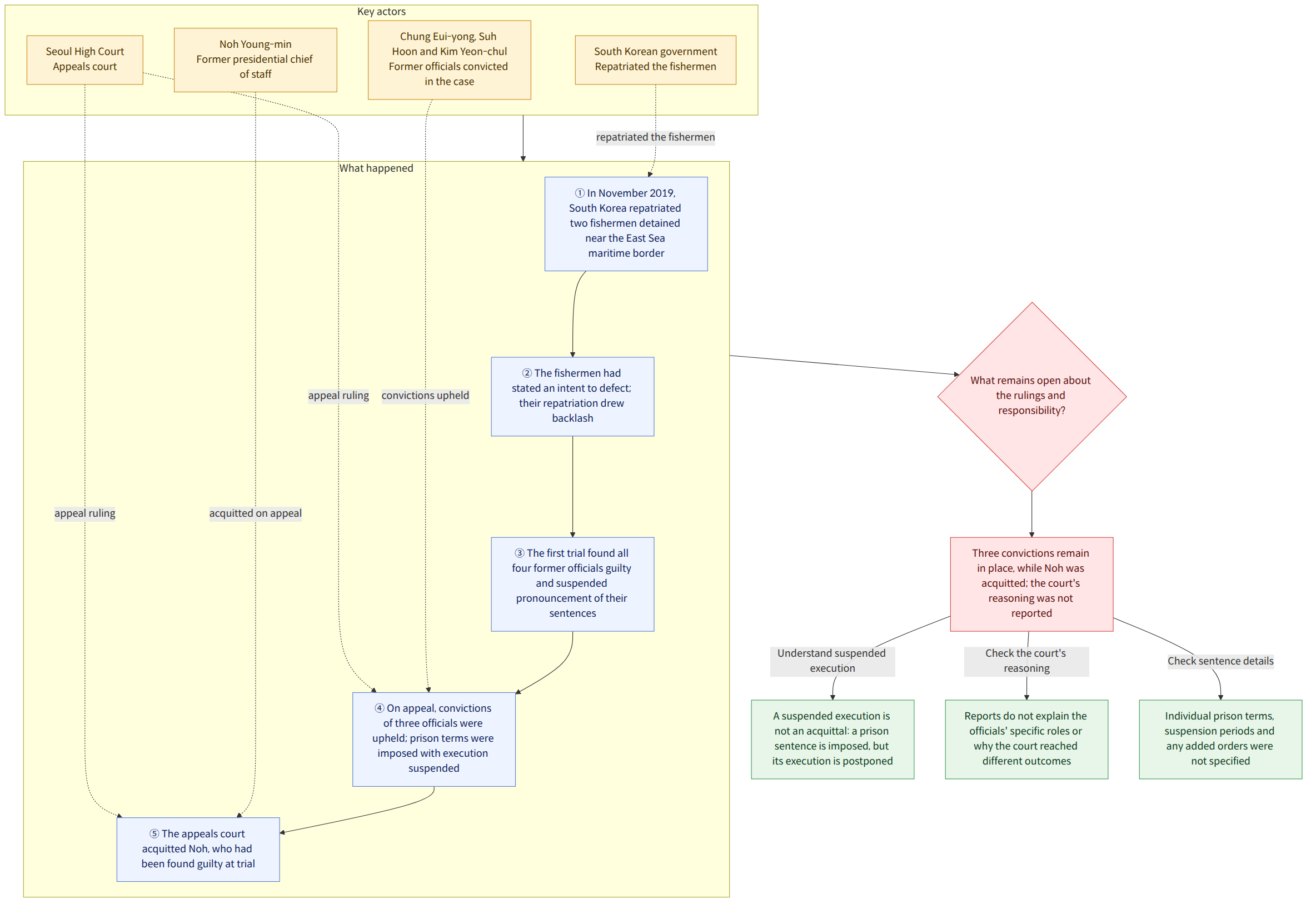
On Wednesday, the Seoul High Court (서울고등법원) upheld the convictions of former National Security Office chief Chung Eui-yong, former National Intelligence Service chief Suh Hoon and former Unification Minister Kim Yeon-chul in connection with the forced repatriation of two North Korean fishermen in 2019, sentencing them to prison terms with suspended execution. By contrast, it acquitted former presidential chief of staff Noh Young-min, who had previously been found guilty for his involvement in the case. All four served in the administration of then-President Moon Jae-in.
Background and context
In November 2019, the South Korean government repatriated two North Korean fishermen who had been detained near the maritime border in the East Sea. They were suspected of murdering 16 crew members. The fact that they were repatriated despite stating their intent to defect to South Korea drew backlash from critics.
The case involves both South Korea’s policy of accepting North Korean defectors and the question of criminal responsibility for the judgments and actions officials took in an individual case. However, based on the reported information alone, it is not possible to tell how the appeals court assessed each official’s specific role or decisions, or why it acquitted former chief of staff Noh.
The first trial found all four former officials guilty but suspended the pronouncement of their sentences. On appeal, the convictions of three were upheld and they were given prison terms with execution suspended, while Noh was acquitted. The key point, therefore, is that the appeals court did not reach the same conclusion for all four: its rulings differed by defendant.
What this news means
The convictions of the three former officials were upheld, meaning the appeals court also found officials involved in the fishermen’s repatriation criminally responsible. At the same time, one person was acquitted, showing that the responsibility of all officials cannot be treated as one and the same simply because they were implicated in the same case. However, because the reports did not include the reasoning behind the rulings, it is not possible to determine what facts or legal assessments accounted for this difference.
Because the fishermen’s stated intent to defect and their repatriation are both being discussed, the case may renew public attention to policies for accepting North Korean defectors and the decision-making procedures of state institutions. However, the reported facts alone are not enough to establish the appeals court’s specific judgment on the legality of the repatriation or the case’s broader policy effects.
For example, a reader who takes a suspended sentence to mean the same thing as an acquittal would misunderstand the outcome. In this case, the convictions of the three men were upheld, not overturned, and execution of their prison sentences was suspended. The reports did not specify the individual prison terms or the length of the suspended-execution periods.
Related legal provisions and support information
A suspended pronouncement of sentence and a suspended execution of sentence sound similar, but have different effects. A suspended pronouncement postpones the pronouncement of a sentence itself, while a suspended execution imposes a sentence but postpones its execution for a set period. At the first trial, all four men were found guilty and the pronouncement of their sentences was suspended. On appeal, the three men were sentenced to prison, with execution suspended.
A suspended execution is not an acquittal. If the suspension period passes without being revoked or cancelled, the sentence loses effect, but the fact that a sentence was imposed is not erased.
Probation, community service or an order to attend a course may also be imposed alongside a suspended execution, and the suspension may be revoked if conditions or orders are seriously violated. However, the reports did not say whether any such orders were imposed on the three men. In addition, some cases treat the suspension period as running from the date the judgment becomes final, so the judgment and applicable laws should be checked to determine the period and effects in a specific case.
What is confirmed and what remains unknown
Confirmed facts
- In November 2019, the South Korean government repatriated two North Korean fishermen who had been detained near the maritime border in the East Sea.
- The fishermen were suspected of murdering 16 crew members, and reports that they had stated their intent to defect to South Korea prompted a backlash.
- The appeals court upheld the convictions of former officials Chung Eui-yong, Suh Hoon and Kim Yeon-chul and sentenced them to prison terms with suspended execution.
- The appeals court acquitted former chief of staff Noh Young-min. At the first trial, all four men were found guilty and the pronouncement of their sentences was suspended.
What remains unknown
- What prison terms and suspended-execution periods were imposed on each of the three men?
- What reason did the appeals court give for acquitting former chief of staff Noh?
- Were any additional orders, such as probation or community service, imposed on the three men?
What readers should check
- When considering the meaning of the ruling, check separately whether the outcome was guilty or not guilty, what type of sentence was imposed, and whether its execution was suspended. A suspended execution is not the same as an acquittal.
- The reports did not provide the individual prison terms or suspended-execution periods, or the reason former chief of staff Noh was acquitted. The detailed judgment must be reviewed to find specific answers.
- The circumstances in which a suspended execution applies may vary depending on the judgment and the law. If you face a similar legal issue, review the judgment in the case and the laws in effect at the relevant time, and seek help from a legal professional.
If you are dealing with a similar issue, attorney Ji-sun Ahn of Ijun Law Firm can review the procedural history, the specific facts or evidence in dispute, and the relevant court or agency notices with you. These details can help clarify which options apply to your situation.
References
- Essential Guide to Suspension of Pronouncement, Suspended Execution, and Parole
- Other coverage consulted: en.yna.co.kr

















