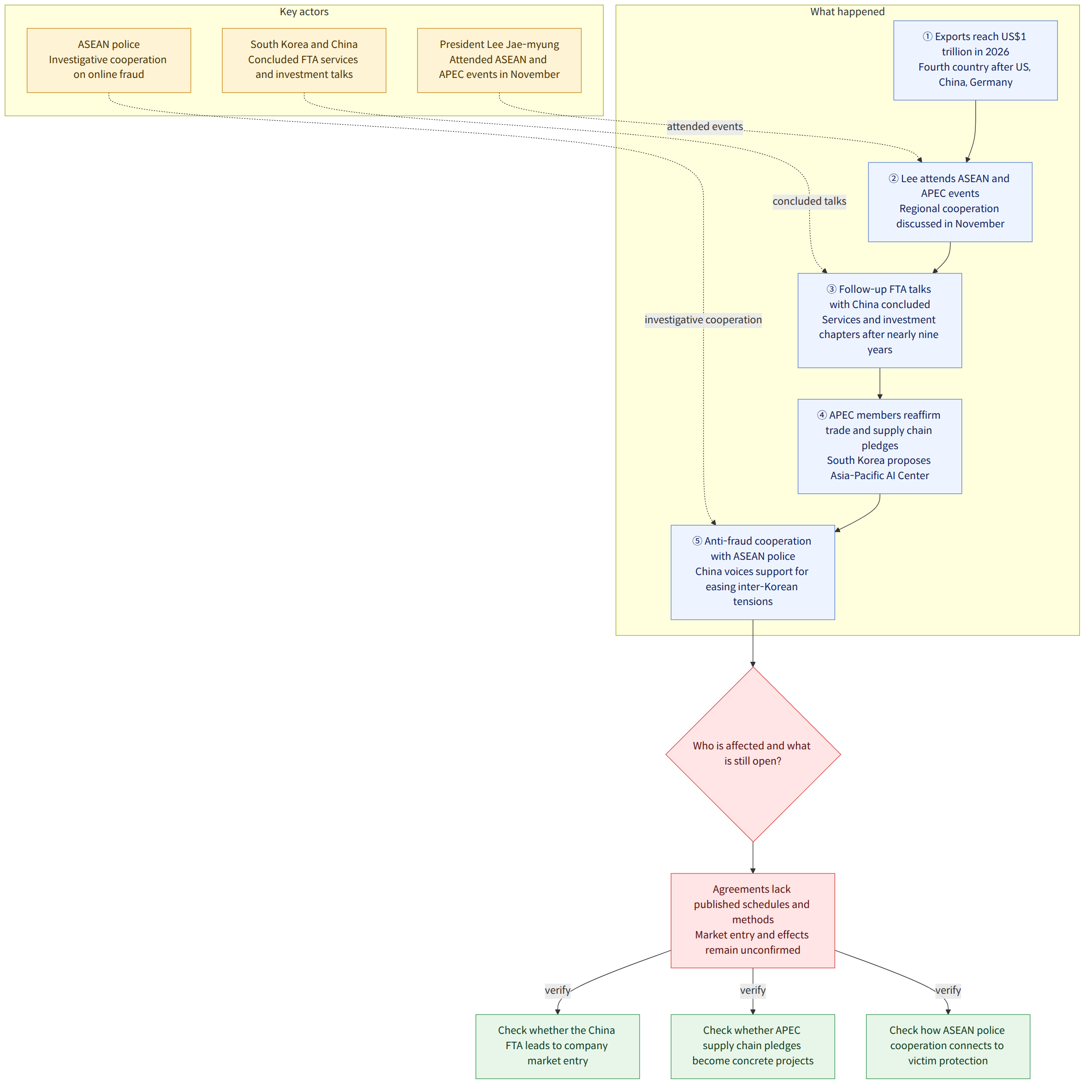
According to the source, South Korea reached annual exports of US$1 trillion in 2026, becoming the fourth country to do so after the United States, China, and Germany. About 73% of South Korea's trade is with the 21 member economies of APEC, which account for 61% of world GDP, while ASEAN accounts for 16% of its trade. President Lee Jae-myung attended ASEAN- and APEC-related events in November and discussed regional cooperation.
The source describes the outcomes of the visit in four areas: expanding multilateral and regional cooperation, economic and trade and supply chain cooperation, responses to shared challenges, and diplomacy for peace on the Korean Peninsula. To understand what these outcomes mean for South Korea's trade and security, it is necessary to look not only at the scope of the agreements but also at the next steps in implementation.
Background and Context
The source explains that South Korea depends heavily on imports for much of its energy and minerals and has built its economy on trade and advanced industries. Under these conditions, the regional environment for transporting goods and maintaining supply chains is closely tied to economic interests, as well as relationships with major trading partners. This is why the source links APEC and ASEAN cooperation to South Korea's core interests.
The source places these developments against the backdrop of US-China competition, the rise of protectionism, and tensions in Northeast Asia. It also assesses that Northeast Asia lacks a comprehensive framework for regional multilateral security cooperation. The interpretation offered in the article is that, in this situation, ASEAN and broader Asia-Pacific multilateral cooperation systems could serve as diplomatic and economic safety nets.
What This News Means
In the economic and trade field, the notable point is that South Korea and China concluded follow-up negotiations on the services and investment chapters of their bilateral FTA (free trade agreement, an agreement that lowers trade barriers between countries). According to the source, the negotiations took nearly nine years, and their purpose is to create an institutional foundation for companies of both countries to enter each other's markets and expand in the service sector. However, the conclusion of the negotiations itself should be distinguished from actual market entry and business expansion by companies. The source does not present specific implementation schedules or company-level effects.
South Korea is pursuing an upgrade of its FTA with ASEAN and has also discussed cooperation on critical mineral supply chains in the Mekong region. The source reports that at APEC, members reaffirmed their commitment to maintaining trade in essential goods and strengthening supply chain resilience. If this cooperation leads to concrete projects, it could help stabilize the supply of energy, food, and critical minerals on which South Korea depends for imports, which is why it draws attention.
Multilateral cooperation is also connected to people's safety, not only to the economy. The source reports that South Korea has conducted investigative cooperation with ASEAN police to respond to transnational crimes such as online fraud and has strengthened the foundation for protecting nationals overseas. For example, for a citizen who has fallen victim to online fraud abroad, the question of how international investigative cooperation actually connects to case handling and protection may be of interest. However, the source does not include the specific procedures of the cooperation or the outcomes of individual cases.
Proposals and messages also emerged in the technology and diplomacy fields. At the APEC framework, South Korea proposed establishing an Asia-Pacific AI Center and also presented a plan to share strategies for AI development and responses to demographic change. Regarding the Korean Peninsula, the source reports that China expressed support for easing inter-Korean tensions and creating dialogue between North Korea and the United States, and said it would play a constructive role. It cannot be concluded that these proposals and expressions of support have led to actual cooperation or reduced tensions. Their effects should be confirmed through follow-up developments.
Confirmed Facts and Unknowns
Confirmed facts
- The source reports that South Korea reached annual exports of US$1 trillion in 2026.
- The source states that the 21 APEC member economies account for 73% of South Korea's trade, and ASEAN accounts for 16%.
- South Korea and China concluded follow-up FTA negotiations on services and investment, which took nearly nine years.
- South Korea agreed to hold a 2029 ASEAN-Korea Special Summit (한-ASEAN 특별정상회의), and proposed the establishment of an Asia-Pacific AI Center at APEC.
Unknowns
- The specific timing and agenda of the 2029 ASEAN-Korea Special Summit are not presented in the source.
- Whether the statement adopted at the summit and South Korea's proposals will be implemented, and on what schedule and in what manner, cannot be confirmed from the source alone.
What Readers Should Verify
- Business and related readers should check how the follow-up negotiations on the South Korea-China FTA services and investment chapters and the discussions on improving the ASEAN FTA translate into actual institutions and business activity.
- Readers with interests in energy, food, critical mineral supply chains, or maritime logistics can examine the follow-up measures and implementation methods of related cooperation.
- The 2029 ASEAN-Korea Special Summit (한-ASEAN 특별정상회의) and the proposed Asia-Pacific AI Center are matters to watch for whether their timing, agenda, and follow-up plans become more concrete.