



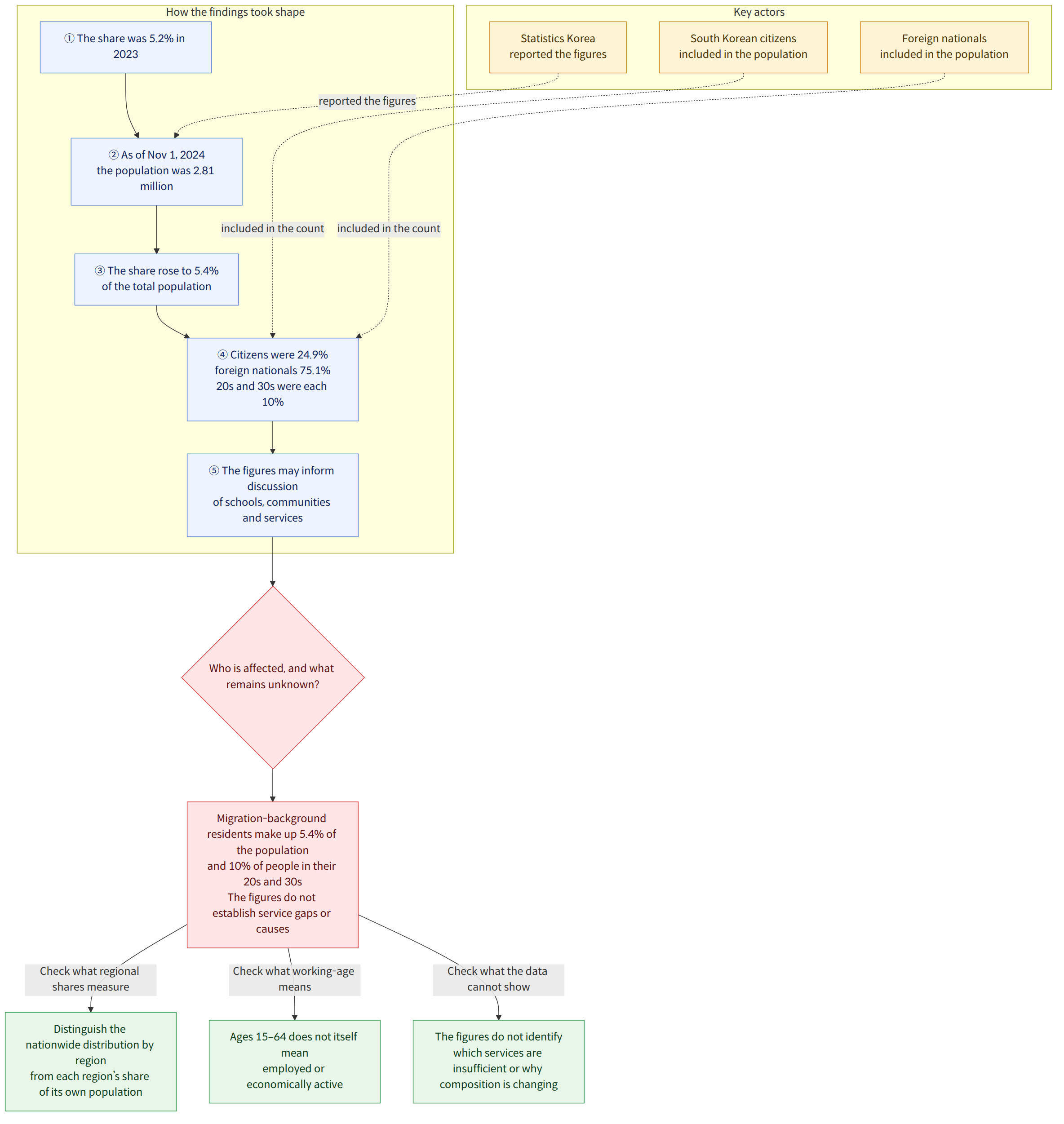
Statistics Korea (통계청) announced on October 26 that, as of November 1, 2024, the population with a migration background nationwide was 2.81 million. That represents 5.4% of the total population, up from 5.2% in 2023. In particular, people with a migration background made up 10% of the population in both the 20s and 30s age groups.
The population with a migration background includes both South Korean citizens and foreign nationals. Of this population, 701,000 are South Korean citizens (24.9%) and 2.109 million are foreign nationals (75.1%). This statistic therefore does not count only foreign residents; it examines the population’s composition while also including people who hold South Korean citizenship.
Background and context
The share of the population with a migration background rose from 5.2% in 2023 to 5.4% in 2024, a difference of 0.2 percentage points. The change may seem small when viewed only as a share of the total population, but the data also show that people with a migration background account for 10% of both the population in their 20s and the population in their 30s.
By age, people in their 30s were the largest group in the population with a migration background, at 667,000 (23.7%). They were followed by people in their 20s, at 607,000 (21.6%), and people in their 40s, at 439,000 (15.6%). Of the total population with a migration background, 2.302 million (81.9%) are aged 15–64, 344,000 (12.2%) are aged 0–14, and 164,000 (5.8%) are aged 65 or older. However, being in the 15–64 age range does not in itself mean that someone is employed or economically active.
The population cannot be reduced to a single profile based on citizenship, either. Among South Korean citizens with a migration background, second-generation people with a migration background accounted for 14.1%. People who had naturalized or acquired South Korean citizenship in another way accounted for 9.1%, while other South Korean citizens accounted for 1.7%. These figures show that the population with a migration background includes groups with different citizenship statuses and backgrounds.
By region, Gyeonggi Province accounted for the largest share, at 32.3%, followed by Seoul at 17.1%, Incheon at 6.7%, South Chungcheong Province at 6.6%, and South Gyeongsang Province at 6.3%. These figures alone do not establish that they represent the share of each region’s total population that has a migration background. When comparing regions, it is important to check the counting criteria and determine whether the figures show the distribution of the nationwide population with a migration background or the share of each region’s population.
What this news means
The finding that people with a migration background account for 5.4% of the total population and 10% of people in their 20s and 30s shows that this is not an issue confined to certain age groups or regions. It may become increasingly important to take the growing diversity of the population into account in discussions involving residents’ everyday lives, such as those about schools, communities, and public services. However, this statistic alone does not show which services may be insufficient or what is causing changes in the population’s composition.
For example, when planning education or public services in a region, examining the backgrounds and age groups that make up its population could serve as a starting point for discussion. This is not a policy impact directly established by the statistics, but a possible way to use the information in light of the data provided on age, citizenship, and regional composition.
On May 20, the 19th Together Day (함께하는 날) commemoration ceremony was held at Yongsan Art Hall in Yongsan-gu, Seoul. The article’s photo caption described the purpose of Together Day as building a society where South Koreans and foreign residents live together in harmony while respecting one another’s cultures and traditions. If population statistics show changes in the population’s composition, the purpose of the event prompts reflection on what kind of society people should seek to build together amid those changes.
What is confirmed and what remains unknown
Confirmed facts
- As of November 1, 2024, the population with a migration background was 2.81 million, or 5.4% of the total population.
- People with a migration background account for 10% of both the population in their 20s and the population in their 30s.
- Among the population with a migration background, 701,000 are South Korean citizens (24.9%) and 2.109 million are foreign nationals (75.1%).
- Of the population with a migration background, 81.9% are aged 15–64, and people in their 30s are the largest age group.
- The regional figures are listed as Gyeonggi Province, 32.3%; Seoul, 17.1%; Incheon, 6.7%; South Chungcheong Province, 6.6%; and South Gyeongsang Province, 6.3%.
What remains unknown
- What specific counting criteria does the article use for “population with a migration background”?
- Where can the detailed survey methods and raw data for the 2025 statistics be found?
- What explains the high share of people with a migration background among those in their 20s and 30s?
- The data do not make clear whether the regional figures are shares of each region’s total population or the regional distribution of the nationwide population with a migration background.
What readers should check
- Before citing the population with a migration background or comparing it with other population statistics, first check who is included and the reference date.
- When comparing regional shares, check the denominator. The regional distribution of the nationwide population with a migration background and the share of each region’s population with a migration background mean different things.
- Do not interpret age-group shares as indicators of employment or economic activity. The data show the age composition; employment status and the causes of statistical changes need to be checked separately.

















