



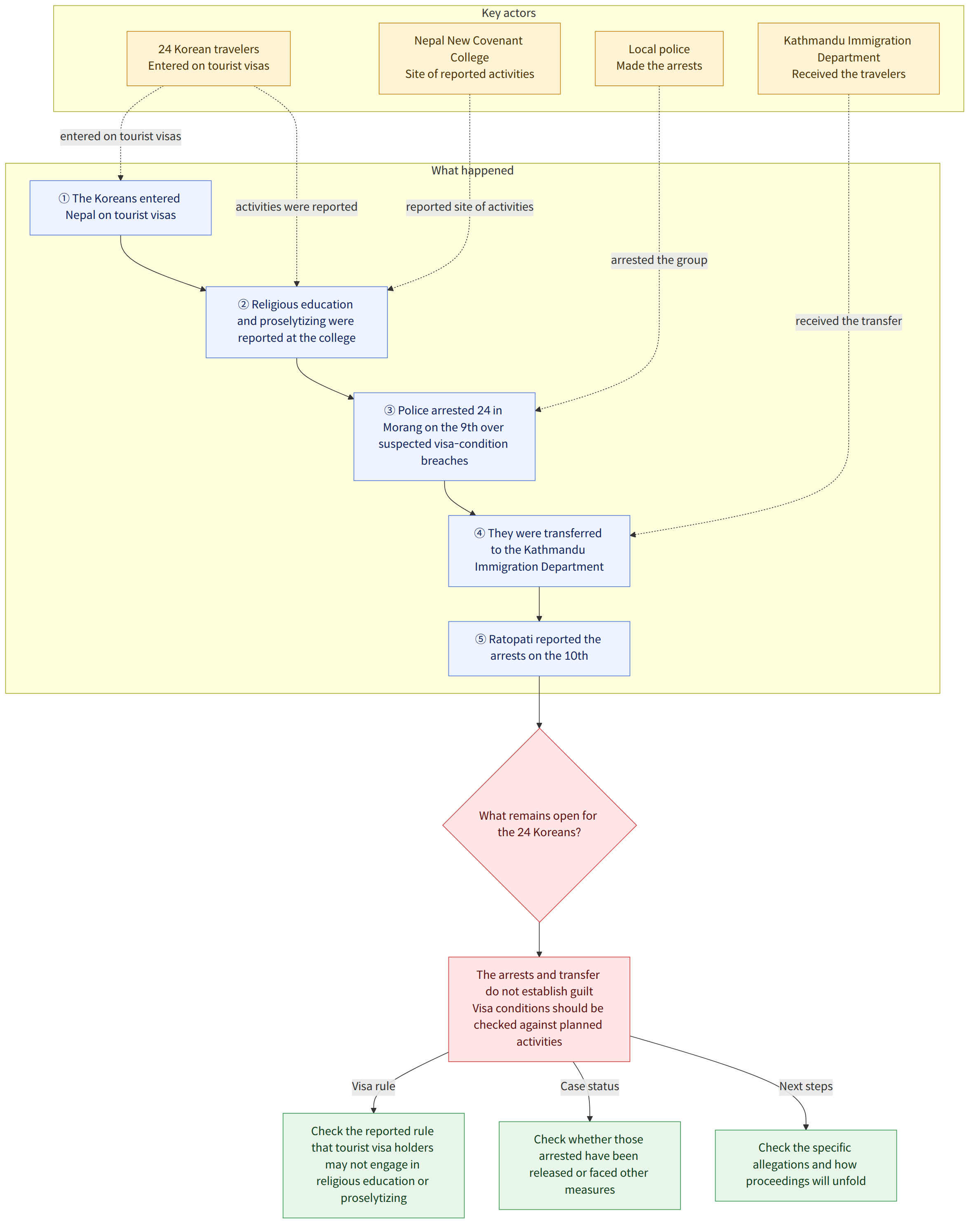
Twenty-four Koreans who entered Nepal on tourist visas were arrested by local police on suspicion of taking part in religious activities. The Nepalese online outlet Ratopati reported on the 10th that they were arrested on the 9th in the Morang area of Koshi Province in eastern Nepal and subsequently transferred to the Immigration Department in the capital, Kathmandu. According to local regulations cited in reports, foreign nationals who enter on tourist visas may not engage in religious education or proselytizing.
Background and context
According to Ratopati, the group took part in religious education and proselytizing, among other activities, at Nepal New Covenant College in Sundar Danda. The institution was reported to be a religious education center supported by a Christian missionary organization. Ratopati reported that the institution operates without authorization from the Nepalese government and has more than 300 students.
The Koreans reportedly arrived at the institution between the 6th and 7th, traveling from Kathmandu via Biratnagar in Koshi Province, and had originally planned to stay in Nepal until the 12th. Local police are said to have arrested them after determining that their activities might not comply with the conditions of stay permitted by their tourist visas. However, this was the police assessment as reported by the outlet; the specific allegations or applicable legal provisions have not been confirmed.
The central issue is not a general assessment of religious activity itself, but whether the activities carried out in Nepal matched the visa used to enter the country. A visa sets the conditions for entry and stay, so people entering for tourism need to consider what activities their visa permits. The prohibition on religious education and proselytizing by foreign nationals holding tourist visas, as described in reports about Nepalese regulations, was cited as the context for the arrests.
What this news means
The incident shows the importance of checking visa conditions not only for travelers visiting Nepal, but also for people invited by local educational institutions or religious organizations. A short schedule or a visit to a school or institution does not automatically make an activity tourism. In particular, activities such as “education” or “proselytizing,” which may be interpreted differently from the purpose and nature of a tourist itinerary, should be checked for eligibility before departure.
For example, if someone planning to visit Nepal on a tourist visa is invited to take part in a religious education program run by a local organization, they should check whether the activity is permitted under that visa before agreeing to participate. This is a hypothetical based on the prohibition described in reports about this case; it does not determine whether a specific individual’s activities would be permitted.
The arrests and transfer mean that the individuals are subject to relevant proceedings, but do not, by themselves, mean that the allegations have been established or that a guilty verdict has been issued. Reports available so far do not provide the identities or affiliations of those arrested, whether they have been released, or what action was taken afterward. Further information is therefore needed on what activities were considered problematic and what procedures the individuals will face, rather than on the outcome of the case alone.
Confirmed facts and what is not yet known
Confirmed facts
- Ratopati reported on the 10th that 24 Koreans were arrested on the 9th in the Morang area of Koshi Province in eastern Nepal.
- They were transferred to the Kathmandu Immigration Department and were reportedly involved in religious education and proselytizing, among other activities, at Nepal New Covenant College.
- They entered on tourist visas, and local police are said to have arrested them after considering the possibility that their activities did not comply with the conditions of their stay.
- According to reports, foreign nationals who enter Nepal on tourist visas are prohibited from engaging in religious education or proselytizing.
What is not yet known
- What are the identities and affiliations of those arrested?
- Have they been released or faced other measures?
- What specific allegations have been made, and how will the subsequent proceedings unfold?
What readers should check
- Anyone planning to visit Nepal should check before departure what activities are permitted under a tourist visa. Schedules that may involve purposes other than tourism, such as religious education or proselytizing, should be reviewed especially carefully.
- If invited by a local institution, it is safer to confirm the purpose of the visit and the details of the actual program, and to check that the activities comply with visa conditions before finalizing plans.
- Regarding this case, readers should not infer that the allegations have been established or assume the individuals’ current status based only on reports of their arrest. They should look for follow-up reporting to confirm whether they have been released and what procedures they face.
References
- Other coverage consulted: m.koreaherald.com
- Other coverage consulted: en.yna.co.kr

















