



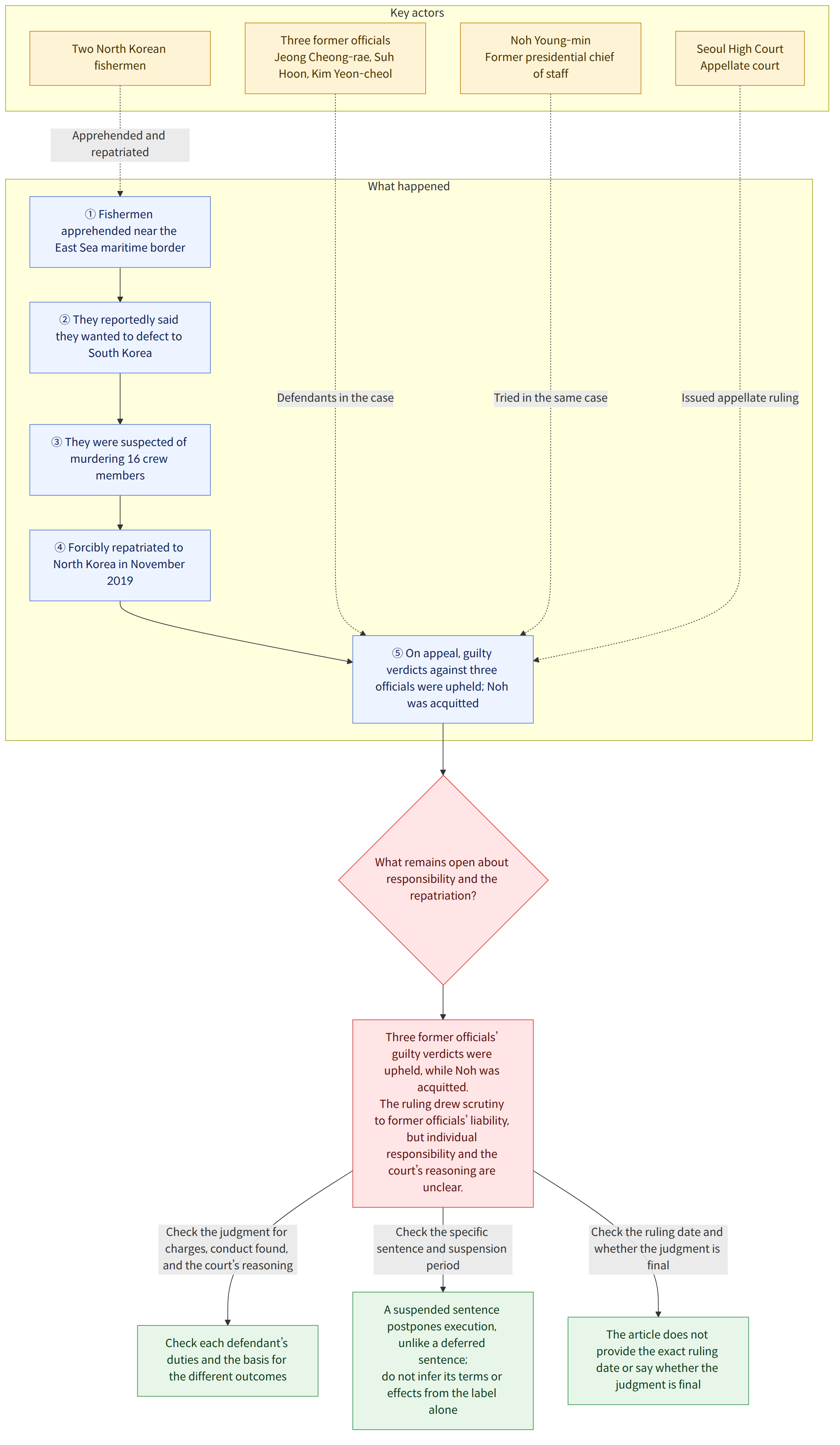
An appellate court sentenced three former officials to prison terms with suspended sentences in connection with the 2019 forced repatriation of North Korean residents. The Seoul High Court (서울고등법원) upheld the guilty verdicts against them, while former presidential chief of staff Noh Young-min, who was tried alongside them, was found not guilty, according to reports. The article does not specify the sentences or charges.
Background and context
The case concerns the repatriation of two North Korean fishermen to North Korea in November 2019. They were apprehended near the maritime border in the East Sea and were forcibly repatriated despite reportedly saying they wanted to defect to South Korea.
At the time, the fishermen were suspected of murdering 16 crew members. Reports noted both that they had expressed an intention to defect and that they were suspected of murder, but the article provided does not explain the details of the repatriation decision or the role of each defendant.
The original article says that the fishermen and Noh Young-min were all in office under the Moon Jae-in administration in November 2019.
What this news means
The ruling has drawn attention because an administrative decision over the repatriation of North Korean residents led to a criminal trial examining the liability of former senior officials. However, the fact that the guilty verdicts were upheld does not, by itself, establish all the issues surrounding the repatriation or the scope of each person’s responsibility. The report does not include the specific charges or the court’s reasoning.
In the same case, three people were found guilty and one was acquitted. This means that all defendants did not receive the same outcome simply because they were implicated in the case. The article provided, however, does not explain how the court distinguished among the four people’s responsibilities.
For example, readers examining a case involving a similar public decision would need to look not only at the final outcome but also at each defendant’s duties, the conduct the court found to have occurred, and the charges brought, in order to understand the scope of the ruling. Those details are not available in the article about this case.
Relevant legal information
A suspended sentence is different from a deferred sentence, which postpones the pronouncement of a sentence. A suspended sentence is a system under which the execution of a sentence, such as imprisonment, is postponed for a set period; if that period passes without the suspension being revoked or otherwise terminated, the sentence may lose effect. However, the fact that a person received a suspended sentence does not disappear from their history.
According to a legal guide, probation, community service, or an order to attend classes may be imposed alongside a suspended sentence, and serious violations of conditions or orders may result in the suspension being revoked. The outcome may also change if a person is tried for a new crime during the suspension period, so the timing of the offense and when the new judgment becomes final, among other things, must be considered. For a specific case, the laws in force at the relevant time and the contents of the judgment need to be checked.
Therefore, when reading this report, it is important not to infer the specific length of the sentences or their subsequent legal effects from the term “suspended sentence” alone. The article does not state the prison terms or suspension periods imposed on the three people. (Reference used: L2)
Confirmed facts and what remains unknown
Confirmed facts
- An appellate court sentenced three former officials to prison terms with suspended sentences in connection with the 2019 forced repatriation of North Korean residents.
- The Seoul High Court was reported to have upheld the guilty verdicts against Jeong Cheong-rae, Suh Hoon, and Kim Yeon-cheol.
- Noh Young-min, who was tried in the same case, was acquitted on appeal.
- The case concerns the November 2019 repatriation to North Korea of two North Korean fishermen who had said they wanted to defect.
- The article page displays a publication time of October 21, 2026, at 3:54:39 p.m. Korea time.
What remains unknown
- What prison terms and suspension periods were imposed on each of the three people, and what specific charges were brought?
- On what exact date was the ruling issued, and has the appellate judgment become final?
- On what grounds did the court distinguish among the conduct and responsibilities of the three people?
What readers should check
- Further reporting or the written judgment may provide each defendant’s specific sentence and charges, as well as the court’s reasoning.
- The date of the appellate ruling and whether it is final need to be checked to determine the current procedural outcome accurately.
- When considering the effects of a suspended sentence, readers should also check its duration and whether additional orders, such as probation or community service, were imposed.
If you are dealing with a similar issue, attorney Ji-sun Ahn of Ijun Law Firm can review the procedural history, the specific facts or evidence in dispute, and the relevant court or agency notices with you. These details can help clarify which options apply to your situation.
References
- Essential Guide to Suspension of Pronouncement, Suspended Execution, and Parole
- Other coverage consulted: koreatimes.co.kr

















