



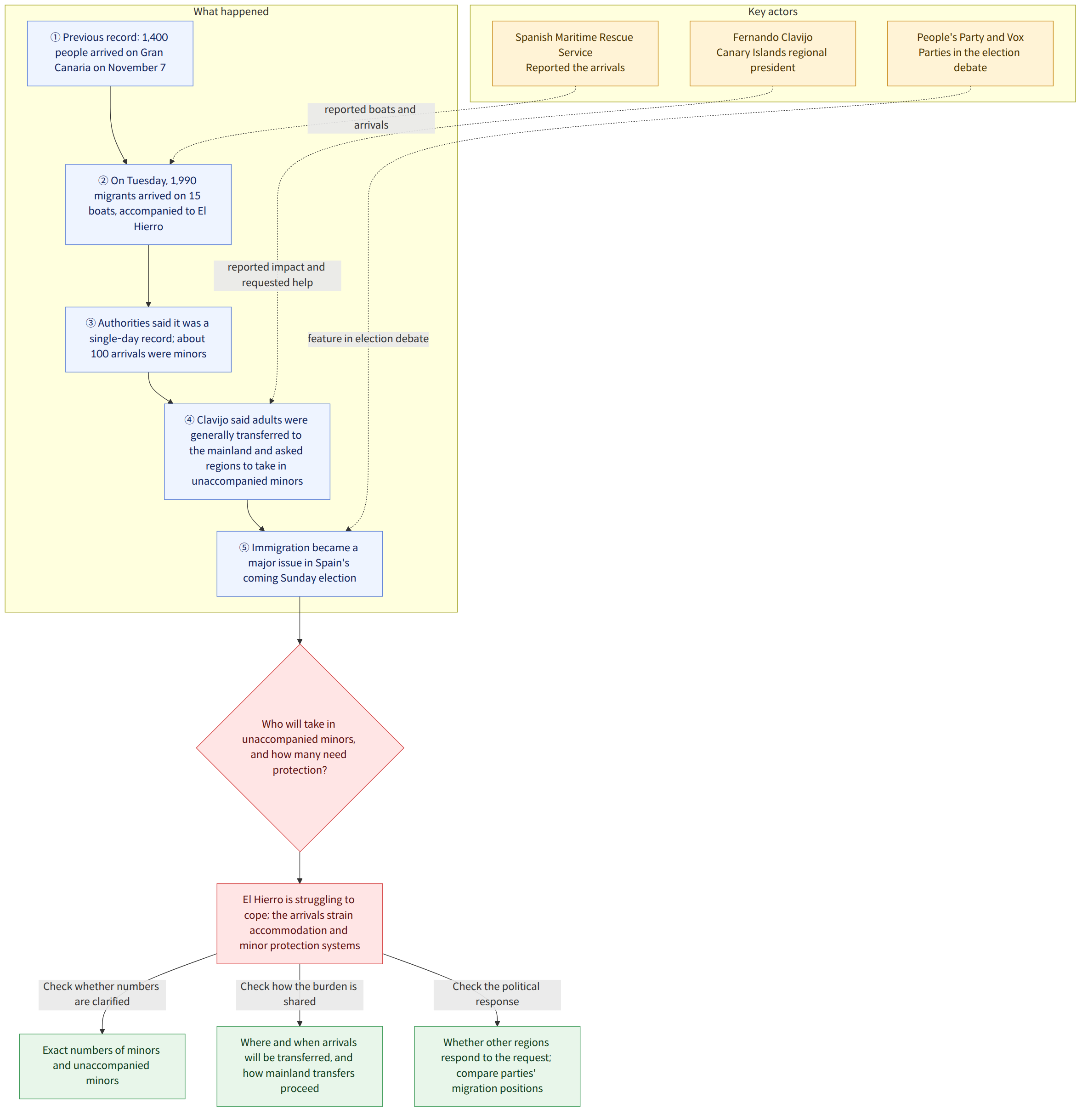
On Tuesday, 1,990 migrants arrived in Spain’s Canary Islands. According to the Spanish Maritime Rescue Service, they came aboard 15 boats, which rescue vessels accompanied to the island of El Hierro. Authorities said this was the highest number of migrants ever to arrive in the Canary Islands in a single day.
About 100 of those who arrived were minors, including a four-day-old baby born during the journey. Fernando Clavijo, president of the Canary Islands regional government, said he was generally satisfied with the transfer of adult migrants to mainland Spain, but that he had asked other regions to help take in unaccompanied minors who need protection.
Background and context
This record was well above the previous one. The previous single-day high was 1,400 people, who arrived on the island of Gran Canaria about two weeks earlier, on November 7. More than 26,000 migrants have arrived in the Canary Islands this year, and reports said about half of them arrived in November.
The Canary Islands lie off the coast of West Africa, about 105 kilometers from the nearest African coast. However, some people take longer routes to avoid security forces, so the journey can take anywhere from several days to several weeks, and thousands of people have died attempting it, the article reported. A key feature of this route is that the distance to the geographically nearest coast does not necessarily reflect the actual journey’s risks or duration.
Migration from West Africa is seasonal. In November, more people often leave before winter seas become rough, and Clavijo said recently calm seas, a full moon and favorable sailing conditions had contributed to the increase in departures. He added that most of the boats arriving on Tuesday had departed from Senegal and Gambia.
What this news means
The record number of arrivals could place concentrated pressure on the islands’ capacity and protection systems. El Hierro, with a population of about 12,000, is struggling to cope with the large influx, and many arrivals were exhausted or in poor condition, Clavijo said. His statement that adults are generally being transferred to the mainland contrasts with the need for other regions to help take in unaccompanied minors, showing that the number of arrivals alone does not fully capture what the response requires.
For example, if some of those arriving are minors without a guardian accompanying them, the difficulty of continuing to accommodate them on the island shows how cooperation from other regions could become a key factor in ensuring their protection and transfer. However, reports have not established how many of the approximately 100 minors were unaccompanied.
Immigration is also a major issue in Spain’s election this coming Sunday. The conservative People’s Party is seeking to replace the Socialist-led central government, and the article says it may have to form a coalition with the far-right Vox party to take power. Reports say Vox strongly advocates deporting migrants and social policies that prioritize Spaniards over recently arrived foreigners.
Clavijo condemned attempts to demonize migrants. He also criticized as “absurd” an agreement on sending migrants to Rwanda involving Austria, Denmark, Germany, Greece and the Netherlands. His remarks show that the record number of arrivals is tied not only to a local capacity issue but also to a political debate over how migrants should be treated.
Confirmed facts and what remains unknown
Confirmed facts
- On Tuesday, 1,990 migrants arrived in the Canary Islands on 15 boats.
- Authorities said this was the highest number of arrivals in a single day. The previous record was 1,400 people on the island of Gran Canaria on November 7.
- About 100 of those who arrived were minors, including a four-day-old baby born during the journey.
- Clavijo cited El Hierro’s limits on accommodating arrivals and said he had asked other regions to help take in unaccompanied minors.
What remains unknown
- Reports available to the public do not confirm the exact number of minors or unaccompanied minors among those who arrived.
- No plans have been provided on where the arrivals will be transferred afterward or on what schedule.
- Reports do not confirm how other regions will respond to the request to take in unaccompanied minors.
What readers should look for
- In follow-up reports, readers can look for whether the exact numbers of minors and unaccompanied minors are disclosed separately.
- Checking how the transfer of arrivals to mainland Spain and the request for other regions to take in minors actually proceed can help clarify how the islands’ accommodation burden is being distributed.
- In election coverage, it is worth distinguishing the positions each party takes on responses to migrants and the protection of minors.
















