
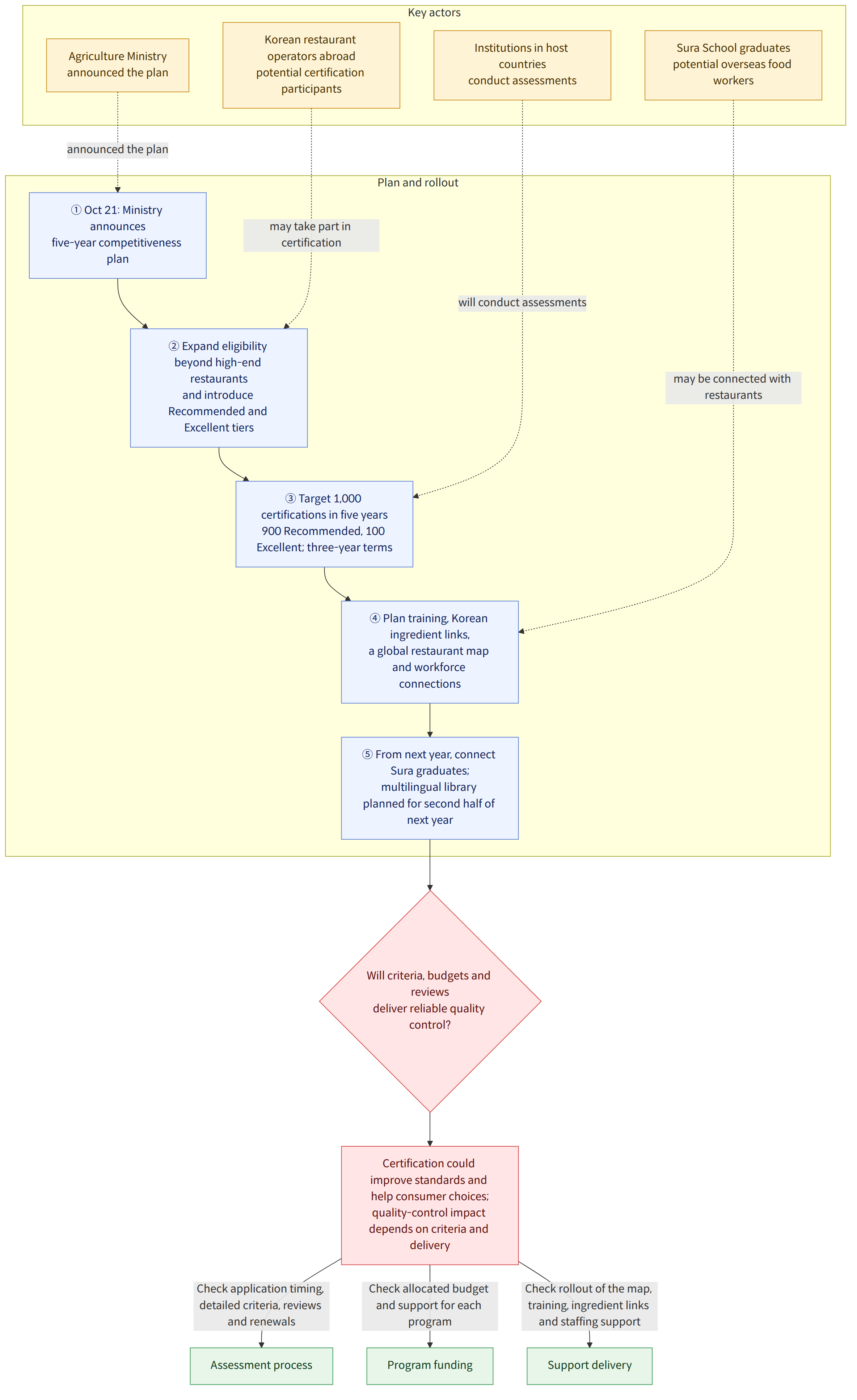
On October 21, the Ministry of Agriculture, Food and Rural Affairs (농림축산식품부) announced a plan to strengthen the competitiveness of Korean restaurants abroad. Over the next five years, it will certify 1,000 such restaurants and support them with cooking and hygiene training, supplies of Korean ingredients and opportunities for Korean food professionals to work abroad. As global awareness of Korean cuisine grows, the government aims to combine quality controls for Korean restaurants with tailored support.
Background and context
According to the Ministry of Agriculture, Food and Rural Affairs (농림축산식품부), global awareness of Korean cuisine rose from 60% in 2023 to 68.6% last year. Alongside bibimbap and bulgogi, a range of dishes—including Korean-style fried chicken, tteokbokki and gimbap—have also gained popularity. The government aims to turn this growing demand into stronger competitiveness for Korean restaurants abroad.
The existing “Excellent Korean Restaurant” certification system (“우수 한식당”) focused on high-end restaurants. The new plan’s central feature is to broaden eligibility to more accessible casual restaurants and introduce a two-tier assessment: “Recommended,” based on basic service and hygiene standards, and “Excellent,” which also assesses criteria such as the use of domestic ingredients. Over the next five years, 900 restaurants are to receive the Recommended designation and 100 the Excellent designation.
Institutions in the countries where the restaurants operate will conduct the assessments, and designations will be valid for three years. A renewal process is also planned. Since the program will involve not only expanding the number of eligible restaurants but also assessments and renewals, whether it actually contributes to quality control will depend on the specific criteria and how the program is run.
What this means
For businesses operating Korean restaurants abroad, certification could provide an opportunity to review their service and hygiene standards and ingredient use. In particular, the Excellent designation is expected to include additional criteria such as using domestic ingredients, so certification could affect not only restaurant operations but also connections with Korean ingredient suppliers. However, the application schedule and detailed assessment criteria have not yet been provided.
For consumers, a global Korean restaurant map showing the locations, designations and signature dishes of government-recommended restaurants by country and city could help them make informed choices. The map is planned to link to mapping and reservation services. For example, once the map is available, consumers looking for Korean restaurants abroad could use it to compare locations, designations and signature dishes when choosing where to eat.
Support for staffing and training could also affect businesses and workers. A digital resource library containing cooking recipes and training videos in multiple languages is scheduled to open in the second half of next year. Mobile-based courses are planned to offer short videos, 10–20 minutes long, on cooking, hygiene and ingredient management. Also, starting next year, the government will support Korean food professionals seeking work abroad by connecting graduates of Sura School (수라학교), a culinary training program run by public and private organizations, with Korean restaurants abroad.
What is confirmed and what remains unknown
What is confirmed
- On October 21, the Ministry of Agriculture, Food and Rural Affairs (농림축산식품부) announced a plan to strengthen the competitiveness of Korean restaurants abroad.
- It plans to certify 1,000 Korean restaurants abroad over the next five years: 900 with the Recommended designation and 100 with the Excellent designation.
- The Recommended tier assesses basic service and hygiene standards; the Excellent tier assesses additional criteria, including the use of domestic ingredients. Designations will be valid for three years, and a renewal process is planned.
- The plan includes a multilingual digital resource library, mobile training courses, a global Korean restaurant map, and connections with Korean ingredient suppliers and Sura School graduates.
What remains unknown
- What will the application schedule and detailed assessment criteria for the new certification program be?
- What budget has been allocated to the plan, and how much support will each program receive?
- How will assessment institutions in different countries conduct reviews, and how will designation renewals be handled?
What readers should check
- Operators of Korean restaurants abroad should check whether the application schedule and assessment criteria for the Recommended and Excellent tiers are announced. Based on the information currently available, applications have not yet opened and specific requirements have not been finalized.
- Consumers looking for Korean restaurants abroad can check restaurant locations, designations and signature dishes once the global Korean restaurant map is available. The date when the map will be released has not been announced.
- Korean restaurant operators and workers, as well as ingredient exporters, can watch for details on who will be eligible for training, workforce connections and ingredient supply support, and how to apply. The relevant timelines and levels of support have not yet been confirmed.